
UPDATED on Sunday 30 August.
Thieves who targeted one of Europe’s most important Bronze Age gold collections in a meticulously planned early-morning raid in eastern Spain succeeded in stealing most of the Treasure of Villena, authorities have now confirmed.
Officials had initially declined to reveal the extent of the losses following the break-in at the Museum of Villena (MUVI) in the Alicante province (Valencia region), which is believed to have lasted only a matter of minutes.
But Villena mayor Fulgencio Cerdán has now confirmed that the thieves escaped with the majority of the celebrated prehistoric hoard.
Only a handful of objects from the main treasure were left behind, including three silver vessels, a bracelet and part of the decoration from a ceremonial staff. One of the collection’s crowns also survived after apparently being dropped and found on the floor of the museum.
The separate, smaller collection known as the Tesorillo de Cabezo Redondo was not taken.
Although the archaeological and cultural value of the stolen objects is effectively impossible to calculate, the approximately 10 kilograms of gold contained in the complete treasure would alone be worth more than €1.5 million at current bullion values.
The scale of the loss was confirmed at a press conference attended by Cerdán, Colonel Francisco Poyato, head of the Guardia Civil command in Alicante province, and Spanish government subdelegate Manuel Pineda.
Investigators are continuing to analyse security-camera footage from both inside and outside the museum. The speed and apparent precision of the operation have strengthened suspicions that the raid was carried out by an organised group of professional thieves.
The Guardia Civil’s judicial police unit is leading the investigation, with authorities releasing few further details while officers examine evidence and attempt to trace the stolen objects.
The break-in occurred at the Museum of Villena, in the Alicante province town of Villena, where the internationally renowned Treasure of Villena had been displayed behind reinforced protection.
Guardia Civil police and forensic specialists began examining the museum immediately after the raid as investigators attempted to reconstruct an operation which early evidence suggested had been carefully planned and carried out by experienced criminals.
According to municipal sources quoted by El País, the thieves appear to have used a diversion to draw police away from the museum immediately before the break-in.
At around 5.16am, an alarm was triggered at a sports complex on the outskirts of Villena, prompting security forces to head towards the site.
Minutes later, the museum’s own security system was activated.
‘At 5.24am, when the officers arrived, it was already empty,’ municipal sources told the newspaper.
The assailants are understood to have initially tried unsuccessfully to enter through the museum’s main entrance before forcing their way through protected windows on one side of the building.
Despite the security and reinforced protection in place, they managed to gain access, seize most of the treasure and escape within minutes.
Sources familiar with the initial investigation told El País that the method used indicated that ‘they are not amateurs’.
Spanish state broadcaster RTVE reported that the museum alarm was registered at 5.26am, citing police sources, while confirming that the Guardia Civil were investigating the robbery.
The precise chronology remains subject to the continuing police investigation.
One of Europe’s greatest prehistoric gold discoveries
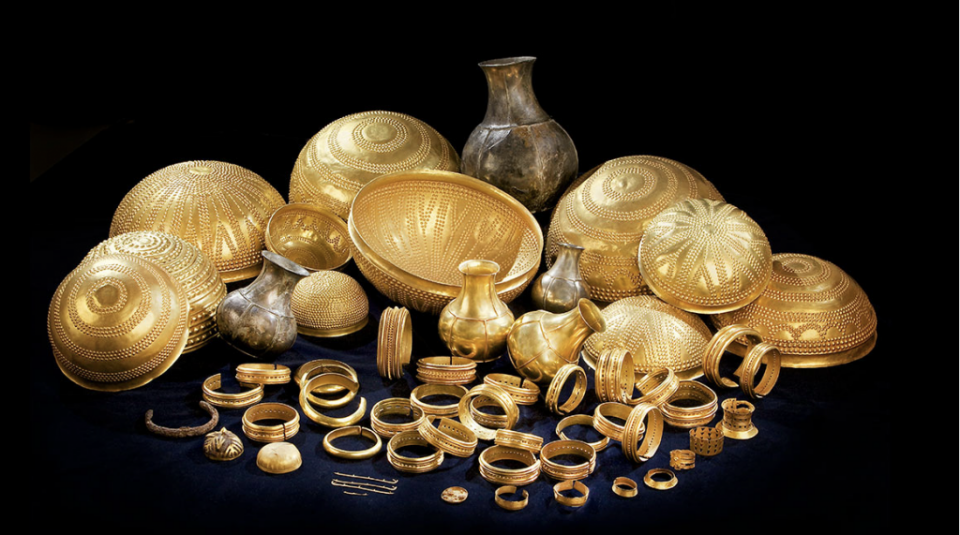
The Treasure of Villena is considered one of the most important discoveries of prehistoric gold ever made in the Iberian Peninsula and one of the outstanding collections of Bronze Age metalwork in Europe.
Hidden more than 3,000 years ago, the extraordinary hoard contained around 10 kg of gold, together with objects made from silver, iron, amber and other materials.
Its gold pieces included bowls, bracelets and bottles, while other objects incorporated silver, amber and iron.
The scale and quality of the collection have led to comparisons with some of Europe’s most important Bronze Age discoveries, including the treasures associated with the royal tombs of Mycenae in Greece.
While the precious-metal value is considerable – with the gold alone now estimated at more than €1.5 million – its archaeological and historical significance means the treasure’s true value cannot realistically be expressed in financial terms.
The treasure was discovered in 1963 near Villena after local builder Paco García Arnedo came across an initial object and alerted archaeologist José María Soler.
Soler subsequently directed excavations in the area, with the collection eventually recovered from a ceramic vessel buried in the bed of a dry watercourse.
The discovery attracted enormous scientific and media attention because the objects did not appear to have any obvious relationship with archaeological sites in the immediate area.
One notable exception is the smaller Tesorillo de Cabezo Redondo, another collection found in Villena in 1963 containing 35 objects, including gold pieces bearing similarities to those in the larger treasure.
That collection was left untouched during the museum raid.
The Treasure of Villena has generally been dated to around the later Bronze Age, although estimates of its precise age vary. The collection was displayed at MUVI in a dedicated room, with the objects protected behind a large armoured glass case.
Iron that came from space
Two of the collection’s most unusual objects have also helped make the Treasure of Villena internationally significant.
Scientific research by Spain’s CSIC concluded that iron used in two pieces – including a bracelet – was of meteoritic origin, meaning the metal came from a meteorite rather than iron smelted from terrestrial ore.
The objects date from a period before ironworking became widespread in the Iberian Peninsula, when iron was exceptionally rare and could itself be regarded as a precious material.
The discovery has provided researchers with important evidence about the use of meteoritic iron in prehistoric Iberia.
Third major Spanish museum theft in four months
The Villena raid is also the latest in a remarkable series of thefts targeting valuable historical collections in Spanish museums.
On 25 April, thieves broke into the Provincial Archaeological Museum of Badajoz (Extremadura) and stole 144 of the 149 gold coins making up the Treasure of Villanueva de la Serena. The collection consisted of gold doubloons minted during the reigns of Carlos I and Fernando VI.
Then, on 27 July, four masked thieves targeted the Museum of Albacete (Castilla-La Mancha), stealing more than 200 coins from a temporary exhibition in a raid reportedly completed in less than two minutes.
The similarities mean the Villena robbery is now the third major museum theft of its kind in Spain in around four months, although there has so far been no suggestion from investigators that the three crimes are connected.
For Villena, a town of around 35,000 inhabitants whose identity is closely associated with its archaeological treasure, confirmation that most of the collection has been stolen has deepened the shock caused by the raid.
Investigators are now examining security footage and other evidence in an attempt to identify those responsible, establish precisely how they defeated the museum’s security measures so rapidly and determine whether the apparent diversion shortly before the break-in formed part of a coordinated operation.
The overriding priority will also be to recover a prehistoric collection whose importance extends far beyond the monetary value of its gold — and which had survived for more than three millennia before disappearing from its museum display in a matter of minutes.
Enjoying the news from Spain in English? Add us as a preferred news source in Google.
Subscribe to the Weekly Newsletter from Spain in English.
Roban en el Museo del Tesoro de Villena, uno de los más valiosos de la Edad de Bronce en Europa https://t.co/GNOVx2ODrN
— RTVE Noticias (@rtvenoticias) August 27, 2026
Los ladrones robaron gran parte del Tesoro de Villena en cuestión de minutos.https://t.co/pKFqRJZEbt pic.twitter.com/hEWu9C5KQG
— EFE Noticias (@EFEnoticias) August 27, 2026
Estamos en el Museo de Villena donde se ha producido el robo del tesoro de Villena. Los ladrones rompieron una ventana y se llevan objetos por valor de 1,5 millones euros
📍Villena (Alicante) 🎥https://t.co/Bl7GNN5J5D pic.twitter.com/XvXAQSL2ef— Atlas News (@atlasnews_x) August 27, 2026

Click here to get your business activity or services listed on our DIRECTORY.