
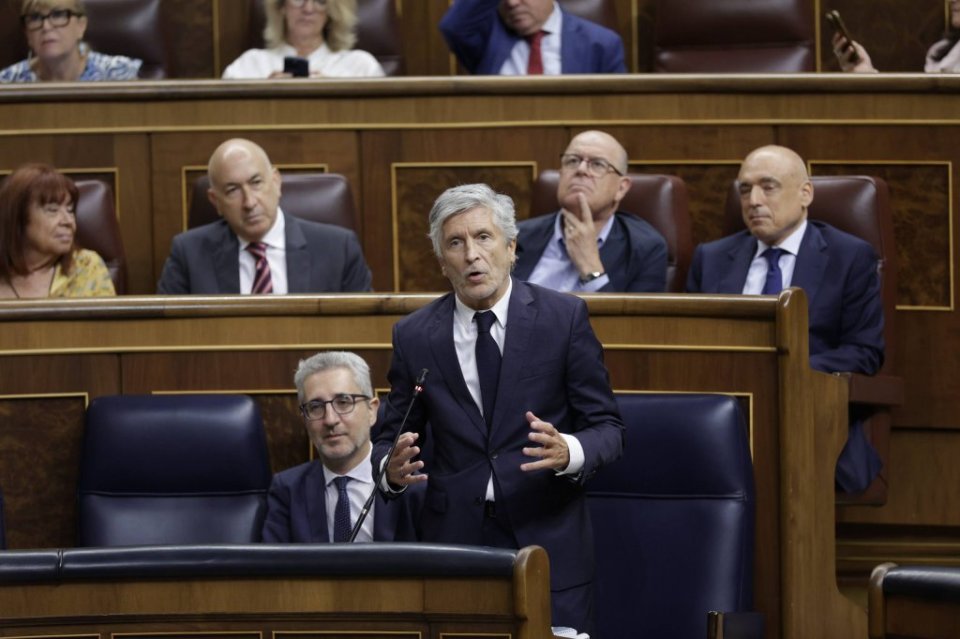
Spain’s Interior Minister Fernando Grande-Marlaska (main image) is facing mounting criticism over a confidential dossier compiled by his ministry that classified hundreds of journalists, commentators and media figures according to their political views and, in many cases, their attitude towards the government.
The document, prepared by the ministry’s Communication Office in February 2024, was revealed by the online newspaper El Confidencial on Tuesday. Its existence has been acknowledged by the ministry, which has apologised for some of its contents while insisting that it was an internal working document and was never intended to restrict press freedom.
Journalists’ associations have condemned the practice, while opposition parties have accused the government of compiling a political ‘blacklist’. The controversy has also prompted criticism from within the governing socialist party (PSOE) itself.
What the dossier contains
The document consists of 54 pages and 281 profiles, according to the reports published following its disclosure. It carries the Interior Ministry’s letterhead and identifies the Communication Office on its cover.
The profiles include photographs, names, media affiliations and information about journalists and commentators who appear on radio and television discussion programmes. Many also contain assessments of their presumed political orientation or their position towards the government of Prime Minister Pedro Sánchez.
Descriptions cited from the dossier include ‘conservative tendency’, ‘far right’, ‘clearly left wing and supports the government’, ‘lately more combative’ and ‘radical right-wing ideology’. Other entries reportedly describe individuals as sympathetic to, supportive of or highly critical of the government.
The list includes journalists, editors, columnists and political analysts from a range of Spanish media organisations, as well as people associated with professional journalists’ bodies. El Confidencial, which published the dossier in full on Tuesday evening, reported that its existence had been kept confidential within the ministry.
Ministry apologises but denies any intention to censor
Grande-Marlaska initially sought to play down the significance of the document during a press conference in Ceuta on Tuesday, describing it as an internal working dossier with no ulterior motive.
The minister said it had ‘no greater implications’ and insisted that it had ‘in no way’ resulted in differences in the treatment of media organisations or individual journalists when providing information or responding to requests.
In a subsequent statement, the Interior Ministry said the dossier had been prepared for consultative purposes, ‘without any intention of establishing censorship or any restriction or limit on the work of journalists and the media organisations for which they work’.
‘We apologise to the professionals who may have felt offended by the contents of the document and by some of the assessments made, which have in no case conditioned the work of this Communication Office towards the journalists and political analysts mentioned, as they have been able to verify in the time that has elapsed since the document was prepared, more than two and a half years ago,’ the ministry said.
The department maintains that its Communication Office deals with all journalists and media organisations without discrimination.
Journalists’ associations condemn political profiling
The Federation of Journalists’ Associations of Spain (FAPE) has strongly criticised the dossier, warning that the compilation of ideological profiles by a state institution is incompatible with the rule of law.
‘In a democratic society, no state body has the legitimacy to register, catalogue or ideologically profile those who practise journalism, as it constitutes a direct attack on press freedom,’ the federation said.
FAPE also warned that such practices introduce an element of surveillance and potential retaliation that could affect the exercise of critical journalism.
The Association of Journalists of Madrid (APM) and the Association of Parliamentary Journalists (APP) have also condemned the document. The professional organisations have called for an immediate end to this type of practice and for explanations about how and why the dossier was compiled.
Criticism from within the PSOE
The revelation has also caused discomfort within the governing socialist party itself. Patxi López, the PSOE’s spokesperson in Congress, said he strongly opposed the classification of people according to their personal characteristics or beliefs.
‘I do not like any list in which anyone is classified at all: not by their thinking, not by their ideology, not by their race, not by anything,’ López said, adding that he expected the Interior Ministry to provide the necessary explanations.
Government spokesperson Elma Saiz, meanwhile, defended the government’s record on press freedom. She said the government ‘deeply respects’ the work of the media and ‘firmly believes in freedom of the press and acts accordingly every day’.
Saiz also contrasted the government’s approach with previous remarks made by political opponents about public broadcaster RTVE and journalists, insisting that the Sánchez administration was not responsible for such rhetoric.
Opposition demands resignation
The main right-wing opposition People’s Party (PP) has accused the Interior Ministry of targeting journalists and has described the dossier as a ‘blacklist’.
PP spokesperson Ester Muñoz said the ministry had compiled a list ‘to single out and label’ journalists, arguing that the practice recalled periods of Spain’s past ‘to which we should not return’, in an apparent reference to the Franco dictatorship.
The party has also linked the controversy to its criticism of Grande-Marlaska’s handling of the unprecedented migrant influx into Ceuta on 30 and 31 July, when more than 70,000 people crossed from Morocco. The minister was visiting the North African Spanish territory when the dossier controversy emerged.
The dispute continued in Congress on Wednesday. PP secretary-general Miguel Tellado demanded Grande-Marlaska’s resignation, while the minister rejected the accusation that his department had maintained a blacklist.
Grande-Marlaska insisted that the document did not identify people according to their ideology and said the ministry had already apologised if its format was inappropriate. He maintained that there was no discrimination against journalists on political grounds.
The controversy has nevertheless left the government facing questions about the purpose of the dossier, who authorised its preparation and whether the ministry’s assurances are sufficient to address the concerns raised by journalists’ organisations.
Enjoying the news from Spain in English? Add us as a preferred news source in Google.
Subscribe to the Weekly Newsletter from Spain in English.
El dosier completo de 54 folios de Interior con las fichas de 280 periodistas y tertulianos por su ideología.
— El Confidencial (@elconfidencial) September 9, 2026
El informe elaborado por el equipo de Marlaska con la ideología de los periodistas abarca la práctica totalidad de los principales medioshttps://t.co/udJZbkyzmH
LA FAPE considera la lista elaborada por Interior una práctica incompatible con el Estado de derechohttps://t.co/29Xs4MLgu4 pic.twitter.com/j1FuX8G4Fw
— FAPE (@fape_fape) September 8, 2026

Click here to get your business activity or services listed on our DIRECTORY.