
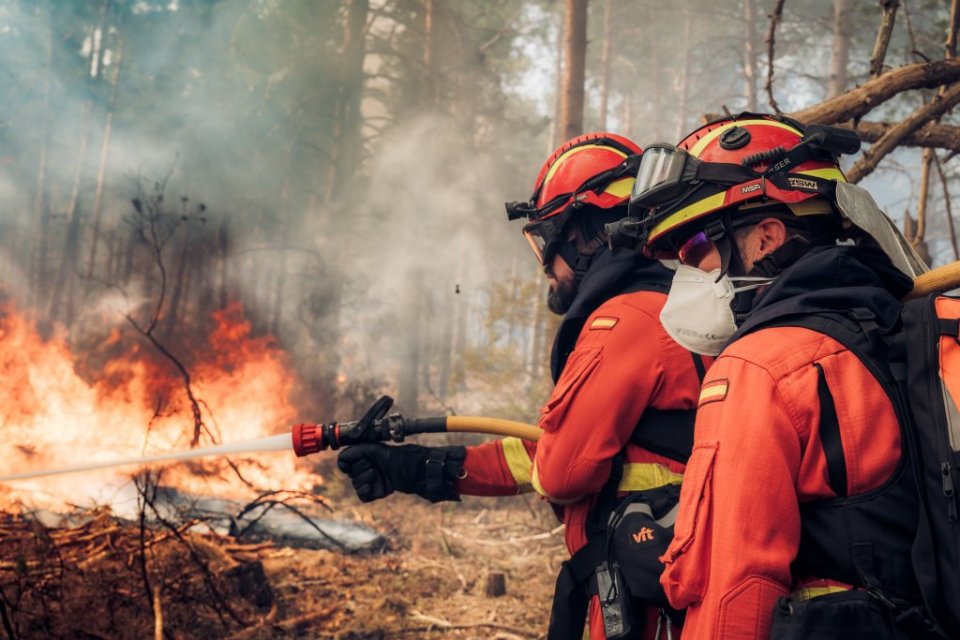
Human-driven climate change dramatically increased the likelihood of the extreme weather conditions that fuelled the recent devastating wildfires in Spain and France, according to new scientific research, with experts calculating that the conditions behind Spain’s record-breaking blaze were around 20 times more likely because of global warming.
The findings come as Spain and France continue to battle major wildfires that have scorched vast areas of land, forced the evacuation of hundreds of thousands of people and, in Spain, contributed to the country’s largest wildfire on record. ALSO READ: PP and Vox reject Sánchez’s national climate pact as prime minister defends government’s record.
The analysis, carried out by the international World Weather Attribution (WWA) group, found that human-caused climate change doubled the likelihood of the extreme fire weather experienced in southwestern France while increasing the probability of similar conditions in central Spain by a factor of 20. ALSO READ: Pedro Sánchez visits wildfire-hit Galicia and pledges ‘national pact’ to address climate emergency.
Researchers assessed the combination of high temperatures, prolonged drought, low humidity and strong winds that create ‘fire weather’ – conditions that make wildfires easier to ignite, spread rapidly and become far more difficult to contain once they begin.
The scientists also concluded that warming over the past 26 years has tripled the odds of the severe fire-risk conditions seen in Spain, while increasing the likelihood of comparable conditions in France by around 40%. ALSO READ: Spain faces escalating wildfire crisis as Sánchez warns climate emergency cannot be ignored.
According to the study, under today’s climate these exceptionally dangerous fire conditions can now be expected roughly once every six years in central Spain and around once every 20 years in southwestern France.
Spain’s extreme fire season has been intensified by an unusual weather pattern that saw the country’s wettest January in 25 years followed by what Spain’s national weather agency says is its hottest summer on record. The wet winter encouraged abundant vegetation growth before prolonged drought and extreme heat dried it out, leaving forests and countryside packed with highly combustible fuel.
Researchers said this sequence of a wet winter followed by a hot, dry spring and summer is becoming an increasingly significant factor in Europe’s growing wildfire risk.
‘The change in these fire weather conditions in Spain is really extremely strong and is, I think, one of the largest changes that I’ve seen,’ said Friederike Otto, climate scientist at Imperial College London and coordinator of the World Weather Attribution initiative.
Otto also pointed to land abandonment in parts of Spain, where unmanaged vegetation has accumulated over time, creating additional fuel for fires. In southwestern France, extensive pine forests around the Bordeaux region have similarly contributed to rapid fire spread once blazes become established.
The WWA study was completed while the fires were still burning and therefore has not yet undergone peer review. However, the researchers stressed that it uses well-established scientific methods that have been widely applied in previous attribution studies, many of which have subsequently been published in peer-reviewed journals.
Clair Barnes, a research associate in extreme weather at Imperial College London and co-author of the analysis, said: ‘We’ve seen repeatedly how climate change increases hot, dry, flammable conditions that are extremely conducive to wildfires.’
‘What’s unique about this case is that it’s still early in the season – and with another heatwave looming, these findings are extremely scary,’ Barnes added.
The WWA findings were published alongside a separate peer-reviewed study in the journal Scientific Reports, which concludes that southern Europe now experiences more than twice as many days with extreme wildfire weather as it did in previous decades.
Lead author Raúl Cordero, a climate scientist at the University of Groningen in the Netherlands, said the region historically experienced around 10 days each year with extreme fire weather, but that number has now risen to approximately 25 annually. Those dangerous days are also around 50% more intense than they were between 1981 and 2010.
Cordero noted that although improved firefighting techniques and forest management helped reduce both the number of fires and the total area burned from the 1980s until around 2018, climate change has increasingly overwhelmed those gains.
‘It doesn’t matter how many resources or how much money you have, you just cannot stop the propagation of a fire when the weather is so extreme,’ Cordero said. ‘The climate forcing is so extreme nowadays that it’s just amazing.’
The researchers said reducing wildfire risk will require more than simply expanding firefighting capacity. They argue that governments must invest in long-term landscape management, including clearing accumulated dry vegetation before fire season, alongside broader efforts to curb greenhouse gas emissions.
Enjoying the news from Spain in English? Add us as a preferred news source in Google.
Subscribe to the Weekly Newsletter from Spain in English.
World Weather Attribution: Climate change increases likelihood of compounding drivers of severe wildfire conditions in France and Spainhttps://t.co/fzxcDTZoiK pic.twitter.com/N3ufVlqmMe
— @Troposfera (@Troposfera) July 31, 2026

Click here to get your business activity or services listed on our DIRECTORY.