
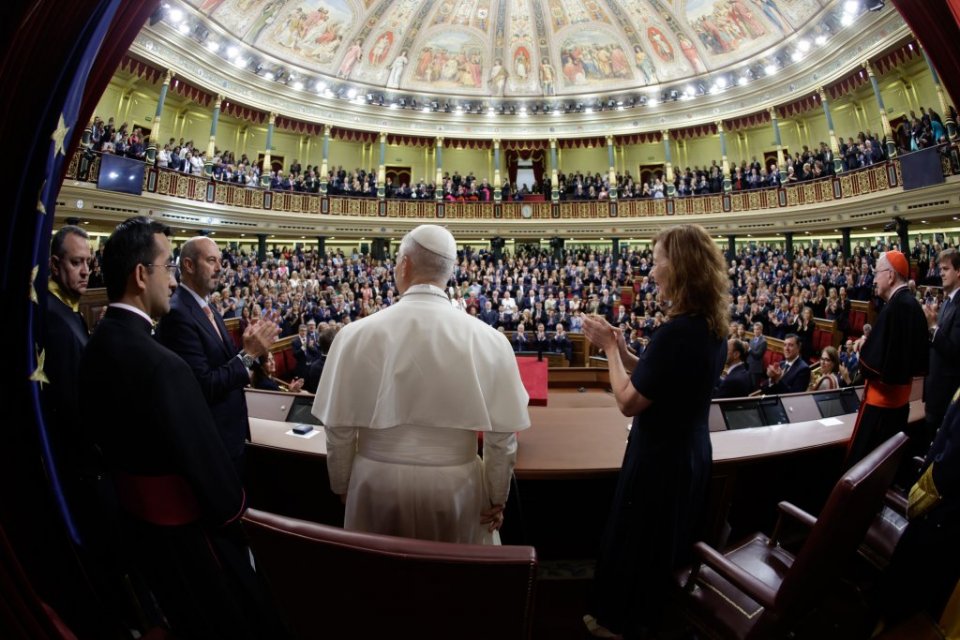
Pope Leo XIV used the first papal address ever delivered to Spain’s parliament on Monday to warn that the world is facing a ‘profound spiritual and cultural crisis’, calling for moral renewal in public life, greater protection for migrants, respect for international law and renewed efforts to achieve peace rather than military escalation.
Speaking in Spanish before lawmakers at Madrid’s Las Cortes Generales, Leo delivered one of the most wide-ranging political speeches of his papacy so far. The address came amid renewed hostilities between Israel and Iran and formed part of a week-long visit to Spain that has focused heavily on migration, social cohesion and the role of faith in public life. ALSO READ: Pope Leo draws 1.2 million to Madrid Mass, calling for unity, faith and compassion.
The speech was met with a lengthy standing ovation lasting several minutes, with lawmakers from across the political spectrum rising to applaud and some chanting ‘¡Viva el Papa!’ (‘Long live the Pope’).
The visit marks a notable moment in modern Spanish politics. While the Catholic Church was once closely associated with Franco’s dictatorship and wielded considerable influence over Spanish society, its role diminished after the return of democracy in the late 1970s as Spain became increasingly secular. Many observers viewed Leo’s invitation to address the Spanish Congress as evidence of a renewed willingness to engage with the Church in the public sphere. ALSO READ: Pope Leo begins landmark Spain tour amid political tensions and migration debate.
A world in crisis
Leo said humanity was experiencing a deep moral and cultural breakdown, reflected in growing violence, political division and a weakening commitment to human dignity.
‘The world is undergoing a profound spiritual and cultural crisis, which is manifested in multiple forms of violence, polarisation, and mutual distrust,’ he told lawmakers.
Calling for greater responsibility from political leaders, he argued that democratic institutions required a ‘moral renewal’ rooted in respect for the dignity of every person, particularly the most vulnerable members of society.
In what appeared to be a reference to Spain’s increasingly fractured political landscape, he cautioned that ‘political pluralism should not degenerate into the constant disparagement of one’s adversary’.
Peace, international law and rearmament
The pope devoted a significant portion of his speech to international conflicts, speaking as Israel and Iran exchanged fresh retaliatory strikes that threatened to reignite a broader regional war.
He renewed his call for diplomacy and dialogue, insisting that disputes between nations should be resolved through international law rather than force. ALSO READ: Spain blocks its airspace to US military flights linked to the war in Iran.
‘Peace demands diplomatic courage, ethical responsibility and a vision for the future grounded in respect for the identity of every people and in the obligation of states to resolve their disputes through the peaceful means offered by international law,’ he said. ALSO READ: Pedro Sánchez responds to Donald Trump: ‘No to war’.
Repeating his opposition to the growing militarisation of Europe, Leo expressed concern over rising defence spending across the continent. ALSO READ: Pedro Sánchez urges ‘loyal cooperation’ not ‘confrontation’ with US amid tensions over Iran war.
‘It is therefore a cause for concern that, in various parts of the world — and in Europe as well — rearmament is once again being presented as an almost inevitable response to the fragility of the international situation,’ he said.
He added: ‘Weapons can impose a temporary silence; but they can never build an authentic and lasting peace.’ ALSO READ: Sánchez at Munich security conference: EU must strengthen its defence, but ‘nuclear rearmament not the way’.
The pope has previously described European rearmament as a betrayal of democratic values. His comments come as European military spending has risen sharply following Russia’s invasion of Ukraine and amid pressure from US President Donald Trump for NATO allies to increase defence expenditure.
Spain has resisted Trump’s demand that NATO members spend 5% of GDP on defence, although the country’s military budget has more than tripled since Prime Minister Pedro Sánchez took office in 2018.
Artificial Intelligence and warfare
Leo also returned to a theme that has become increasingly central to his papacy: the ethical implications of Artificial Intelligence (AI).
Warning against the growing role of automated systems in warfare, he called for ‘rigorous ethical oversight’ of AI technologies. ALSO READ: Spanish government approves draft law to crack down on AI deepfakes and image misuse.
He insisted that decisions involving life and death must never be delegated to machines.
‘Decisions regarding life and death are never left to automated systems nor removed from the moral responsibility of the human person,’ he said.
The remarks follow a manifesto issued by the pope last month urging governments to slow the development of increasingly powerful AI systems.
Migration and human dignity
Migration was another central focus of the address.
Leo argued that the treatment of migrants had become a test of the world’s moral character and warned that failures in this area were undermining ‘the ethical foundation of the international order’.
‘The moral greatness of a nation is manifested, above all, in its capacity to accompany, protect and love those lives that are most fragile,’ he said. ALSO READ: Spain stands alone as EU backs tougher deportation rules and overseas return centres.
The pope urged governments to move beyond ‘the mere management of flows’ and instead address the root causes that force people to leave their homes, including war, poverty, insecurity, economic inequality and climate change.
He called for stronger international cooperation to combat human trafficking and migrant smuggling while also promoting safe and legal migration routes. ALSO READ: Irregular migration to Spain dropped by over 40% in 2025.
‘This gives rise to a twofold demand for social justice: to offer safe and legal pathways, a respectful welcome and real opportunities for integration; and, at the same time, to promote the right to remain in one’s own land, working to ensure that no one has to leave their home due to a lack of peace, security or decent living conditions, including economic inequalities and the effects of the climate crisis,’ he said.
The pope’s visit will culminate in a trip to the Canary Islands, where he is due to meet migrants who risked dangerous Atlantic crossings to reach Europe.
According to NGO Caminando Fronteras, more than 3,000 people died in 2025 attempting the journey, often aboard overcrowded and unseaworthy boats.
Spain’s socialist-led government has defended immigration on both economic and humanitarian grounds and recently launched a programme expected to allow around 500,000 undocumented migrants to apply for legal status. ALSO READ: Spain to commence mass regularisation of undocumented migrants.
Lessons from Spain’s history
Leo also reflected on Spain’s historical role in shaping ideas about international law and human rights.
He praised the 16th-century School of Salamanca, whose theologians and philosophers developed early concepts of universal human dignity and limits on political power during the era of Spain’s colonial expansion.
The thinkers of Salamanca, he said, understood that ‘reason could not be invoked to legitimise whatever force or self-interest that seemed convenient’ and recognised that there were ‘moral limits of power’.
At the same time, Leo acknowledged that both society and the Church had often failed to live up to those principles.
‘It must be acknowledged that society and the church herself did not always live up to these insights found in their own Christian tradition,’ he said.
The comments echoed a recent apology by the pope for the Holy See’s historic role in legitimising slavery and colonial conquest in the Americas.
Church, state and religious freedom
In some of his most extensive comments to date on relations between Church and state, Leo defended the place of faith within public life and called for stronger protections for religious freedom.
He argued that religious belief should not be excluded from political debate or public discourse.
Faith, he said, ‘cannot be relegated to silence as though it were irrelevant to public life’.
The pope also strongly defended the confidentiality of the Catholic seal of confession, which prohibits priests from disclosing information revealed by penitents.
Several countries, including France, have debated whether clergy should be compelled to report information about abuse disclosed during confession.
Protecting the seal, Leo argued, preserves ‘a sacred space of inner freedom, where the believer can open his or her soul before God’.
A delicate political moment
The speech took place against a backdrop of growing political tensions in Spain.
Prime Minister Pedro Sánchez’s minority socialist-led coalition government has faced mounting difficulties amid a series of corruption investigations affecting figures close to his administration, as well as continued political polarisation and legislative gridlock. ALSO READ: Spanish PM denies any knowledge of suspected scheme targeting corruption probes.
Despite ideological differences — Sánchez is an atheist and his government has championed policies such as same-sex marriage, abortion rights and euthanasia — the Spanish leader and the pope have increasingly found common ground on issues including migration, diplomacy and opposition to military escalation. ALSO READ: Spanish government proposes including the right to abortion in the constitution.
Following a recent meeting at the Vatican, Sánchez described Leo as a ‘moral compass’. ALSO READ: Spain’s health minister rebukes US ‘interference’ over euthanasia, warns ‘we will not allow disinformation’
The overlap is particularly notable given the Catholic Church’s traditionally closer relationship with Spain’s right-wing and far-right political forces.
Yet on Monday, Leo’s message transcended many of the country’s usual political divides, with lawmakers from across the spectrum joining together in applause at the conclusion of a speech that blended appeals for peace, dignity, ethical leadership and solidarity with the most vulnerable. ALSO READ: Spain signs landmark church-state deal to compensate victims of clergy abuse.
Enjoying the news from Spain in English? Add us as a preferred news source in Google.
Subscribe to the Weekly Newsletter from Spain in English.
#VisitaPapaRTVE | Larga y emotiva ovación al papa León XIV tras su histórico discurso en el Congreso de los Diputados https://t.co/I1ahdMder8 pic.twitter.com/8fFnQQx0Xo
— RTVE Noticias (@rtvenoticias) June 8, 2026
#VisitaPapaRTVE | León XIV en el Congreso de los Diputados: “Una ley no alcanza su verdadera grandeza por el mero hecho de haber sido formalmente aprobada (…) Les invito a alzar la mirada para recordar que toda decisión toca personas de carne y hueso”. pic.twitter.com/WxTTOU6hBD
— RTVE Noticias (@rtvenoticias) June 8, 2026
“Con el deseo de que los derechos de todos estén siempre en el ejercicio de la actividad legislativa de esta sede democrática de la soberanía nacional española”.
— Congreso (@Congreso_Es) June 8, 2026
Estas son las palabras que Su Santidad ✝️ el Papa León XIV ha escrito en el Libro de Honor del #Congreso. 📷 🏛️ pic.twitter.com/b7rY8rBvLa
Pope Leo XIV addresses a joint session of Spain’s Parliament in Madrid, and recalls that every truly democratic society must promote freedom of thought, conscience, and religion.https://t.co/RIydjFz6KG
— Vatican News (@VaticanNews) June 8, 2026

Click here to get your business activity or services listed on our DIRECTORY.