
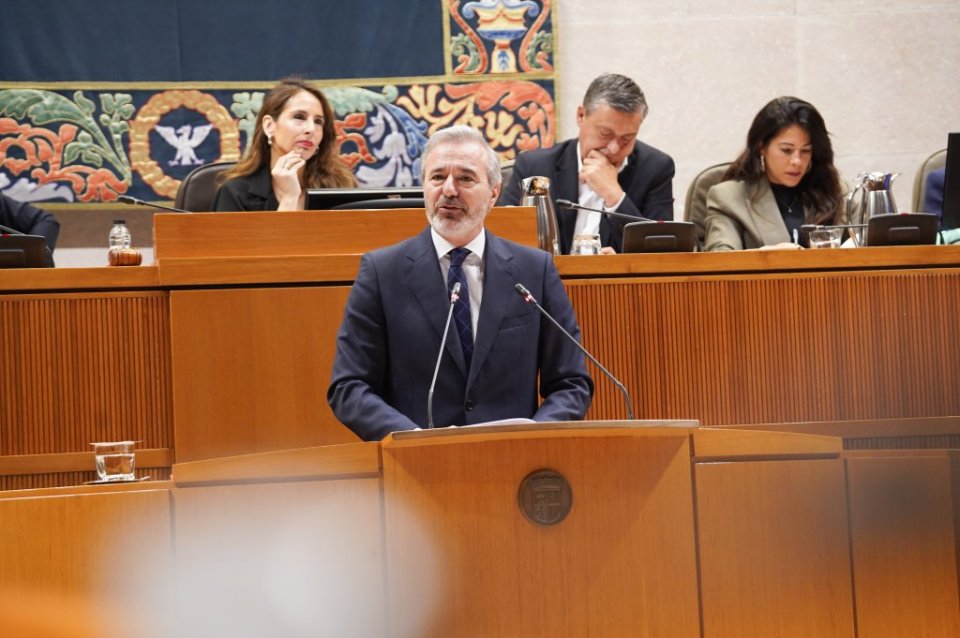
Spain’s main opposition right-wing force has once again joined with the far-right to secure power at regional level, after its candidate was re-elected as leader of Aragón on Wednesday — the latest sign of cooperation ahead of the next general election.
In Spain’s highly decentralised system, regional governments hold wide-ranging authority over areas such as healthcare, education and housing, meaning such alliances are often seen as indicators of broader national trends.
Jorge Azcón (main image), representing the People’s Party (PP), retained his position at the head of the northeastern region with the backing of the far-right Vox group.
Following the parliamentary debate and vote in Aragón’s regional assembly, a visibly pleased Azcón exchanged handshakes with Vox’s regional figurehead, Alejandro Nolasco.
The PP had emerged as the largest force in Aragón’s February elections, defeating the PSOE candidate Pilar Alegría — a former minister for socialist Prime Minister Pedro Sánchez’s government — but did not secure an outright majority. ALSO READ: PP wins Aragón election, dependent on Vox after far-right surge; PSOE records all-time low.
As a result, the PP were compelled to strike a deal with Vox in order to form a government, mirroring a similar arrangement reached just days earlier in the western region of Extremadura. ALSO READ: Far-right Vox rejoins Extremadura government in ‘national priority’ deal with PP.
Relations between the two parties had previously frayed. In 2024, Vox pulled out of five regional coalitions with the PP, citing disagreements over how unaccompanied migrant minors should be distributed across regions. ALSO READ: Spain to commence mass regularisation of undocumented migrants.
However, those tensions have since eased at the regional level. The parties remain in talks elsewhere, including in Castilla y León in the northwest, where the PP also depends on Vox support to govern. ALSO READ: PP wins Castilla y León election, but needs far-right’s support – and PSOE improves its result.
Speaking in parliament in Madrid on Wednesday, Sánchez criticised the growing cooperation, saying a PP–Vox pact based on ‘national priority’ in regional administrations ‘is nothing but xenophobia, racism, segregation and confrontation’.
The durability and impact of these renewed alliances are expected to be closely scrutinised by voters in the run-up to Spain’s next general election, which Sánchez is required to call by mid-2027.
Opinion polls currently suggest the PP would emerge as the largest party nationally, but would likely still need Vox’s backing to secure a governing majority in Spain’s increasingly fragmented political landscape. ALSO READ: Latest opinion polls show PSOE gaining on anti-war stance, as support for far right stalls.
ALSO READ: Andalusia heads to the polls on 17 May in high-stakes regional vote
Enjoying the news from Spain in English? Add us as a preferred news source in Google.
Subscribe to the Weekly Newsletter from Spain in English.
🔴 Jorge Azcón ya es, de nuevo, presidente del Gobierno de Aragón con 39 votos a favor: los del Partido Popular, junto con el apoyo de Vox
— RTVEAragón (@RTVEaragon) April 29, 2026
➡️Ha conseguido la reelección a la primera por mayoría absoluta
🎙️ @CarmenRFleta
📹 Alejandro Lozano pic.twitter.com/BdMAp3X3lT
A mí me encanta que Aragón sea imparable.
— Jorge Azcón (@Jorge_Azcon) April 29, 2026
Sé que sigue quedando mucho que mejorar, pero también sé que vamos por el buen camino.#InvestiduraAragón12 pic.twitter.com/3gJxK5GrOy

Click here to get your business activity or services listed on our DIRECTORY.