
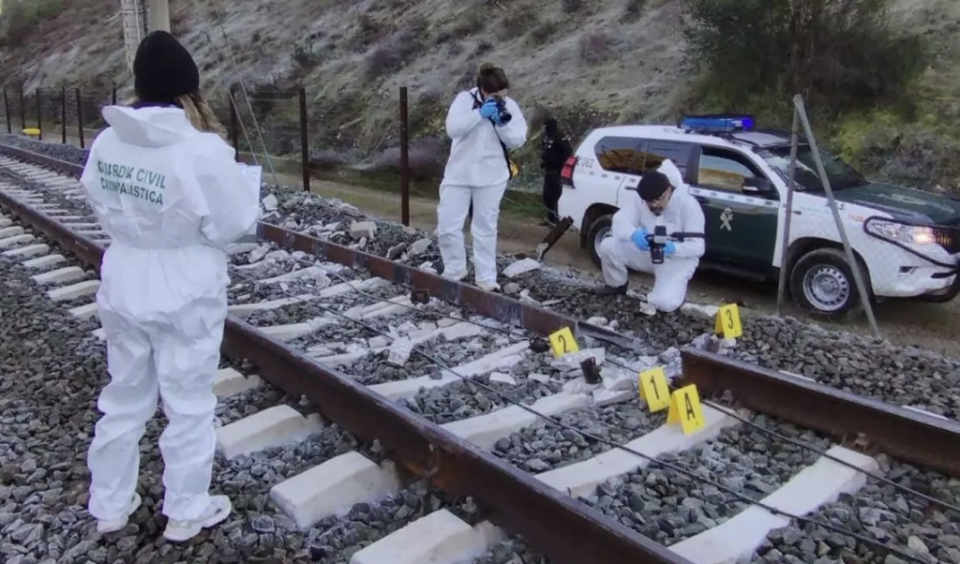
A preliminary investigation into last weekend’s deadly high-speed rail crash in southern Spain indicates that a fracture in the track may have existed before the accident, according to an initial report released on Friday.
The collision, which left 45 people dead and over 100 injured, is among the most serious rail disasters in Europe this century and has prompted renewed scrutiny of safety standards across Spain’s extensive high-speed rail system, the second largest in the world. ALSO READ: Sánchez vows ‘to get to the truth’ about cause of train tragedy, as Spain declares three days of mourning.
The crash is the deadliest in Spain since a 2013 crash that killed 80 people when a commuter train in the northern region of Galicia hurtled off the rails as it came around a bend going too fast.
Last Sunday’s crash occurred at 7.45pm in the municipality of Adamuz, in the Andalusian province of Córdoba, when the back three carriages of a high-speed train operated by private company Iryo derailed. The carriages crossed onto the neighbouring line, and struck an Alvia train travelling in the opposite direction run by state operator RENFE.
Both trains were moving within the speed limit – yet still more than 200 kph – and together were transporting nearly 500 passengers. The Iryo 6189 train was travelling from Málaga to Madrid with 300 people on board. The Alvia 2384 train was travelling from Madrid to Huelva in Andalusia with 186 passengers on board.
The head of the Alvia train took the brunt of the impact. The collision knocked its first two carriages off the track and sent them plummeting down a four-metre embankment. ALSO READ: Hope amid tragedy as dog missing after train tragedy in Andalusia is found safe.
Inspectors examining the Iryo train found damage to its wheels, with the preliminary report from Spain’s Commission of Investigation of Rail Accidents (CIAF) noting that an inspection ‘detected notches in the tread of the right-sided wheels’ on four of the train’s carriages.
‘These notches in the wheels and the deformation observed in the track are compatible with the fact that the track was cracked’, the report stated, describing this conclusion as a ‘working hypothesis’.
According to the CIAF, similar damage ‘with a compatible geometric pattern’ was also identified on the right-side wheels of three other trains that had passed over the same section of track in the hours leading up to the crash.
Investigators said the cause of the apparent fracture remains unclear and stressed that no possibilities have been excluded at this stage.
Based on the evidence currently available, ‘we can put forward the hypothesis that the cracking of the track took place before the passage of the Iryo train that suffered the accident, and therefore before the derailment’, the report said.
However, the CIAF warned that ‘this hypothesis … must be corroborated by later detailed calculations and analysis’.
The undercarriage of a train found half-submerged in a stream near the crash site could also shed light on the cause of the derailment that led to the collision.
Spain’s Transport Minister, Óscar Puente, said it was ‘reassuring’ that investigators had already identified a plausible explanation for the disaster just days after it occurred.
‘The conclusions are not final, but they do shed light on the theory that commission technicians currently consider the most plausible,’ he told journalists in Madrid.
Puente added that the fracture in the rail must have been extremely small, as it did not disrupt the electrical current running through the track — something that would normally have activated safety systems and brought rail traffic to a halt. ALSO READ: Train crash probe points to possible damaged track, amid uncertainty over cause or consequence.
The section of track involved was described as flat and straight, and had undergone recent renovation. The Iryo train itself had been built in 2022.
Authorities have also ruled out human error, confirming that both trains were operating within the permitted speed limits at the time of the collision. ALSO READ: RENFE president: human error ‘practically ruled out’ as cause of high-speed train collision in Andalusia.
Spain’s Interior Minister Fernando Grande-Marlaska said on Tuesday that the investigation was considering all hypotheses but had also ruled out sabotage, saying this ‘was never considered’.
‘From the beginning, we have been talking about technical issues related to railway transport. There has never been any element suggesting otherwise,’ he said.
Meanwhile, the Semaf train drivers’ union in Spain has announced a nationwide strike scheduled for 9-11 February, citing what it describes as recurring safety failures. The call for action follows a separate incident earlier this week near Barcelona, where a commuter train struck a retaining wall that had collapsed onto the tracks.
In that incident, a trainee train driver was killed and dozens of passengers were injured, several of them seriously. Officials attributed the collapse to recent heavy rainfall in the northeastern region of Catalonia. ALSO READ: One dead, 37 injured, as commuter train ploughs into rubble of collapsed wall near Barcelona.
Puente has insisted the two incidents were ‘completely unrelated’ and urged the public not to ‘question’ Spain’s rail system, which he described as ‘a great transport system’.
Catalonia’s Rodalies commuter network, used daily by hundreds of thousands of passengers, was shut down on Wednesday and Thursday while inspections were carried out and drivers refused to operate services, arguing that safety checks had not been properly completed.
Services resumed on Friday, but were suspended again from Saturday at 1pm ‘until passenger safety could be guaranteeed’. They remained suspended throughout Sunday. ALSO READ: All commuter and regional trains suspended in Catalonia ‘until safety of citizens can be guaranteed’.
High-speed network in Spain
Spain has spent decades investing heavily in high-speed trains. It currently has the largest rail network in Europe for trains traveling more than 250 kph, with more than 3,900 kilometres of track, according to the International Union of Railways.
The network is a popular, competitively priced and safe mode of transport. Officials said that Sunday’s collision was the first with deaths on Spain’s high-speed rail network since it opened its first line in 1992.
ALSO READ: Fourth train incident in 5 days: ‘passenger lightly injured’ after train hits crane in Murcia.
Subscribe to the Weekly Newsletter from Spain in English.
La investigación preliminar apunta a una rotura previa de la vía como causa del accidente en Adamuz.https://t.co/tgBKwboYMv
— RTVE Noticias (@rtvenoticias) January 23, 2026
#AccidenteFerroviario | Continuamos con los trabajos de investigación y retirada de los trenes accidentados en #Adamuz.#AccidenteFerroviarioAdamuz #descarrilamiento pic.twitter.com/50BETkPO9J
— Guardia Civil (@guardiacivil) January 21, 2026
Nueva rueda de prensa para ofrecer información detallada de las novedades que vamos conociendo. https://t.co/m2ycEa7r8n pic.twitter.com/2TogcvbjkW
— Óscar Puente (@oscar_puente_) January 23, 2026

Please support us with a donation.
Click here to get your business activity or services listed on our DIRECTORY.