
Plans to expand the Guggenheim Museum from the northern Spanish city of Bilbao into a nearby protected nature reserve have been abandoned following sustained opposition from environmental groups and local residents.
After almost 20 years marked by legal challenges, public resistance, scientific objections and a consultation process that confirmed a lack of public backing, the museum’s board of trustees recently voted to halt the project.
‘The board has decided not to go ahead,’ it said in a statement.
The trustees include the Basque regional government, the provincial council of Biscay and the Solomon R Guggenheim Foundation, the three founding bodies behind the museum that had promoted the expansion. The foundation also operates museums in New York, Berlin, Venice and Abu Dhabi.
Pello Otxandiano, leader of the EH Bildu party — the former political wing of the now-defunct terrorist group ETA and a leading critic of the proposal — welcomed the decision. ‘Common sense has prevailed. This was just a whim — to build a museum in a protected biosphere,’ he said.
The move is seen as the most significant decision concerning the museum since the opening of the Frank Gehry-designed Guggenheim in 1997. That project, which also faced fierce opposition at the time, is credited with transforming Bilbao from a struggling post-industrial city affected by terrorism into a global symbol of urban regeneration — a phenomenon later dubbed the ‘Bilbao effect’.
The proposed expansion, which critics framed as a clash between ‘culture and nature”’, carried an estimated price tag of €100 million, including the construction of a rail link. Visitor numbers at the new site were to have been capped at 140,000 annually. The initiative was promoted as a way to revive the struggling economy of the Busturialdea region, which has suffered industrial decline and population loss.
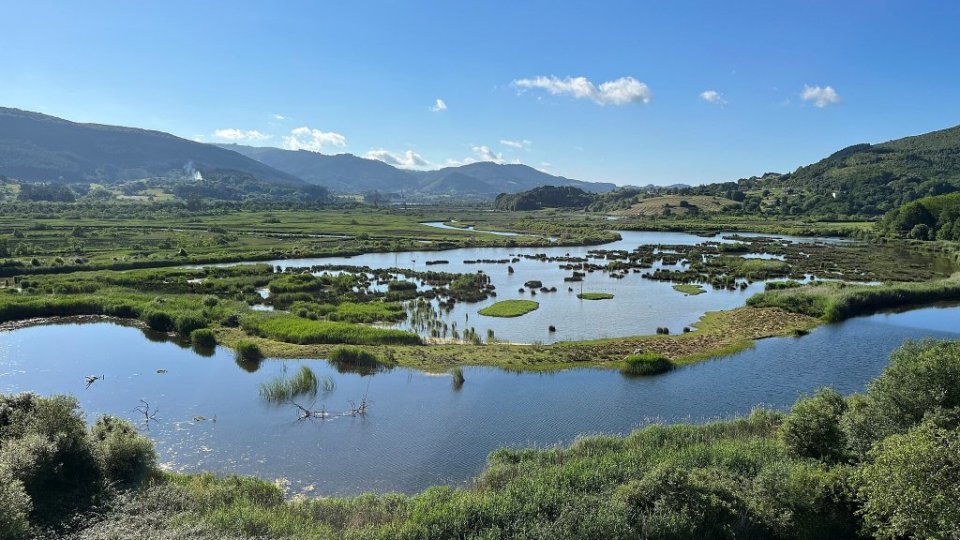
Authorities had planned to locate the extension within the Urdaibai biosphere reserve (main image), a coastal area roughly 20 kilometres from Bilbao. The proposal sparked widespread opposition, with environmentalists warning that the development would cause irreversible damage to a fragile and unique ecosystem.
Urdaibai — an estuary east of Bilbao — was designated a UNESCO biosphere reserve in 1984. Around 45,000 people live in the area, whose wetlands provide vital nesting and wintering grounds for dozens of bird species, including the sea eagle, spoonbill and Eurasian bittern.
Under the plan, two buildings would have been constructed five kilometres apart and linked by a ‘green path’ designed for walking, cycling or electric vehicles. One building, housed in a renovated cutlery and kitchenware factory in Guernica, was intended to function as an artists’ residence and education centre. The second, to be built on the former shipyards at Murueta, would have hosted the museum galleries, exhibition spaces and an observatory.
A tunnel through the mountains separating greater Bilbao from the Urdaibai estuary was also proposed to facilitate access for the tens of thousands of additional visitors expected each year.
Opponents accused officials of using the language of sustainability to mask the environmental impact that an influx of 140,000 visitors would inevitably bring.
They also argued that Spanish law prevents the alteration or repurposing of the shipyards where the museum was to be built. Once the existing concession — held by a local shipping company — expires, the law requires the dismantling of the facilities so the land can revert to its natural coastal state.
After 16 years of development work, Basque authorities announced in January 2024 a two-year suspension to reassess the project’s viability.
That year, several thousand people demonstrated against the expansion on the streets of nearby Guernica.
The governing Basque Nationalist Party (EAJ-PNV) said at the time that the delay stemmed largely from changes in leadership at the Guggenheim Foundation in New York. Local media, however, suggested the project had been put on ice amid concerns over political backlash.
Opponents welcomed the pause. ‘The Guggenheim in Urdaibai was an anti-ecological, unnecessary, absurd, unsustainable project, in the middle of a biosphere reserve, absolutely far from the real needs of the region because it did not guarantee any type of return,’ said Miren Gorrotxategi, a spokeswoman for the left-wing Podemos party in the Basque Country.
Subscribe to the Weekly Newsletter from Spain in English.
💪Una victoria para la naturaleza y la sociedad civil.
— SEO/BirdLife (@SEO_BirdLife) December 27, 2025
El que el museo Guggenheim no vaya a estar en Urdabai, ha sido fruto de una campaña internacional que pone sobre la mesa los riesgos ambientales que conllevaría.
La colaboración es clave. https://t.co/k8Bfa2i4aJ pic.twitter.com/BcOfOSAw5i

Click here to get your business activity or services listed on our DIRECTORY.