
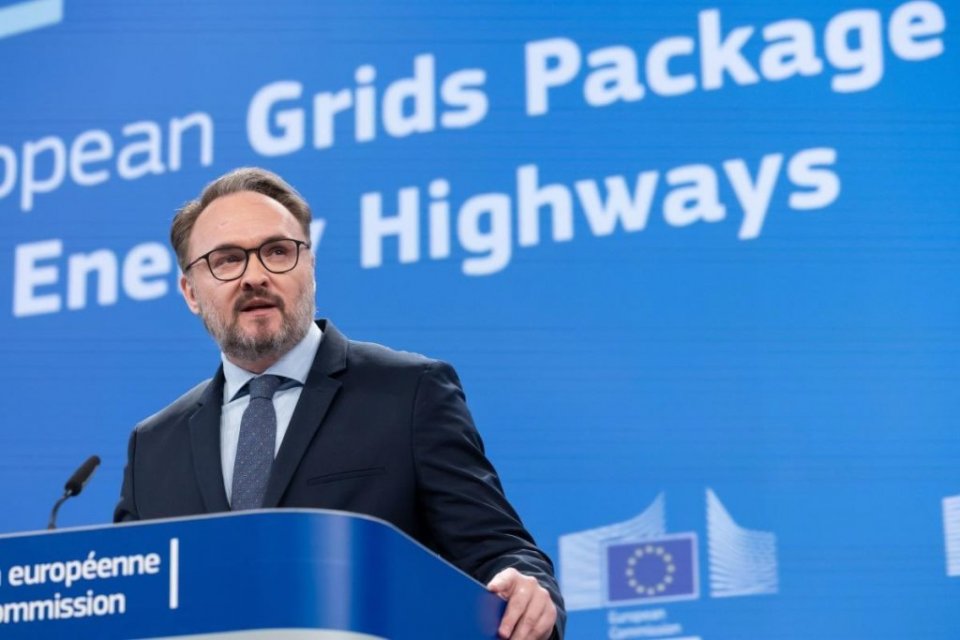
The European Union said on Wednesday that it intends to strengthen energy links between France and Spain, as part of a broader effort to safeguard the bloc’s power supply months after a major outage disrupted much of the Iberian Peninsula.
Spain and Portugal have long argued that France has been slow to develop the infrastructure needed to properly integrate the peninsula with the wider European grid. ALSO READ: Spain’s grid operator warns of new ‘voltage swings’, yet not posing risk of another blackout.
‘I’m probably not offending anybody by saying that sometimes France has been somewhat reluctant to have more interconnections,’ EU energy commissioner Dan Jorgensen (main image) said during a press briefing in Brussels.
The European Commission unveiled proposals aimed at accelerating authorisation procedures and improving joint planning for cross-border grid initiatives. Such projects, it said, are essential to supporting the shift toward clean energy and easing the high electricity costs faced by households and businesses.
At the top of the commission’s priority list are two new power links across the Pyrenees connecting France and Spain, highlighted among eight ‘energy highways’ Brussels wants to prioritise. ALSO READ: EU Investment Bank pledges €1.6bn for Bay of Biscay power link connecting Spain & France.
Other plans include a ‘hydrogen corridor’ stretching from Portugal to Germany, along with upgrades to electricity networks across the Baltic region.
Interconnections are seen as vital to ensuring reliable supplies, allowing nations to import or export power as demand fluctuates.
Teresa Ribera, the EU’s vice president for the green transition, stressed that stronger links are crucial for managing shocks in Europe’s energy system. ‘The more connected we are, the more possibilities we have to react,’ she said.
The Iberian Peninsula remains relatively isolated from the rest of Europe’s grid, relying on only a handful of links through France — a factor cited in the delayed recovery from April’s blackout. Click here to read all our reports related to Spain’s blackout.
Improving these connections is also expected to help curb Europe’s notoriously high energy prices by broadening supply options and reducing reliance on volatile oil and gas markets.
According to European Commission figures, industrial electricity costs in the EU reached 0.199 euro per kWh in 2024, compared with 0.082 euro in China and 0.075 in the United States.
‘No energy security can be achieved in Europe if electricity is not able to flow freely across the continent,’ said Neil Makaroff, director at the think tank Strategic Perspectives.
‘Building resilient and integrated grids is the prerequisite if the EU wants to power its economy with electricity instead of gas and oil.’
Subscribe to the Weekly Newsletter from Spain in English.
Today we present the European Grids Package ⚡️
— Energy4Europe 🇪🇺 (@Energy4Europe) December 10, 2025
It will enable energy to flow efficiently across all EU countries, integrating cheaper clean energy and accelerating electrification.
Learn more ➡️ https://t.co/jK4heDKydw#AffordableEnergy #EnergyInfrastructure pic.twitter.com/2xH09AZlwo
We welcome & support the #EUGridsPackage.
— Nadia Calviño (@NadiaCalvino) December 11, 2025
In 2025, the @EIB will reach a record €11 billion in new financing for energy grids
Together with the @EU_Commission, we are helping lower costs for businesses and families, boosting security and powering Europe’s cleantech leadership. https://t.co/x3SMt22v1d

Click here to get your business activity or services listed on our DIRECTORY.