
Spain is forecast to replace France as the world’s most visited country by 2040, with international arrivals expected to reach around 110 million a year, according to a major new study examining the future of global tourism.
Research by Deloitte and Google predicts that Spain will move ahead of its northern neighbour over the next 14 years as worldwide international travel continues to expand.
France remains the global leader for now, having welcomed a record 102 million international tourists in 2025. Spain was not far behind, however, receiving 96.8 million foreign visitors – 3.2% more than the 94 million recorded in 2024. ALSO READ: Spain sets new tourism record with 96.8 million foreign visitors in 2025, spending €134.7 billion.
By 2040, the study forecasts approximately 110 million annual international arrivals in Spain, compared with 105 million in France.
The projections come as global tourism is expected to undergo substantial growth and become increasingly spread across a wider range of destinations.
Global tourist trips forecast to reach 2.4 billion
The Deloitte and Google research examines the development of international tourism over several decades and considers how demographic, economic and geopolitical changes could affect travel patterns through to 2040.
Before the Covid-19 pandemic interrupted the trend, international arrivals had grown dramatically over the preceding decades, reaching almost 1.5 billion in 2019.
The study expects that long-term expansion to continue, with international trips worldwide reaching around 2.4 billion by 2040.
Europe is forecast to remain the largest destination region. The continent is expected to attract more than 362 million additional international tourists between 2019 and 2040, accounting for 38% of the increase in global arrivals.
Asia-Pacific is expected to record the second-largest increase, gaining more than 278 million additional international visitors over the same period.
At the same time, international tourism is predicted to become less concentrated among the countries which have traditionally dominated the market.
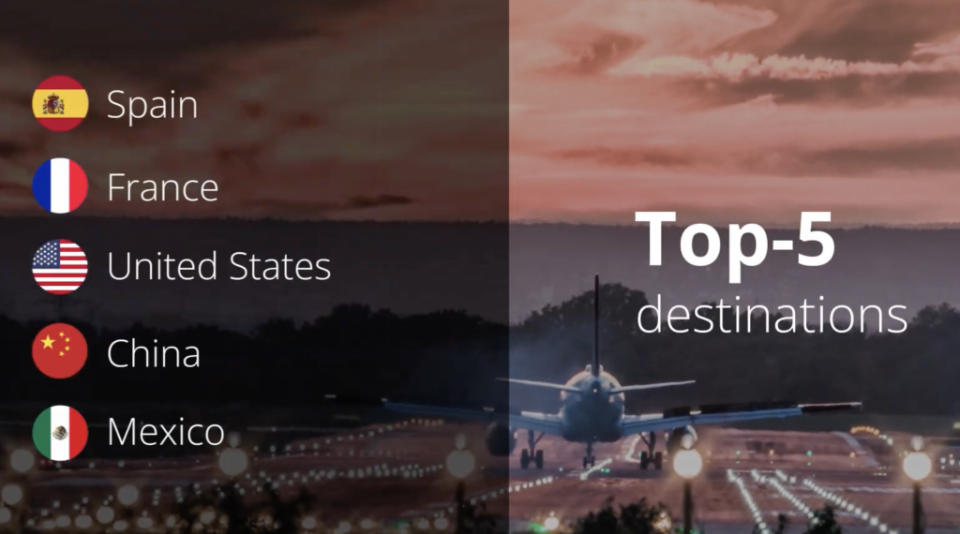
Spain, France, the United States and China are all forecast to remain among the world’s five most visited countries. Mexico is expected to climb to fifth position, while Italy drops to sixth.
Other destinations are also expected to become increasingly prominent, with Saudi Arabia, Indonesia and the United Arab Emirates among the countries that could enter the global top 15 by 2040.
Spain closes the gap on France
Spain’s record-breaking tourism figures mean the country is already relatively close to the level Deloitte and Google forecast for 2040.
The 96.8 million international visitors recorded in 2025 left Spain approximately five million behind France, which retained first place with 102 million. ALSO READ: Spain on course to welcome 100 million foreign tourists as spending hits new highs.
France’s foreign visitors generated 743 million overnight stays in 2025, while international tourism receipts reached a record €77.5 billion, up 9% on the previous year.
Spain, despite receiving fewer foreign tourists, recorded substantially greater international visitor spending.
Income from overseas tourists in Spain increased by 6.8% in 2025 to €134.7 billion, compared with approximately €126 billion the previous year, according to figures from Spain’s Tourism Ministry.
The figures underline the economic importance of international tourism to Spain and come as the country increasingly looks beyond simply maximising visitor numbers.
Spanish authorities have instead been promoting a model intended to distribute tourism more evenly throughout the country and across different times of the year, reducing the intense concentration of visitors in established destinations and during the traditional summer season.
Tourism Minister Jordi Hereu has previously referred to the objective as ‘calm growth’, with greater emphasis placed on areas including cultural, gastronomic, nature and inland tourism, as well as attracting visitors outside the busiest months.
Spain is particularly well placed to broaden its tourism season because of the variety of destinations it offers, ranging from Barcelona, Madrid, Seville, Valencia and Málaga to the Canary and Balearic Islands, Mediterranean resorts, historic inland cities, northern Spain and rural areas.
Its extensive tourism infrastructure, international air connections and relatively mild climate also allow much of the industry to operate throughout the year.
Tourism boom brings growing pressure
Becoming the world’s most visited country would nevertheless intensify an already contentious debate in Spain over the social and environmental impact of mass tourism.
Anti-overtourism demonstrations have taken place in a number of the country’s most popular destinations in recent years, including Barcelona, the Canary Islands and the Balearic Islands. ALSO READ: ‘Mallorca at breaking point’: record anti-tourism protest ends in clashes with police.
Residents and campaign groups have raised concerns about the impact of large visitor numbers and holiday accommodation on housing, rents, public services, transport, natural resources and heavily visited neighbourhoods. ALSO READ: Spain to impose tougher rental regulations, including caps on room rents and limits on seasonal lets.
The issue has left authorities attempting to balance one of Spain’s most important industries against increasing pressure in communities where tourism is most heavily concentrated.
A series of measures has consequently been introduced at national, regional and local level.
In September 2025, the Spanish government announced that around 53,000 properties would be removed from the Single Register of Tourist and Seasonal Rentals after failing to meet the required conditions. The government said the properties could instead be used for permanent residential rentals. ALSO READ: Spanish government to limit short-term rentals and tourist flats to address housing crisis.
Barcelona has gone considerably further, with plans to stop renewing licences for approximately 10,000 tourist apartments when they expire in 2028, with the aim of returning the properties to residential use. ALSO READ: Barcelona wants to revoke all city’s 10,101 tourist apartment licences by Nov 2028.
The Catalan capital has also acted to reduce the impact of cruise tourism. In 2023, the number of cruise ships permitted to call at the city’s central port facilities on any one day was reduced from 10 to seven, while further changes to cruise infrastructure are being pursued.
Other popular Spanish destinations have adopted measures of their own.
The Balearic Islands have tightened restrictions targeting excessive alcohol consumption and party tourism, including controls affecting party boats.
Malaga, meanwhile, has used a public-awareness campaign to encourage better behaviour among visitors. Messages displayed on buses, billboards and social media have urged tourists to respect residents, keep noise levels down – particularly at night – avoid shouting or playing loud music in residential areas, and use designated toilets and rubbish bins. ALSO READ: Three-year ban on new licences for tourist flats comes into force in Malaga.
Economic success – and a growing challenge
The prospect of Spain attracting another 13 million international tourists a year by 2040 illustrates the dilemma facing the country’s tourism industry.
At national level, further growth has the potential to generate billions of euros in additional spending and support businesses and employment across a wide range of sectors.
In the areas already receiving the greatest numbers of visitors, however, continued expansion could add to pressure on housing, transport, beaches, historic centres, infrastructure and natural resources. ALSO READ: Spain to spend €1.3 billion on ‘industrial construction of social housing’.
The Deloitte and Google forecast therefore raises a question extending beyond whether Spain will eventually overtake France.
If the projections prove correct, Spain’s challenge will be how to accommodate around 110 million international visitors a year while spreading the economic benefits of tourism more widely – and preventing its success as a destination from damaging the communities and places on which that success depends.
Click here to download the full report from Deloitte.
Enjoying the news from Spain in English? Add us as a preferred news source in Google.
Subscribe to the Weekly Newsletter from Spain in English.

Click here to get your business activity or services listed on our DIRECTORY.