
Three people have been injured and buildings damaged after a new magnitude 4.8 earthquake struck the province of Granada (Andalusia) on Tuesday morning, followed by a series of strong aftershocks that prompted evacuations, road closures and restrictions at the Alhambra.
The latest earthquake struck at 10.37am, with its epicentre northwest of Gójar, just south of Granada city, at a depth of five kilometres, according to Spain’s National Geographic Institute (IGN).
It is one of the strongest tremors recorded during the continuing series of earthquakes affecting the province since 14 August and matched the magnitude of the major quake recorded on 15 August near Alhendín. ALSO READ: Earthquake hits Granada and is strongly felt across Malaga province.
Tuesday’s initial earthquake was followed by several further tremors, including three that were particularly widely felt across the Granada metropolitan area.
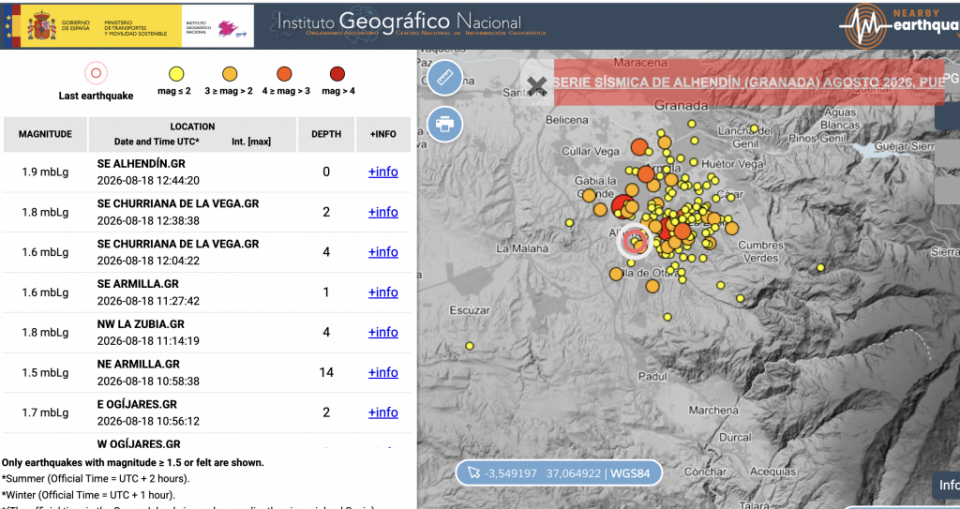
A magnitude 3.9 earthquake was recorded at 10.53am with its epicentre at Churriana de la Vega, followed at around 11.35am by a magnitude 4.3 tremor centred on Alhendín. Another magnitude 4.2 earthquake struck Alhendín at 12.39pm, also at a depth of five kilometres.
Several smaller tremors were also detected around Gójar and Las Gabias, including earthquakes provisionally measured at magnitudes 2.7, 2.9 and 2.6.
The latest activity comes after almost 100 aftershocks had already been recorded following the earthquake on 15 August. Until Tuesday, the strongest of those subsequent tremors had measured 3.3.
The Andalusian regional government confirmed that three people suffered minor injuries during Tuesday’s earthquakes. Regional vice president Antonio Sanz said all three had ‘light injuries’, with one of those, a teenage girl, taken to hospital.
The tremors caused damage to a number of buildings, with cracks reported in walls, masonry and other pieces of façades falling into streets and debris scattered across pavements.
Granada City Council raised its response from the pre-emergency phase to emergency operational level 1 following a meeting of its seismic risk advisory committee.
Mayor Marifrán Carazo said the immediate priority was to inspect affected homes and buildings and restore normality in areas that had been closed because of potential hazards.
Authorities identified damage at nine locations in Granada city, resulting in seven streets being closed, principally because of falling masonry and damaged elements of building façades. The densely populated Zaidín district was among the areas particularly affected.
Local Police received 229 calls following the earthquakes, while firefighters dealt with 168 and the 092 municipal service received a further 61, many from residents seeking information.
The mayor urged residents to report any cracks or structural damage they discovered and appealed for calm as the seismic activity continued. People whose homes had suffered no apparent structural damage were advised to remain inside in the event of further tremors and to stay away from the line of building façades when outdoors.
Carazo also stressed that aftershocks cannot be predicted and urged the public to follow advice issued by experts from the Andalusian Institute of Geophysics. Granada Local Police was reinforcing its presence with an additional 16 patrols during Tuesday afternoon and ten overnight.
The Andalusian regional government’s Emergency Plan for Seismic Risk also remains activated at operational level 1, a measure introduced following the 15 August earthquake.
Andalusian regional president Juanma Moreno urged the public to exercise ‘maximum caution’.
‘Experts say it is possible that seismic activity and aftershocks will continue in the area, and it is important to know how we should act in these situations. Please follow the advice and remain calm,’ he said on X.
Alhambra partially evacuated
Precautionary measures were introduced across Granada following Tuesday morning’s earthquakes, including at the Alhambra, a UNESCO World Heritage Site and one of Spain’s most visited historic monuments.
Visitors were evacuated from the Nasrid Palaces and the Alcazaba and public access to those parts of the complex was suspended while specialists assessed whether the earthquakes had caused any damage. Visits to the Partal and Generalife were initially able to continue as normal.
Granada City Council and the provincial authority also ordered the precautionary closure of non-essential public buildings, while administrative offices, museums and sports facilities were among those affected. Primary healthcare facilities remained open.
The Nevada shopping centre in Armilla, one of Spain’s largest shopping centres, was also evacuated as a precaution, with shoppers and employees ordered to leave the building and retail staff gathering in an outdoor parking area.
Several hotels were also reportedly evacuated.
Granada’s metro introduced a temporary speed restriction, reducing trains to 30km/h as a precaution while checks were carried out.
Emergency services remained deployed across the metropolitan area to inspect buildings and respond to reports of damage.
The 112 emergency service advised people to remain calm during further tremors, take shelter beneath sturdy furniture where appropriate and avoid using lifts when evacuating buildings. Residents were also asked to keep emergency telephone lines free except in cases involving injuries, serious emergencies or significant structural damage.
Although the earthquakes were centred around the southern outskirts of Granada, the tremors were felt across a much wider part of Andalusia.
Reports came from elsewhere in Granada province as well as Almería, Córdoba, Jaén and Málaga, including several communities along the eastern Costa del Sol such as Rincón de la Victoria, Torre del Mar, Torrox and Nerja.
Previous earthquakes in southern Spain
Granada and the surrounding region have a long history of seismic activity. According to the IGN earthquake catalogue, around 80 earthquakes of magnitude 4.5 or greater and at depths of less than 70 kilometres have been recorded in Andalusia and neighbouring Murcia since 1900.
Among the largest was a magnitude 5.5 earthquake near Jimena de la Frontera in the Cádiz province in 2013, although its low intensity meant it was barely noticed by the population.
Much more destructive was the magnitude 5.1 Lorca earthquake in Murcia in May 2011. Despite its relatively moderate magnitude, its shallow depth and proximity to the city resulted in severe damage and nine deaths.
Authorities in Granada are continuing to assess Tuesday’s damage while monitoring the latest seismic activity, with officials warning that further aftershocks remain possible.
Enjoying the news from Spain in English? Add us as a preferred news source in Google.
Subscribe to the Weekly Newsletter from Spain in English.
Evacúan La Alhambra de forma preventiva por el nuevo terremoto de magnitud 4,8 en Granada.
— RTVE Noticias (@rtvenoticias) August 18, 2026
Los equipos de conservación están inspeccionando el recinto y la dirección del Patronato decidirá si se reabre pronto o si permanece cerrada hasta que se detenga por completo la actividad… pic.twitter.com/T4d0V5jvTu
🔇 Consulta toda la información de los #terremotos en nuestro territorio en el #visualizador de terremotos próximos
— Instituto Geográfico Nacional-O.A.CNIG (@IGNSpain) August 18, 2026
👉 https://t.co/pmeEbSLW2h#ignspain #cnig @transportesgob #earthquake #granada #andalucía #terremoto pic.twitter.com/qlJ4pYnqfz
🔴 Coches destrozados, toldos caídos y daños en fachadas y mobiliario urbano: un nuevo terremoto de magnitud de 4,7 sacude Granada https://t.co/H005fqBXhz pic.twitter.com/Sj89Q4HQOG
— Europa Press (@europapress) August 18, 2026
🔴 Al menos 3 heridos y daños materiales tras un nuevo terremoto de magnitud 4,8 en la provincia de Granada https://t.co/rsMcLI16l6 pic.twitter.com/LED7Pt0c5Y
— RTVE Noticias (@rtvenoticias) August 18, 2026

Click here to get your business activity or services listed on our DIRECTORY.