
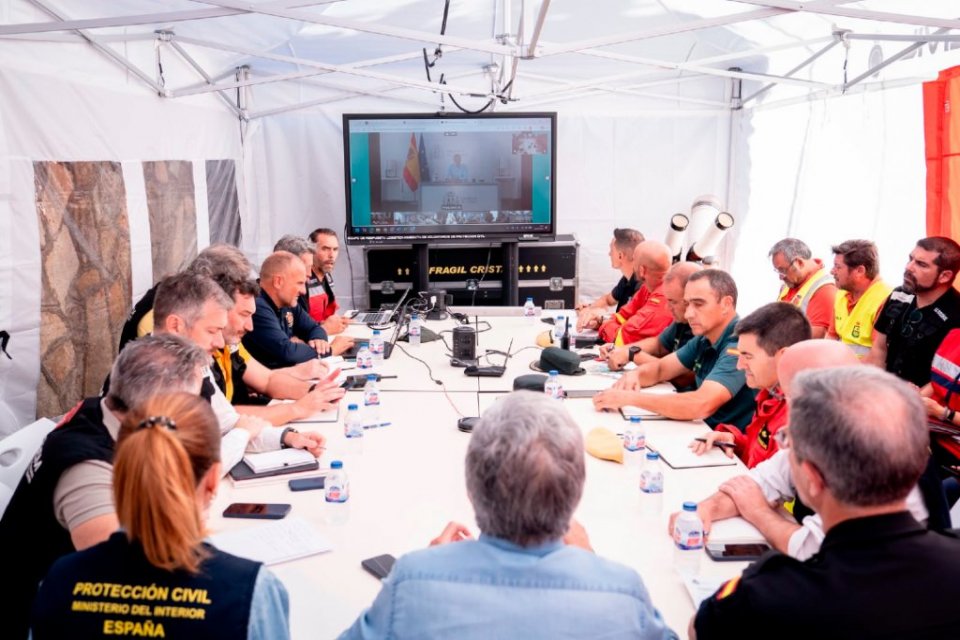
Spain has declared a national emergency for the first time in response to wildfires after a series of rapidly spreading blazes around Madrid and th neighbouring province of Ávila (Castilla y León) forced the evacuation of more than 10,000 people, with some estimates putting the total at close to 20,000 as the situation continued to evolve.
The unprecedented measure, announced by the Interior Ministry, places responsibility for coordinating the emergency response under Interior Minister Fernando Grande-Marlaska and allows national authorities to rapidly mobilise additional resources, including Spain’s Military Emergency Unit (UME), to support regional firefighting operations.
The declaration came after the regional government of Madrid headed by Isabel Díaz Ayuso requested assistance, describing the situation as one of ‘extreme gravity’ as multiple fires threatened to overwhelm local firefighting capacity.
Authorities warned that three major fires burning in Villa del Prado, San Martín de Valdeiglesias and neighbouring Almorox, in the Castilla-La Mancha region, risked merging, while another fast-moving wildfire in Burgohondo, in Ávila province, threatened to spread into the Madrid region because of strong winds and extreme weather conditions.
More than 10,000 people have been evacuated across the Madrid region in recent days, including around 3,500 residents of Aldea del Fresno, approximately 60 kilometres west of the capital, who received emergency evacuation alerts early on Thursday. Elsewhere in Ávila province, residents of Burgohondo, El Tiemblo and Navaluenga were ordered to remain indoors as flames spread out of control.
Around 1,500 people were also evacuated from a rural tourism complex and nearby housing development in El Tiemblo as the fire advanced rapidly.
Although firefighters managed to slow the overnight advance of several blazes, authorities warned that worsening weather conditions were expected to make containment efforts significantly more difficult.
‘Meteorological conditions, fundamentally the wind, will complicate firefighting operations this Friday,’ the Madrid regional government said in a post on X.
Prime Minister Pedro Sánchez said the government had committed every available resource to the emergency.
‘The government has deployed every available resource to stop the terrible fires currently affecting numerous areas: Ávila, León, Toledo, Madrid and other parts of Spain,’ he wrote on X, urging the public to exercise ‘great caution’ and follow official instructions.
Later, Sánchez added: ‘We are experiencing a dramatic situation, not just in several Spanish regions but also in neighboring countries. My solidarity with all the people who have been affected and been forced to leave their homes.’
The national emergency is the first ever declared in Spain specifically because of a wildfire. The previous time the same level of emergency was activated was during last year’s nationwide power blackout.
Interior Minister Grande-Marlaska said the densely populated area west of Madrid, where many residents own second homes, had influenced the decision to intervene nationally, alongside the unusually aggressive behaviour of the fires and persistent hot, windy conditions.
Spain has also requested assistance from the European Union, with Grande-Marlaska confirming that Italy and Greece are each sending two Canadair water-bombing aircraft to reinforce firefighting operations.
More than 270 emergency personnel, around 40 ground units and several contingents from the UME have been deployed across the affected regions, supported by helicopters, water-dumping aircraft, bulldozers and national firefighting brigades.
Beyond Madrid and Ávila, Grande-Marlaska said nine other serious wildfires are currently burning elsewhere in Spain.
The country’s largest blaze remains in Guadalajara province, about 100 kilometres north of Madrid, where a fire has already destroyed around 32,000 hectares since last week, making it Spain’s second-largest wildfire on record. ALSO READ (20 July): Spain’s largest wildfire of 2026 spreads beyond 26,000 hectares as new heatwave fuels fears.
Spain has endured an exceptionally severe fire season for the second consecutive year. More than 29 major wildfires have broken out so far in 2026, with Environment Minister Sara Aagesen saying the area burned is already more than five times greater than at the same stage in 2025.
Subscribe to the Weekly Newsletter from Spain in English.
Casi todo el territorio de la Comunidad de Madrid se encuentra hoy en peligro MUY ALTO o EXTREMO de incendios forestales⚠️🔥
— Delegación del Gobierno en Madrid 🏛️ (@DGobiernoMadrid) July 24, 2026
Extrema las precauciones para evitar su aparición. Un solo descuido puede tener consecuencias catastróficas‼️
🚭 No arrojes colillas
🔥 No hagas fuego… pic.twitter.com/EV7vGlTRjL
🔴 Tras el CECOD presidido por Pedro Sánchez, Grande-Marlaska informa desde Cenicientos:
— Ministerio del Interior (@interiorgob) July 24, 2026
🔥 9.000 ha en Ávila y 3.000 en Madrid quemadas en 3 incendios.
⚠️ “Día complicado por vientos de 50 km/h y altas temperaturas. Sigan las indicaciones de las autoridades de la emergencia”. pic.twitter.com/tu7i9eE3G1
Esta noche se ha declarado la emergencia de interés nacional por los incendios en Madrid y Ávila.
— La Moncloa (@desdelamoncloa) July 24, 2026
Otras provincias están también afectadas por los incendios forestales.
Sigue las indicaciones de los servicios de emergencia. Te dejamos esta lista⬇️https://t.co/6ghTvL2VdM

Click here to get your business activity or services listed on our DIRECTORY.