
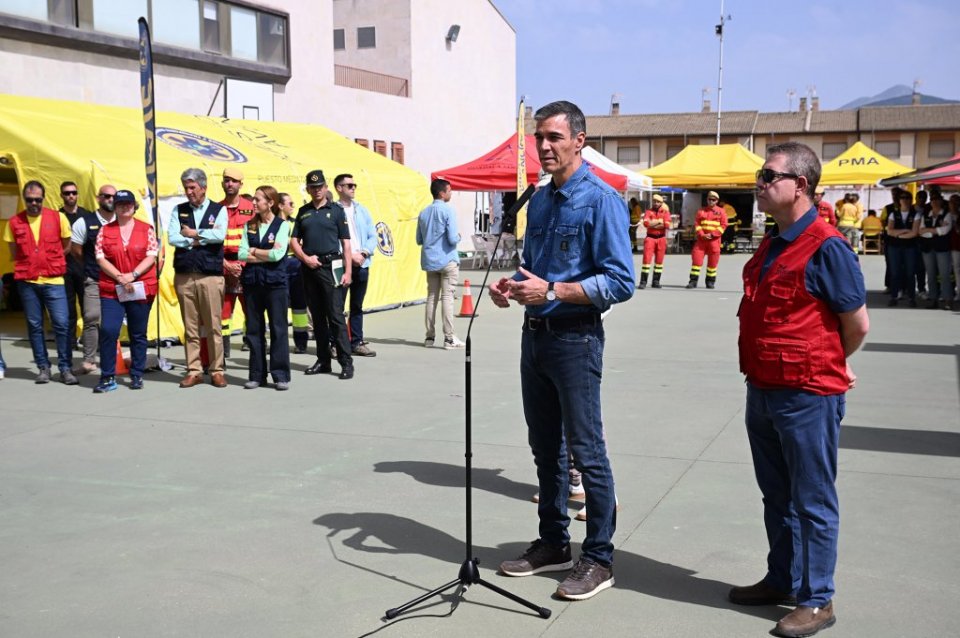
Spain’s largest wildfire of the year has now burned more than 32,000 hectares in the central province of Guadalajara (Castilla-La Mancha), becoming one of the biggest blazes in the country’s recorded history as authorities warn that extreme heat and worsening climate conditions continue to fuel an unprecedented fire season.
The blaze, which has devastated large areas of rural Castilla-La Mancha, began showing signs of stabilising on Tuesday after forcing the evacuation of 34 municipalities and confinement orders in 14 others. While residents of five villages have now been allowed to return home, restrictions remain in place across other affected communities. ALSO READ (20 July): Spain’s largest wildfire of 2026 spreads beyond 26,000 hectares as new heatwave fuels fears.
Firefighters, supported by water-dropping aircraft, have succeeded in protecting homes in all 40 villages within the fire zone, despite the flames sweeping through an area where around 90% of the land forms part of a national park.
Regional authorities hope to bring the nearly week-old fire under control by Friday. Castilla-La Mancha regional president Emiliano García-Page said emergency crews were continuing to work tirelessly to contain the blaze.
Spain’s INFOCAM fire service confirmed that conditions had improved sufficiently for some residents to return, although authorities remain on alert.
Prime Minister Pedro Sánchez visited the fire-ravaged area on Wednesday (main image), touring the village of Tamajón, northeast of Madrid, where he called for greater political unity in tackling climate change and preventing future disasters.
‘Year after year we clearly see how climate change kills and destroys wealth in our communities,’ Sánchez said. ‘This isn’t politics. It is science, it’s about facts.’
He also noted that Spain had already experienced 22 major wildfires this year – defined as fires burning more than 500 hectares – with more than 100,000 hectares destroyed nationwide. ALSO READ: Sánchez praises firefighters and calls for climate action as identification of Almeria wildfire victims begins.
‘To put that into perspective, that is the annual average that Spain experienced over the past decade,’ he said, stressing that more must be done to reduce wildfire risks. ‘We must raise public awareness, and we must not trivialise the effects of the climate emergency.’
According to Sánchez, the amount of land burned so far this year is already four times higher than at the same point in 2024. ALSO READ: More than 12,000 hectares destroyed as Aragón faces escalating wildfire crisis.
Spain’s Minister for the Ecological Transition, Sara Aagesen, described the Guadalajara blaze as ‘one of the largest in the recent history of our country’ and the biggest wildfire ever recorded in Castilla-La Mancha.
According to figures from the Ecological Transition Ministry, cited by Spain’s EFE news agency, it is now the second-largest wildfire ever recorded in Spain, surpassed only by a blaze that burned around 37,000 hectares in the country’s northwest last year. ALSO READ: Sánchez unveils Spain’s largest anti-wildfire operation after devastating 2025 fires.
Although there have been no reported deaths or serious injuries in Guadalajara, the disaster comes less than two weeks after another exceptionally intense wildfire devastated a small expatriate community in southern Spain, killing 13 people, including several foreign nationals, in one of the country’s deadliest recent wildfires. ALSO READ: Seven Britons among 13 wildfire victims as British Ambassador meets survivors in Almeria.
Local leaders praised the efforts of firefighters, whose work prevented far greater destruction.
Miguel Ángel Moreno, mayor of Zarzuela de Jadraque, said all 100 residents of his village were evacuated last Friday, with 14 taking shelter in a Red Cross emergency centre. Although two barns were destroyed, firefighters managed to save every home.
‘(The firefighters) had to run from one side of the village to the other putting out fires,’ Moreno told Spanish public broadcaster TVE. ‘Besides the heroes who won the World Cup, we have other heroes who remain nameless.’
The wildfire comes as Spain endures another severe heatwave. The state weather agency AEMET warned that the risk of wildfires remains ‘very high or extreme’ across most of mainland Spain and the Balearic Islands, with conditions expected to worsen over the coming days.
The agency urged people to ‘exercise extreme caution’ as soaring temperatures combine with dry thunderstorms, strong winds and Saharan dust to create ideal conditions for fast-moving fires.
The current heatwave is expected to peak between Wednesday and Thursday, with temperatures reaching around 40C across many inland regions and climbing to between 42C and 44C in parts of the Mediterranean coast and Andalusia.
Although temperatures are forecast to ease slightly in some areas on Thursday, forecasters say dry westerly winds could drive another surge of intense heat across eastern Spain before a more noticeable cooldown arrives on Friday. However, that respite may prove short-lived, with temperatures expected to rise again from Sunday and another spell of extreme heat likely across much of the country early next week. ALSO READ: Study finds climate change made Spain’s wildfires 40 times more likely.
Like much of southern Europe, Spain has experienced increasingly frequent and intense heatwaves in recent years. Combined with prolonged drought, low rainfall and strong winds, these conditions have created an environment in which even small fires can spread rapidly. ALSO READ: Pedro Sánchez visits wildfire-hit Galicia and pledges ‘national pact’ to address climate emergency.
Scientists say climate change is making such events more frequent and more severe. Europe is the world’s fastest-warming continent, with temperatures rising at roughly twice the global average since the 1980s, according to the European Union’s Copernicus Climate Change Service. Researchers also warn that rising temperatures and increasing dryness, particularly across southern and southeastern Europe, are significantly increasing the risk of devastating wildfires and their impact on communities. ALSO READ: Wildfires in Spain this year confirmed as most destructive in country’s history.
Enjoying the news from Spain in English? Add us as a preferred news source in Google.
Subscribe to the Weekly Newsletter from Spain in English.
➡️ ACTUALIZACIÓN
— INFOCAM (@Plan_INFOCAM) July 22, 2026
🔥 #IFLaMierla en #Guadalajara. 🚨 Nivel 2
Hoy hemos recibido la visita del presidente del Gobierno, @sanchezcastejon junto al presidente de @gobjccm @garciapage, para interesarse sobre la situación del #IFLaMierla.
En su intervención, Pedro Sánchez, ha… https://t.co/iIChJ7TSDf pic.twitter.com/upnVynZvgL
En lo que va de año, 22 grandes incendios han calcinado más de 100.000 hectáreas. Prácticamente lo mismo que se quemó al año de media en la última década.
— Pedro Sánchez (@sanchezcastejon) July 22, 2026
El Gobierno de España seguirá movilizando todos los recursos para la extinción de los incendios y para la recuperación de… pic.twitter.com/NprGGSIL4G

Click here to get your business activity or services listed on our DIRECTORY.