
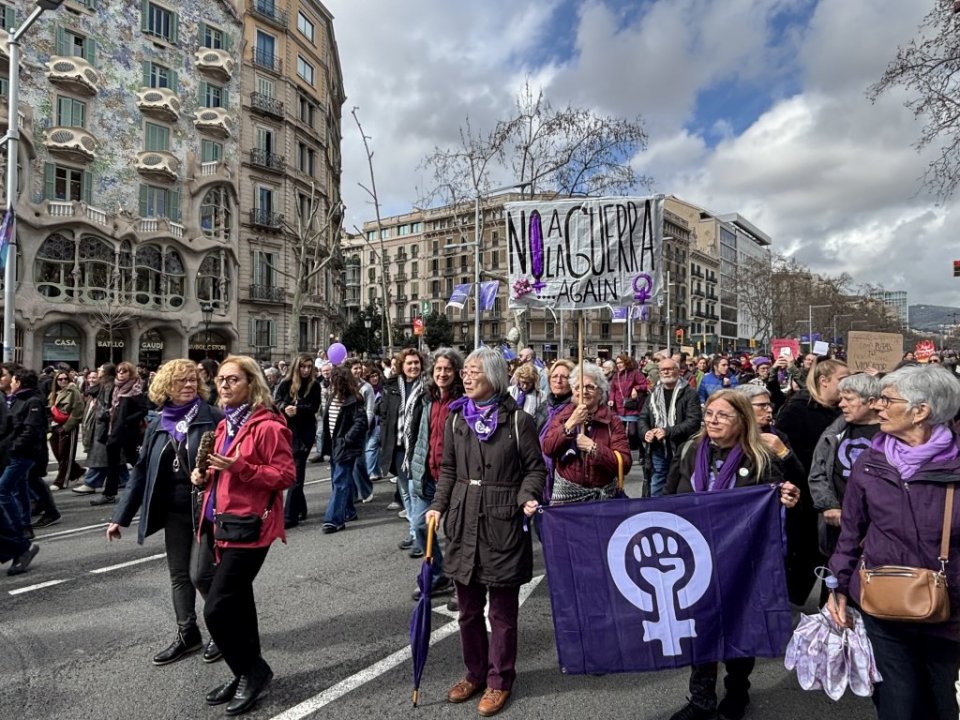
Protesters across Europe took to the streets on Sunday to mark International Women’s Day, holding marches and rallies calling for an end to gender inequality, discrimination and violence against women.
From major capitals to smaller cities, demonstrators demanded faster progress towards gender parity while also voicing concern over global conflicts and their impact on women.
In Spain, thousands of people joined demonstrations across the country to denounce gender-based violence and call for peace amid the widening Middle East conflict following US-Israeli strikes.
Protesters also expressed solidarity with women affected by wars in Ukraine, Iran, Gaza and elsewhere. According to the United Nations, women in conflict-affected regions are disproportionately exposed to gender-based violence.
Demonstrators called for peace and chanted ‘no to war’, while slogans and manifestos also highlighted other demands related to migration policies, armed conflicts, and regimes that enslave women and girls and oppress their rights.
For the fifth consecutive year, several cities including Madrid, Barcelona, Bilbao, Seville, Cádiz and Logroño saw separate demonstrations organised by different strands and perspectives within the feminist movement. Although they share many core demands, these groups held distinct marches attended by thousands of people — mostly women. In many other Spanish cities, however, a single unified march took place for this year’s 8M.
In central Madrid, the streets were awash with purple in a feminist tide where one of the most frequently chanted slogans was ‘Let fascism tremble — feminism is here’, alongside others such as ‘Not one step back in the fight for equality’ and: ‘Against hatred, feminism; against machismo, feminism.’
Entire families with children, grandmothers marching alongside daughters and granddaughters, groups of teenagers and neighbours walking together, feminist organisations and community collectives all filled the streets of the capital. Madrid hosted two separate demonstrations: one organised by the 8M Commission, which marched from Atocha to Plaza de Sevilla under the slogan ‘Friends, feminists will stop fascism’.
At the same time — from 12 noon — another march set off from Cibeles to Plaza de España, organised by the Madrid Feminist Movement.
One of the key differences between the two organisations that the 8M Commission supports Spain’s Trans Law, while the Madrid Feminist Movement is against it and also advocates the abolition of prostitution. In the latter march, chants included ‘My body is not for rent’ and ‘No woman is born to be a prostitute.’ ALSO READ: Spanish government proposes including the right to abortion in the constitution.
The routes and many of the slogans were so similar that some participants admitted they were not entirely sure which march they were attending, according to Spain’s national broadcaster RTVE.
According to provisional figures from the national government delegation in Madrid, around 35,000 people took part across both demonstrations. The organisers gave higher estimates: 160,000 participants, according to the 8M Commission, and 20,000 according to the Madrid Feminist Movement.
In both marches, chants of ‘no to war’ were common. Some placards merged the traditional feminist slogan ‘No means no’ with opposition to war, reading: ‘No means no — also to war’, referring to the attack by Israel and the United States against Iran and the expansion of the conflict in the Middle East.
Both demonstrations also featured slogans supporting Palestine, references to women in Iran and Afghanistan, praise for women such as Gisèle Pelicot with calls for ‘shame to change sides’, and criticism of men such as Jeffrey Epstein.
Despite their differences, the core demands in both marches remained the same: real equality and an end to gender-based violence.
Many teenage participants voiced a common complaint: ‘We are not feminazis — we are women who want equality. It’s simple, just that.’
‘We are also mobilising today in solidarity with Iranian women. We stand in defence of peace and of all the women of the world,’ Second Deputy Prime Minister Yolanda Díaz told the press at the rally in Madrid. ‘It is within our power to stop the war, to stop the barbarity, and to win rights. We proclaim ourselves in defence of peace, in defence of the Iranian people, in defence of Iranian women.’
‘There is no democracy without feminist democracy,’ said Díaz. ‘Let’s move forward with optimism and peace in the world.’ She was taking part in the 8M Commission march in the capital.
That march also included a large representation of the Spanish government, with several ministers from the coalition parties as well as left-wing Podemos leaders Irene Montero and Ione Belarra.
At the other march — which delivered a clear abolitionist message regarding prostitution and opposition to the Trans Law, with chants such as ‘Being a woman is not a feeling’ — a right-wing People’s Party (PP) delegation attended, led by its deputy secretary for education and equality, Jaime de los Santos. He said his party supports ‘authentic feminism’ in contrast with what he described as the government’s ‘nonsense’. ALSO READ: Spain approves new laws on menstrual leave, abortion and transgender rights.
In Barcelona, the demonstration organised by the 8-M Assembly drew thousands of women wearing purple clothing, flags and scarves under the slogan: ‘Not one step back. Transfeminist struggle against colonial and fascist imperialism.’
This march is considered the main unified event in the Catalan capital, although the Barcelona Feminist Movement Coordinating Committee, which includes around 20 organisations, also organised its own demonstration in the city centre, according to the EFE news agency.
Elsewhere in Spain, protesters in Santiago de Compostela marched under the slogan ‘Fighting for our dignity’, demonstrators in Toledo shouted ‘They will not silence us’, and participants in Palma declared ‘Without women there is no revolution’.
The largest demonstrations in Andalusia took place in Seville, where two parallel marches were held. In the Basque Country, thousands of women and men also took to the streets in favour of equality and against ‘imperialism’ and the ‘instrumentalisation‘ of feminism ‘to legitimise wars’. The day also highlighted divisions within the feminist movement, with four separate demonstrations organised in Bilbao by different groups.
Subscribe to the Weekly Newsletter from Spain in English.
#EFEFotos | Miles de mujeres se manifiestan en toda España en defensa de la igualdad y contra la violencia machista.#8M pic.twitter.com/zOnJml0DGk
— EFE Noticias (@EFEnoticias) March 8, 2026
Arranca en Madrid la marcha de la Comisión #8M por el Día Internacional de la Mujer bajo el lema ‘Feministas antifascistas’ y con gritos de ‘no a la guerra’, reclamando derechos, igualdad y paz https://t.co/ziFfnwMrif pic.twitter.com/xQRdRzfU0m
— Europa Press (@europapress) March 8, 2026

Please support us with a donation.
Click here to get your business activity or services listed on our DIRECTORY.