
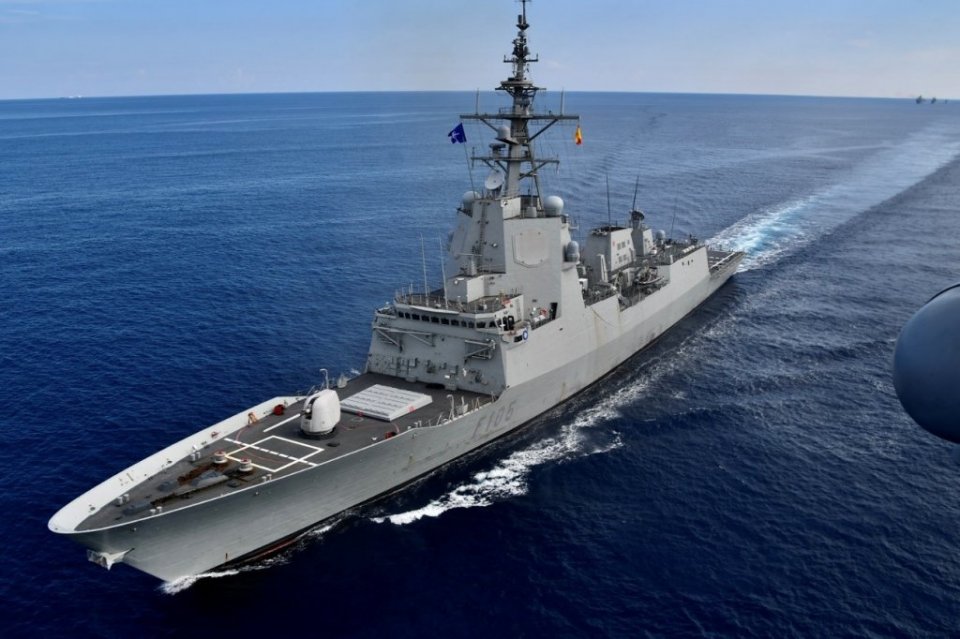
Spain will deploy its most advanced frigate to help protect Cyprus after a drone attack on a British base on the Mediterranean island drew the country into the widening Middle East conflict, the Spanish Defence Ministry announced on Thursday.
The move comes at a time when Madrid is facing mounting pressure from the United States after refusing to allow Washington to use Spanish military bases for operations against Iran — a stance that has prompted threats of trade retaliation from President Donald Trump. ALSO READ: Trump vows to ‘cut off all trade’ with Spain over Iran stance: ‘We don’t want anything to do with Spain’.
On Wednesday, the White House stated that Spain had agreed to ‘cooperate with the US military’, but Madrid later denied this, instead reiterating its position on the use of its bases and its opposition to the conflict.
According to the defence ministry, Spain will deploy the Cristobal Colon frigate to join the French aircraft carrier Charles de Gaulle and Greek naval vessels in order to ‘offer protection and aerial defence’ and to ‘support any evacuation of civilians’.
The ship is expected to sail for the Mediterranean after completing a mission alongside the Charles de Gaulle in the Baltic Sea, with plans to arrive near the Greek island of Crete around 10 March, the ministry said.
Several European nations have also stepped up their presence around Cyprus following the attack. France, Britain, Italy and Greece have all announced naval and air deployments after the runway of the Akrotiri airbase was struck by an Iranian drone on Monday.
‘No to war’
Prime Minister Pedro Sánchez, whose socialist led coalition government has opposed the US-Israeli strikes on Iran that sparked the regional escalation, repeated his message of ‘no to the war’ on Wednesday in his latest clash of policy with Trump. ALSO READ: Pedro Sánchez responds to Donald Trump: ‘No to war’.
Just hours later, White House Press Secretary Karoline Leavitt said Madrid had ‘agreed to cooperate with the US military’, though she did not specify what form that cooperation would take.
Spanish Foreign Minister José Manuel Albares quickly clarified Madrid’s position, telling Cadena SER radio that ‘our position on the use of the bases, on the war in the Middle East, on the bombardment of Iran, has not changed at all’. ALSO READ: US military aircraft leave Spain after government prohibits use of bases for Iran attacks.
Trump had sharply criticised the Spanish government the previous day, calling Spain a ‘terrible’ ally and warning he could cut off trade with the country, one of the world’s most dynamic developed economies.
Defending his government’s stance in a televised address on Wednesday, Sánchez said the policy “can be summed up in four words: no to the war”. ALSO READ: Spain rejects ‘unilateral military action by US & Israel’, but also ‘actions of Iranian regime’.
‘We will not be complicit in something that is harmful to the world and contrary to our values and interests, simply out of fear of retaliation,’ he added.
European support for Spain
Any attempt by the USA to impose trade restrictions on Spain could prove complicated, as Spain is part of the European Union’s single market, which allows goods to circulate freely among the bloc’s 27 member states.
‘Trump’s words don’t always become policy. We will have to see if he follows through, and how,’ said Ángel Saz Carranza, director of the ESADE Center for Global Economy and Geopolitics, a Spanish think tank.
European leaders also expressed support for Sánchez on Wednesday, including French President Emmanuel Macron, European Commission President Ursula von der Leyen and European Council President Antonio Costa.
‘The EU will always ensure that the interests of its member states are fully protected,’ Costa wrote on X.
Sánchez has already clashed with Washington in recent months after declining to join NATO allies in committing to defence spending equivalent to 5% of GDP, a level demanded by Trump. ALSO READ: Spanish government hits back after renewed tariff threats from Donald Trump over defence spending.
He has also been an outspoken critic of Israel’s military campaign in Gaza and of the US operation in January that captured Venezuelan President Nicolas Maduro. ALSO READ: Sánchez: Spain will not join Trump’s Board of Peace, preferring UN-led multilateralism.
US forces currently operate from Spain’s Rota naval base and the Morón air base in southern Spain under a defence agreement first signed in 1953 during the dictatorship of General Francisco Franco.
During the 2003 invasion of Iraq, Spain — then governed by right-wing PP prime minister José María Aznar — strongly backed Washington and sent troops to support the operation.
That decision triggered massive protests across Spain, and many Spaniards later linked it to the 11 March 2004 Madrid train bombings, which killed nearly 200 people.
Al-Qaeda claimed responsibility for the attacks and demanded the withdrawal of Spanish forces from Iraq.
Since taking office in 2018, Sánchez has become a prominent voice among Europe’s progressive leaders, at a time when right-wing parties have gained influence across much of the continent.
Some analysts believe his refusal to allow US use of Spanish bases may also help mobilise support among left-leaning voters, who largely oppose involvement in Middle Eastern conflicts.
The popularity of Sánchez’s minority government has recently been dented by several scandals involving allegations of sexual harassment and corruption, with the next general election scheduled for 2027.
Alberto Núñez Feijóo, leader of the right-wing People’s Party (PP) — which currently leads opinion polls — has accused Sánchez of using foreign policy for ‘partisan’ purposes.
Meanwhile, neighbouring Portugal has taken a different approach. Prime Minister Luis Montenegro told parliament on Wednesday that Lisbon had authorised the United States to ‘conditionally’ use an airbase in the Azores archipelago for the Iran strikes.
The leader said the permission was granted on the condition that ‘these operations are defensive or retaliatory, are necessary and proportionate, and exclusively target military objectives’.
Subscribe to the Weekly Newsletter from Spain in English.
España se suma a otros países europeos y envía la fragata Cristóbal Colón a Chipre tras el ataque iraní https://t.co/yG9jFbOGMO
— RTVE Noticias (@rtvenoticias) March 5, 2026

Please support us with a donation.
Click here to get your business activity or services listed on our DIRECTORY.