
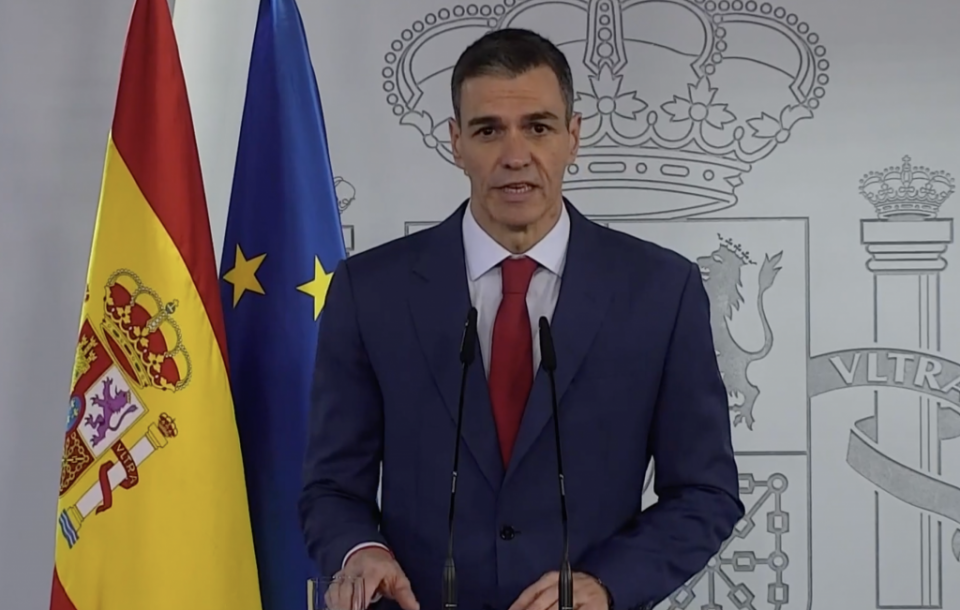
Spanish Prime Minister Pedro Sánchez on Wednesday pushed back against criticism from US President Donald Trump over Madrid’s decision not to allow American aircraft to use Spanish bases for strikes against Iran.
In a televised address, Sánchez reiterated Spain’s opposition to the conflict and defended his government’s stance a day after Trump threatened to cut off trade with the country. ALSO READ: Trump vows to ‘cut off all trade’ with Spain over Iran stance: ‘We don’t want anything to do with Spain’.
‘The position of the government of Spain can be summed up in four words (‘no a la guerra‘ in Spanish): ‘No to war,’ he said.
Sánchez stressed that Spain would not support actions it believes damage global stability. ALSO READ: Spain rejects ‘unilateral military action by US & Israel’, but also ‘actions of Iranian regime’.
‘We will not be complicit in something that is harmful to the world and contrary to our values and interests, simply out of fear of retaliation,’ he added. ALSO READ: US military aircraft leave Spain after government prohibits use of bases for Iran attacks.
‘We oppose this disaster,’ Sánchez said, arguing that his stance is shared by ‘many other governments’ and ‘millions of citizens across Europe, North America and the Middle East who do not want more war or uncertainty tomorrow’.
The remarks came after Trump described Spain as a ‘terrible’ ally on Tuesday during a meeting with German Chancellor Friedrich Merz at the White House.
The US president again criticised Sánchez for declining to join NATO partners in committing to defence spending of 5% of GDP — a target strongly promoted by Trump, who frequently argues that the United States carries too much of the alliance’s burden. ALSO READ: Spanish government hits back after renewed tariff threats from Donald Trump over defence spending.
Relations between Washington and Madrid have already been strained by other disagreements, including Spain’s outspoken criticism of Israel’s war in Gaza and its opposition to a military operation aimed at abducting and arresting Venezuelan President Nicolás Maduro. ALSO READ: Sánchez: Spain will not join Trump’s Board of Peace, preferring UN-led multilateralism.
US forces currently operate from the Rota naval base and Morón air base in southern Spain. During the US-led invasion of Iraq in 2003, however, Spain — then under PP prime minister José María Aznar — strongly backed Washington.
Reaction of Alberto Núñez Feijóo
Almost at the same time as Sánchez delivered his message of ‘no to war’ and called for a ‘diplomatic solution’ to the Iran crisis, the leader of Spain’s main opposition party criticised the government’s foreign policy.
Alberto Núñez Feijóo, head of the right-wing People’s Party (PP), argued that Spain should remain firmly aligned with its allies.
Speaking at a breakfast event in Bilbao, Feijóo said the government’s approach ‘must stand with its allies’.
‘We cannot withdraw from the framework of our EU partners simply due to the partisan or political interests of the Prime Minister,’ he said.
Feijóo went on to accuse Sánchez of showing ‘continued irresponsibility’, warning that Spain now ‘is more isolated than ever and is not a reliable partner’. According to the PP leader, the country has become ‘less secure, less stable, and has less of a role in European and world politics’.
He also cautioned that antagonising the United States could carry economic and strategic consequences. The ‘irresponsibility’ of provoking Washington, he argued, ‘puts our security and our energy at risk’. Feijóo added that the US market remains ‘key’ for several Spanish companies.
Addressing the wider context of the Iran conflict, Feijóo said the Iranian government ‘massacres its own citizens, pursues nuclear weapons, finances terrorism, and destabilises the region’.
Human rights, he argued, should take priority over legal arguments. However, he added that ‘in Iran, there is no national or international law, nor any human rights that the Iranian government and regime uphold’. Therefore, he said that ‘the fewer tyrants there are in the world, the better’.
Feijóo further accused the prime minister of putting political calculations ahead of the country’s national interest.
According to the PP leader, ‘Pedro Sánchez’s position does not serve the general interests of Spain but rather his political needs’, which he summarised as ‘taking votes away from the radical left’.
Subscribe to the Weekly Newsletter from Spain in English.
España está con la Constitución, con la UE, con la ONU y con el derecho internacional.
— Pedro Sánchez (@sanchezcastejon) March 4, 2026
Estamos con la paz, la convivencia y la prosperidad que benefician a todos.
El futuro no está escrito. La espiral de violencia es evitable. pic.twitter.com/cZEwlJpplI

Please support us with a donation.
Click here to get your business activity or services listed on our DIRECTORY.
Click here for further details on how to ADVERTISE with us.