
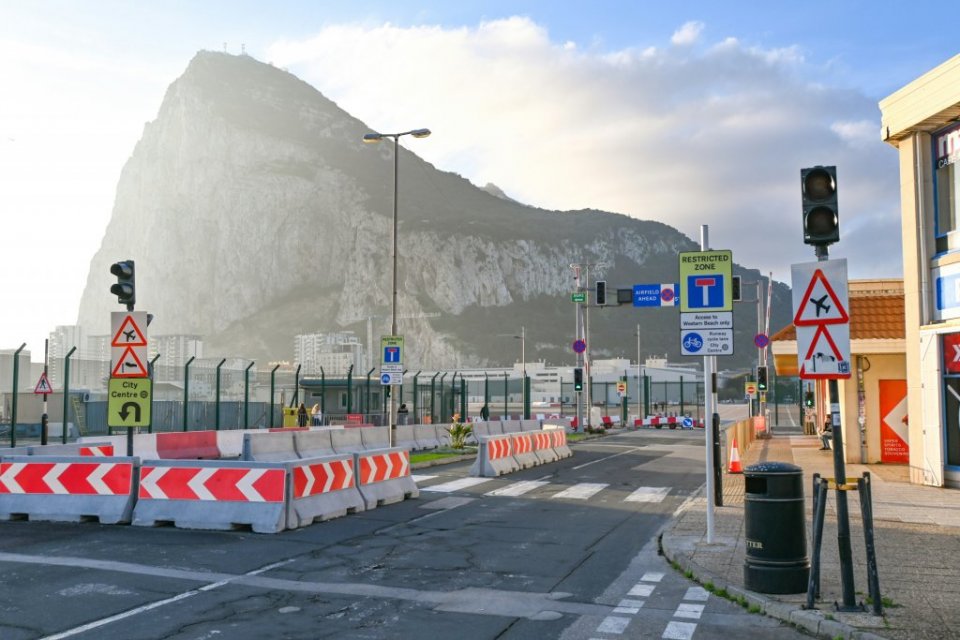
Thousands of people who cross daily between Spain and Gibraltar are set to experience a dramatic change from Wednesday as the long-contested frontier enters a new era, with routine land border controls being abolished under a landmark post-Brexit agreement between Britain and the European Union.
The treaty, due to be signed in Brussels on Tuesday before taking provisional effect just after midnight, removes one of Europe’s oldest physical frontiers while leaving the centuries-old sovereignty dispute over Gibraltar unresolved. ALSO READ: Spain, UK and EU agree ‘historic’ post-Brexit Gibraltar deal – full details.
For decades, lengthy queues and passport checks have been a familiar feature at the crossing, particularly during periods of diplomatic tension between Britain and Spain. During rush hour, commuters have frequently faced delays stretching for hours, making the daily journey unpredictable for the estimated 15,000 cross-border workers who travel into Gibraltar from Spain.
The agreement, reached after years of negotiations involving Britain, Spain and the European Union following Brexit, aligns Gibraltar with the rules of Europe’s passport-free Schengen area without making it part of the EU. ALSO READ: Post-Brexit Gibraltar agreement gives Spain new role in border and residency decisions.
Instead of immigration checks at the land frontier, controls for travellers arriving from outside the Schengen area will move to Gibraltar’s airport and port. Passengers arriving by air or sea will first pass through Gibraltar immigration before undergoing checks by Spanish police acting on behalf of the Schengen zone.
The treaty still requires ratification by the European Parliament later this year and includes a one-year opt-out clause.
Workers, businesses and local leaders on both sides of the frontier have welcomed the changes, saying they will end years of uncertainty created by Brexit and remove one of the biggest obstacles to daily life in the region.
Spanish Prime Minister Pedro Sánchez is due to visit the frontier on Wednesday for a ceremony marking what his government has described as the ‘demolition of the fence’, separating Gibraltar from Spain for more than a century.
Sánchez has previously hailed the agreement as bringing down ‘the last wall’ inside the European Union and creating a zone of shared prosperity.
In recent weeks, workers have already dismantled sections of the old chain-link fencing that divided the two territories. Once complete, the former frontier barrier will disappear entirely, replaced by an open strip around 180 metres wide through which pedestrians and vehicles will move freely. The area will be surfaced with different coloured tarmac to indicate where British territory begins. ALSO READ: Gibraltar-Spain border could vanish in early 2026 under post-Brexit deal.
Fabian Picardo, Gibraltar’s Chief Minister, who played a central role in the negotiations, said the agreement represented a profound change after generations of political division.
Reflecting on Gibraltar’s past, shaped by military sieges, dictator Franco’s closure of the frontier and, more recently, five and six-hour border queues during diplomatic disputes, he said: ‘That’s the past. Now you’ve just got to worry about whether the traffic’s bad or not.’
Picardo said the negotiations had evolved beyond simply protecting Gibraltar from the consequences of Brexit.
‘We started trying to negotiate arrangements that would ensure that Gibraltar didn’t suffer as a result of departure from the European Union,’ he said. ‘But during the course of the negotiation … we became a little bit more ambitious than that. We have been able to distil from this process the things that we always wanted when we were in the EU and were not able to have.’
He stressed that the negotiations had always been centred on people’s daily lives.
‘This agreement had to be about people,’ he said, recalling children delayed on their way to football matches, relatives missing birthdays because of border queues and families separated by political decisions.
‘That ability for people to have their human relations uninterrupted by political bureaucracy getting in the way … for me is the big change.’
Picardo has also described the agreement as removing ‘the physical barriers of a bygone era of friction’ while keeping ‘the keys to our own front door’.
Although border checks will disappear, Gibraltar’s government insists security will be strengthened rather than weakened.
Picardo said the territory would become ‘a digital fortress’, with live facial-recognition cameras coming into operation as the treaty takes effect, backed by expanded CCTV coverage, additional police officers and new equipment for police, customs and border officials.
A new security fence has already been built further inside Gibraltar to protect the airport, military facilities and other sensitive sites.
The agreement also leaves one important restriction in place. While people will be able to move freely across the frontier, it will not grant the automatic right to live in Gibraltar.
Picardo said the government had deliberately excluded the EU’s right of establishment and tightened residency rules after applications from prospective residents increased sharply.
‘We’ve protected Gibraltar from an immigration influx from the EU,’ he said.
Business leaders have broadly welcomed the agreement, arguing that the alternative — Gibraltar becoming a hard external Schengen border after Brexit — would have caused severe economic damage. However, Gibraltar will also lose some of the tax advantages that have long underpinned its economy.
Under the treaty, Gibraltar will begin narrowing the gap between its indirect taxation system and that of the European Union by introducing a transaction tax on goods while remaining outside the EU’s VAT system. Alcohol, tobacco and other traditionally low-tax products are expected to become more expensive, while businesses importing goods from outside the EU will have to meet European product standards.
Picardo has rejected suggestions that Gibraltar made significant concessions, arguing that the new transaction tax broadly replaces existing import duties while leaving the territory’s dominant services industries, including insurance and online gaming, largely outside the treaty’s tax provisions.
He also said numerous airlines had already expressed interest in launching flights between Gibraltar and airports within the Schengen area, potentially providing a significant boost for tourism and for British expatriates living across the border in Spain.
The treaty also explicitly states that the rival sovereignty claims of Britain and Spain remain unchanged.
Britain and Spain have disputed ownership of Gibraltar since the strategically important territory was ceded to Britain under the Treaty of Utrecht in 1713.
Enjoying the news from Spain in English? Add us as a preferred news source in Google.
Subscribe to the Weekly Newsletter from Spain in English.
Hoy, el Reino Unido y la Unión Europea firman en Bruselas el Tratado que establece la nueva relación de Gibraltar con la UE, y mañana empieza su aplicación provisional. El embajador @AlexWEllis explica qué significa esta etapa de oportunidades. pic.twitter.com/EvypkGtZn6
— UK in Spain (@ukinspain) July 14, 2026
Esta medianoche desaparece la verja de Gibraltar https://t.co/YG2YEjFBeX pic.twitter.com/ykQmYpbH4A
— RTVE Noticias (@rtvenoticias) July 14, 2026

Click here to get your business activity or services listed on our DIRECTORY.