
LATEST: Death toll from Almeria wildfire reaches 13 after elderly British woman succumbs to her injuries.
After several days of destruction and tragedy, the deadly wildfire that swept through southeastern Spain has been stabilised, allowing around 1,000 evacuated residents to return home as investigators continue the painstaking task of identifying the victims and determining whether anyone else remains missing. ALSO READ: At least 12 dead as devastating wildfire tears through southern Spain during heatwave.
The blaze, which tore through around 6,600 hectares of countryside in the municipalities of Los Gallardos and Bédar in the province of Almeria (Andalusia), has claimed at least 12 lives, making it one of Spain’s deadliest wildfires in recent years and one of the worst environmental and human disasters in eastern Andalusia’s recent history.
Andalusian regional president Juanma Moreno announced on Sunday that firefighters had succeeded in stabilising the blaze after several days of intense operations.
‘Good news. After several very difficult days,’ Moreno wrote on X (see below), confirming that the Infoca wildfire service had declared the fire stabilised and that the emergency had been downgraded, allowing approximately 1,000 remaining evacuees to begin returning home.
Regional emergency chief Antonio Sanz said around 600 of the nearly 1,500 people evacuated had already been allowed back late on Saturday after firefighters made significant progress containing the fire.
‘The attack carried out today and the stabilisation of much of the perimeter have made it possible to adopt these measures and continue moving, always with the utmost caution, toward a return to normality,’ Sanz said.
Improved weather conditions, including lighter winds and higher humidity, enabled firefighters to mount a direct assault on the flames, which had previously spread at speeds of up to 100 metres per minute through steep valleys, ravines, woodland and dry riverbeds.
Although Moreno described the blaze as fully contained, he stressed that hundreds of firefighters and emergency personnel would remain at the scene until it was completely under control.
Prime Minister Pedro Sánchez is due to visit the devastated area on Monday.
Victims still being identified
While the fire has now been stabilised, uncertainty remains over the final human toll.
Authorities have kept the confirmed death toll at 12 but say the number of missing people remains unclear until all recovered bodies have been identified and outstanding missing persons reports investigated.
The Guardia Civil planned a final search of the affected area on Sunday after already checking more than 250 homes.
‘The Guardia Civil has entered more than 250 homes to verify that no one was inside, and it will now carry out one final sweep of the area to make a complete check that no one else remains,’ Virginia Barcones, secretary-general for Civil Protection, told Spain’s public broadcaster.
Officials say seven formal missing persons reports have been filed, although initial estimates had suggested as many as 23 people could have been unaccounted for in the chaotic aftermath of the fire.
Identification of the victims has also proved exceptionally difficult.
Post-mortem examinations carried out in Almeria failed to establish even the age or sex of the deceased because of the severity of the burns. Biological samples have been flown by Guardia Civil helicopter to a specialist forensic laboratory in Madrid for DNA analysis.
Authorities say the process is expected to take time because many relatives are travelling from overseas to provide DNA samples.
Regional officials believe 11 of the 12 victims are likely to be foreign nationals, probably British and Belgian citizens, although no formal identifications have yet been announced. Officials have declined to comment on reports that three of the victims may have been minors.
Four people suffering severe burns remain in hospital in Seville, including a British woman. A British couple on holiday in Almeria were also rescued from a ravine after being found semi-conscious with burns covering around 40% of their bodies after apparently becoming trapped while hiking.
Fatal escape attempts
Investigators believe many of those who died became trapped while attempting to escape as the fire rapidly surrounded their homes.
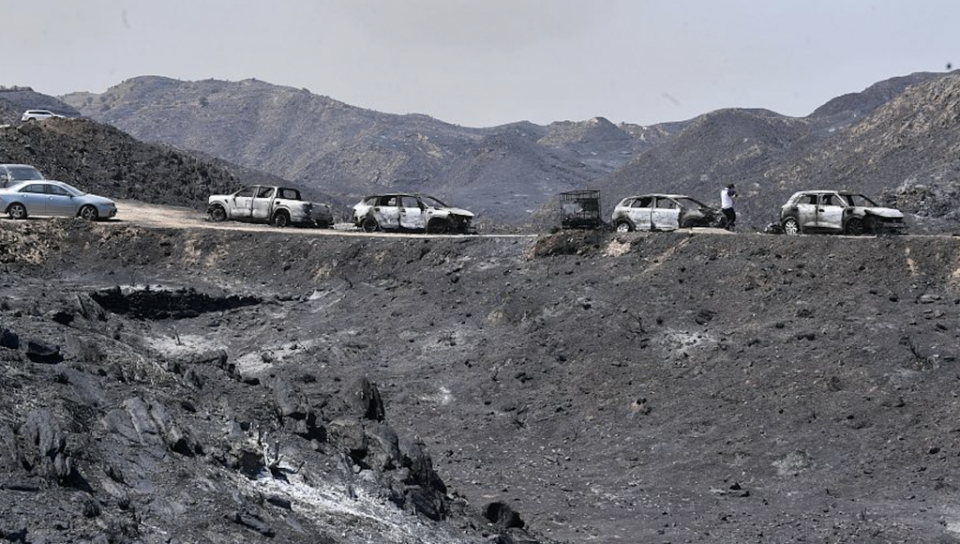
Burned-out vehicles remain scattered along roads and tracks where residents were caught as flames advanced.
The investigation has focused on six cars and a motorcycle abandoned on a hillside dirt track near Bédar after residents apparently attempted to flee along a dead-end route rather than the officially designated evacuation road.
One of the vehicles, a right-hand-drive Honda Accord carrying Spanish registration plates, contained the bodies of four people believed to be British nationals. Eight other victims were found nearby, many after abandoning their vehicles and trying to escape on foot.
Photographs showed several vehicles reduced to skeletal shells, while one appeared to have attempted to turn around after reaching a wall of flames.
Antonio Sanz said emergency services believe some victims unintentionally drove into what became a fatal trap.
‘Unfortunately, the decision to take a different route than the evacuation route and seek their own exit through a dry riverbed was a real trap chosen by the people who ultimately died,’ he said.
Bédar mayor Ángel Francisco Collado Fernández also said one resident had urged neighbours to remain inside his home.
‘Fortunately one of those who decided to stay is still alive, recommending that the other nine neighbours take refuge in his home.
‘They didn’t take his advice and seven died and the other two suffered serious burns and are on their way to the Virgen del Rocío Hospital in Seville.’
Moreno had also repeated appeals for residents to follow official evacuation instructions.
‘Please always follow the authorities’ recommendations,’ he said, ‘because in this type of fire, the wind changes so the fire might come at you from the south and then it might shift in another direction.’
Reuters investigation raises questions
However, some relatives of the victims have challenged the authorities’ account of what happened.
According to a Reuters report on Sunday, Thomas-Wolf Verdonckt, the son of 63-year-old Belgian businessman Stanislas Verdonckt, disputes claims that his father and others ignored official instructions.
Verdonckt told Reuters that he spoke to his father by telephone shortly before 9pm on the evening of the fire after flames approached the area where he lived outside Bédar.
‘The people who died did not fail to follow any orders because no orders were given. No information was provided,’ Verdonckt said. ‘They only started to run when the flames were almost upon them. That was their absolute last resort.’
According to Verdonckt, a group of neighbours first tried to escape using the main road but found it already blocked by flames before attempting a second route along a dead-end dirt track.
‘They couldn’t get through via the main road because they were not warned in advance. Nobody told them that the fire was coming from that direction, and when they tried to get out, it was too late,’ he said.
‘It was not a choice. They drove to the end of the trail, and when even that was in flames, some people chose to run and try to get into the valley.’
Verdonckt described his father as an experienced hiker who knew the local terrain well and remained calm during their final conversation.
Authorities have previously said police officers and local officials either visited homes or telephoned residents with evacuation or shelter-in-place instructions depending on how the rapidly changing fire was moving. The Andalusian regional government and Spain’s Guardia Civil did not immediately respond to Reuters’ request for comment on Verdonckt’s account.
Suspected cause
Investigators believe the fire may have started at around 4.35pm on Thursday near kilometre 511 of the N-340A road after a high-voltage power line apparently fell to the ground.
Witnesses reported seeing the line ignite tinder-dry vegetation as temperatures exceeded 40C and strong winds rapidly spread the flames through woodland and rural communities.
The suspected cause has not yet been officially confirmed and remains under investigation.
Enjoying the news from Spain in English? Add us as a preferred news source in Google.
Subscribe to the Weekly Newsletter from Spain in English.
🔸Noticias de Andalucía desde el Incendio de Los Gallardos
🔸Tras conocer la última hora de los desalojados trasladamos nuestro informativo al pie de la noticia en el acceso a Bédar donde en las próximas horas comenzarán a regresar sus vecinos pic.twitter.com/O2OKUeSs2P
— RTVEAndalucía (@RTVEAndalucia) July 12, 2026
Hoy reina el optimismo tras la estabilización del #IFLosGallardos. Los vecinos podrán volver pronto a sus casas.
Informa @lourdesmaldonad pic.twitter.com/8xm6cTIWMZ
— Telediarios de TVE (@telediario_tve) July 12, 2026
Buenas noticias en el #IFLosGallardos #Almería.
El intenso trabajo de todos los operativos nos permite que 600 de las 1.600 personas evacuadas puedan regresar ya a sus hogares.
Además, se levanta el confinamiento de Lubrín y todas las personas que aún permanecen evacuadas han… pic.twitter.com/MgngqNpdzL
— Antonio Sanz Cabello (@antoniosanz) July 11, 2026
🔴 Buenas noticias. Tras días muy duros, el @Plan_INFOCA da por estabilizado el #IFLosGallardos.
El incendio está perimetrado y acotado. Por tanto, desescalamos a situación operativa 1 y se autoriza el regreso paulatino de las 1.000 personas que permanecían desalojadas.
El…
— Juanma Moreno (@JuanMa_Moreno) July 12, 2026

Click here to get your business activity or services listed on our DIRECTORY.