
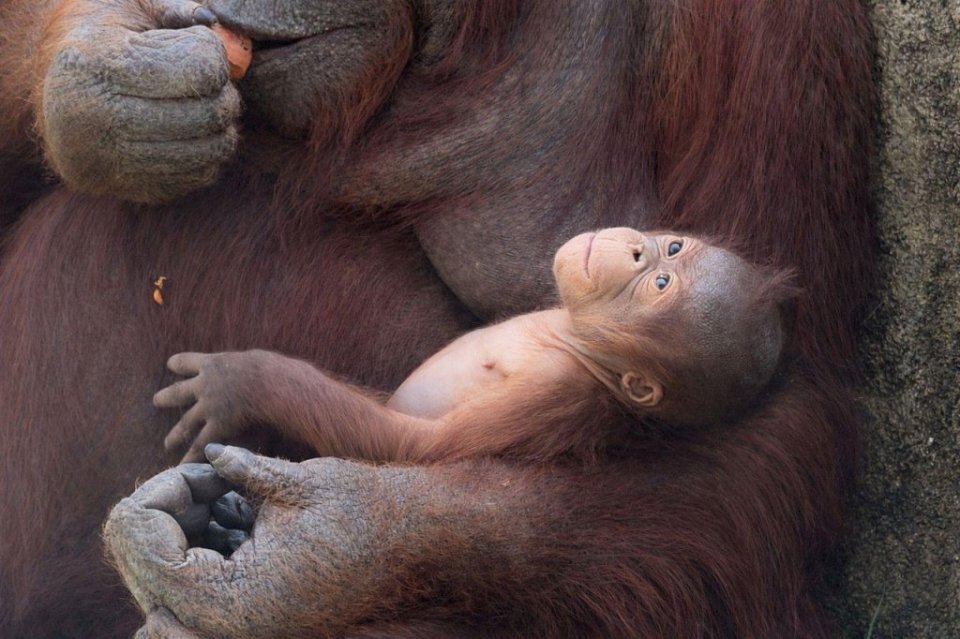
Madrid’s zoo has announced the birth of a critically endangered Bornean orangutan, in what conservationists describe as a significant boost for efforts to protect one of the world’s most threatened primates.
The male was born in the early hours of 2 April after an eight-and-a-half-month pregnancy, weighing around 1.5 kg. Keepers at the Zoo Aquarium de Madrid say the newborn is developing well, feeding regularly and showing healthy early signs.
The baby remains in constant contact with his mother, Surya, who is caring for her fourth offspring. Staff have praised her behaviour since birth, highlighting her attentiveness and experience.
‘When the baby is nursing, everything stops. She stays completely still until he finishes, and only then moves to eat or do anything else. She is a real supermom,’ said Maica Espinosa, a primate keeper at the zoo.
As is tradition at the zoo, the newborn’s name will begin with the letter ‘S’, matching his mother’s, with the public set to help choose it through an online vote in the coming days.
In these early weeks, the infant’s life revolves around feeding and sleeping, clinging tightly to Surya’s fur. Keepers have already noted strong grasping reflexes — an essential survival trait for a species that spends almost its entire life in the treetops. Over the coming months, the youngster will begin to explore solid foods such as fruit and vegetables as its teeth develop.
The newborn joins a family group that includes his father Dahi and siblings Sabah and Sinar, as well as nearby gibbons sharing the enclosure. His arrival has already sparked curiosity among the group, subtly shifting the social dynamic.
Bornean orangutans (Pongo pygmaeus) are fully arboreal and move through forests by brachiation, swinging between branches using their long arms. They build nests high in the canopy and rely on extended learning from their mothers, a process that can last up to eight years.
The birth carries particular importance given the species’ precarious status. Classified as Critically Endangered by the International Union for Conservation of Nature, Bornean orangutans have seen their population collapse by around 60% in recent decades. Their rainforest habitat continues to shrink rapidly — by an estimated 2.5 million hectares annually — largely due to palm oil expansion, poaching and illegal wildlife trade.
With females typically giving birth only once every six to eight years, each new arrival is considered vital. The Madrid birth forms part of the European Endangered Species Programme (EEP), aimed at maintaining a genetically diverse population in captivity.
Zoo officials stress the wider significance of the event beyond its local appeal. ‘Every birth is a genetic success,’ they said, noting collaboration with international conservation groups such as Hutan to protect habitats in the wild.
For now, however, the focus remains on the tiny newcomer — clinging to his mother, largely asleep, and representing a rare moment of hope for a species under growing threat.
Enjoying the news from Spain in English? Add us as a preferred news source in Google.
Subscribe to the Weekly Newsletter from Spain in English.

Click here to get your business activity or services listed on our DIRECTORY.