
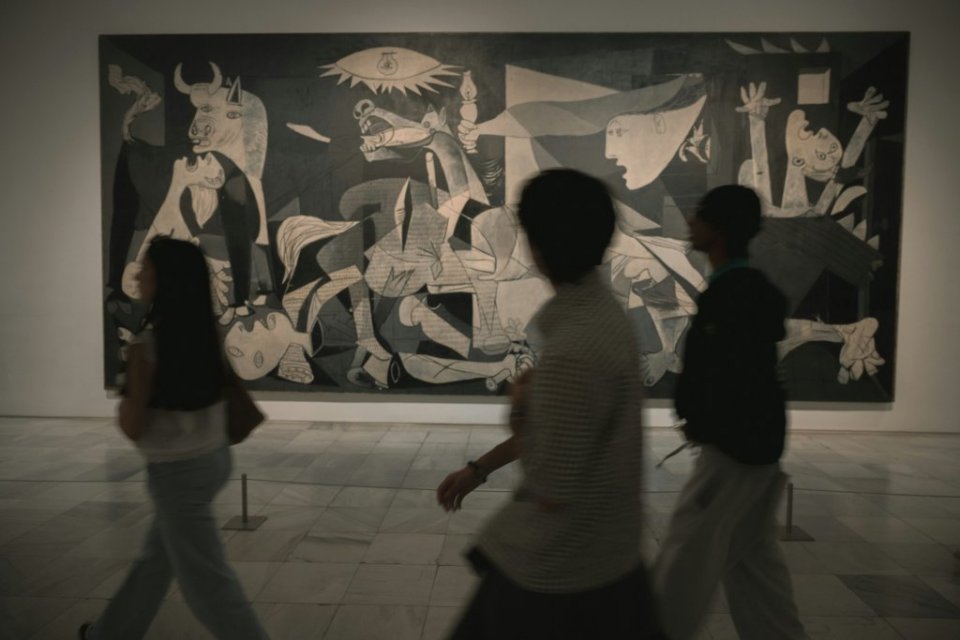
A growing political and cultural dispute has erupted in Spain over whether Pablo Picasso’s iconic anti-war painting Guernica should be temporarily moved from Madrid to the Basque city of Bilbao, with regional leaders, national authorities and museum experts sharply divided over the issue.
The debate was reignited after the Basque regional government formally requested that the masterpiece be loaned from Madrid’s Reina Sofía Museum to the Guggenheim Museum in Bilbao for a nine-month exhibition between October 2026 and June 2027. The proposed transfer would coincide with the 90th anniversary of both the bombing of the town of Guernica in 1937 and the creation of the first Basque government.
Basque leader Imanol Pradales has framed the request as a matter of historical recognition and justice, describing it as ‘a gesture of historical memory and symbolic reparation towards the Basque people’. Regional authorities argue that the painting – created in response to the Nazi and fascist bombing of Guernica during the Spanish Civil War -holds deep symbolic significance for the Basque Country.
According to Spanish media citing Basque government sources, the move would be ‘a symbolic and political reparation, not only to the Basque people, but also a message to the world’.
However, Spain’s Culture Ministry and the Reina Sofía Museum have firmly rejected the proposal, citing serious conservation risks. A newly published 16-page technical report by the museum’s Conservation-Restoration Department ‘categorically’ advises against any transfer, pointing to the fragile condition of the nearly eight-metre-long canvas.
The report details numerous structural issues, including cracks, micro-cracks, loss of polychromy and areas of missing paint. Much of this damage stems from the painting’s history: Guernica travelled extensively after its creation in 1937, undergoing more than 30 journeys – many of which required it to be rolled up – before finally arriving in Spain from New York in 1981 after decades at the Museum of Modern Art (MoMA).
Experts warn that moving the artwork again could have serious consequences. ‘Vibrations could generate new cracks, lifting and loss of the pictorial layer, as well as tears in the support,’ the report states, adding that the painting ‘cannot be rolled up’ and must remain upright under tightly controlled environmental conditions.
The Culture Ministry has echoed this stance, stressing its responsibility to safeguard national heritage. ‘We work to improve the accessibility of culture and therefore welcome the mobility of art. But as the Ministry of Culture, we also have a duty to preserve our heritage, and experts have always advised against moving Guernica due to its delicate state of conservation, as it is already badly damaged,’ said Culture Minister Ernest Urtasun’s team.
Despite this, Basque officials insist their request has been misunderstood. They say they were not seeking confirmation of the painting’s condition, but rather an assessment of the technical and logistical requirements needed to make a transfer possible.
‘We didn’t request a report on the painting’s state of conservation – we already know its condition – but rather a report analysing the conditions under which it would be possible to move it and temporarily relocate it to the Basque Country,’ the Basque executive reiterated. ‘We are still waiting.’
The Basque Country’s regional Culture Minister Ibone Bengoetxea also criticised the response, saying: ‘It would be a serious matter for a formal request from a government to be answered without a serious and in-depth analysis.’ The regional government has offered to cover all costs and proposed setting up a joint technical commission to oversee the operation.
The dispute has quickly taken on a political dimension. Pradales has warned Prime Minister Pedro Sánchez that refusing the request would be ‘a serious political mistake’, raising the stakes at a time when negotiations over regional powers between Madrid and the Basque Country are ongoing. His party, the Basque Nationalist Party (EAJ–PNV), plays a key supporting role in Sánchez’s fragile parliamentary coalition.
Meanwhile, opposition politicians have largely sided with the museum’s technical assessment. Madrid’s regional president of the right-wing People’s Party (PP), Isabel Díaz Ayuso, criticised the proposal as misguided, saying: ‘I think it’s a parochial attitude, and I believe that culture is universal.’
She added that relocating artworks based on origin could set a problematic precedent, remarking that by the same logic, Picasso’s works might be moved to Málaga (Andalusia), his birthplace.
Other senior figures from the PP have also backed the refusal, though in more measured terms. Juan Bravo, the party’s Deputy Secretary for Finance, Housing and Infrastructure, said: ‘We believe the controversy is largely pointless. If the technical reports allowed for the relocation, we wouldn’t consider it a bad idea, but given the warnings about potential damage, we believe a temporary transfer shouldn’t even be considered. In any case, we completely disagree with the idea of the transfer as an act of reparation.’
Within the socialist party (PSOE), opinions are more nuanced. The Basque branch of the party has rejected the notion that the transfer should serve as reparation, stating: ‘It is not appropriate to open a new chapter regarding grievances, and seeking reparations or apologies from the Spanish government.’
A spokesperson added that responsibility for the 1937 bombing lies with ‘the Nazi air force, the Italian fascist air force’, and noted that the Spanish government has already recognised Guernica as a site of democratic memory in 2024. ALSO READ: Spain plans 480 more events to ‘celebrate recovery of democracy’ following Franco’s death 50 years ago.
The issue was also debated in Spain’s Senate House on Tuesday, where Basque lawmakers pressed Culture Minister Urtasun to publicly explain the government’s position.
‘The technical reports are clear: they categorically advise against the transfer,’ he said.
The Reina Sofía’s consistent refusal to loan Guernica is not new. Over the years, it has rejected requests from institutions including New York’s MoMA in 2000, Canada’s Royal Ontario Museum in 2006, and even previous appeals from the Basque government, as well as proposals from Japan and South Korea. The museum maintains that the painting falls outside its loan policy under any circumstances.
Yet this latest request carries particular weight due to its historical symbolism. Even the mayor of the town of Guernica, José María Gorroño, has entered the debate, arguing that if the painting were ever to be moved, it should be displayed in Guernica itself rather than Bilbao.
As the political and cultural tensions intensify, the Spanish government now faces mounting pressure to balance regional demands, national heritage concerns and the expert warnings that moving one of the world’s most famous paintings could put its survival at risk.
Enjoying the news from Spain in English? Add us as a preferred news source in Google.
Subscribe to the Weekly Newsletter from Spain in English.
El debate sobre el traslado del Guernica de Picasso se cuela en la sesión de control al Gobierno en el Senado. #Canal24Horas
— RTVE Noticias (@rtvenoticias) April 7, 2026
▶️ https://t.co/wIMPtOs0Wj pic.twitter.com/LsWIL0gNll

çClick here to get your business activity or services listed on our DIRECTORY.