
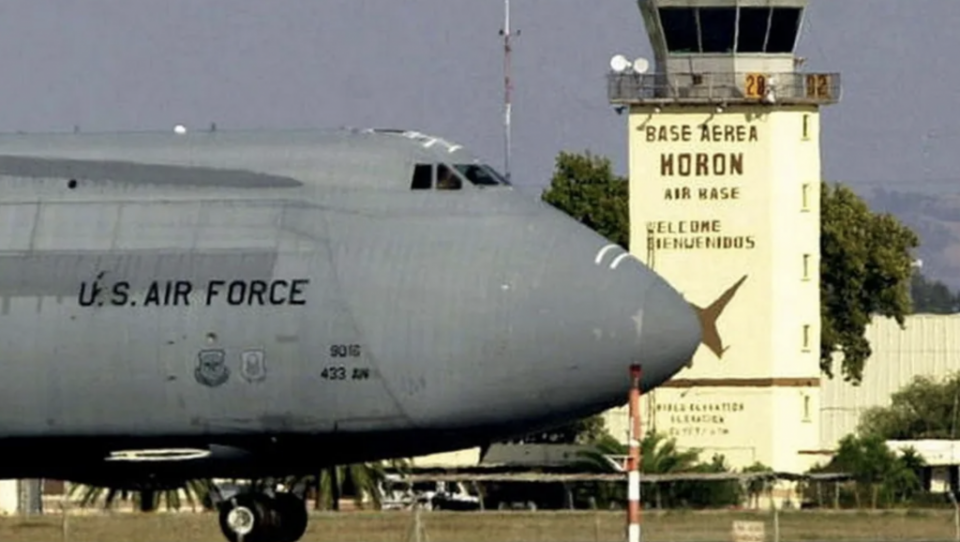
Spain has formally banned the use of its airspace and key military bases for any operations linked to the US and Israel-led offensive against Iran, according to a report by El País citing military sources.
Not only has it refused to allow the use of the bases at Rota (Cádiz) and Morón de la Frontera (Seville) for combat aircraft or aerial refuelling planes participating in the attacks, it has also denied US aircraft stationed in countries such as the United Kingdom or France to fly over Spanish territory, according to the El País report.
Prime Minister Pedro Sánchez had signalled this stance last Wednesday during a session in the Spanish Congress, although his remarks went largely unnoticed amid the political uproar, the paper reported. ALSO READ: Pedro Sánchez responds to Donald Trump: ‘No to war’.
‘We have denied the United States the use of the Rota and Morón bases for this illegal war. All flight plans involving actions related to the operation in Iran have been rejected — all of them, including those of refuelling aircraft,’ he said. ALSO READ: Pedro Sánchez: Middle East conflict ‘much worse’ than 2003 invasion of Iraq.
In practice, this means that overflights by bombers or tanker aircraft involved in the operation are not being authorised.
Despite the ban, Spain continues to allow routine US military activity under its bilateral defence agreement, including logistical support for American forces in Europe. US naval vessels based in Rota have also played a defensive role in the conflict, while Spain has contributed to NATO operations in countries such as Turkey and Cyprus. ALSO READ: Spain to send frigate to Cyprus to ‘offer protection’ and ‘support any evacuation of civilians’.
According to El País, the decision follows weeks of negotiations with Washington, during which Spain rejected requests that could have drawn it more directly into the conflict — including the deployment of US bombers or the use of Spanish-based tanker aircraft to support strikes. ALSO READ: Spain rejects participating in military operations in Strait of Hormuz, urges de-escalation.
The stance has complicated US operations in Europe and reflects what analysts describe as a carefully balanced position: rejecting involvement in what Madrid considers an unlawful war, while maintaining its commitments to NATO and European allies. ALSO READ: Pedro Sánchez urges ‘loyal cooperation’ not ‘confrontation’ with US amid tensions over Iran war.
El País reported that in the weeks leading up to the 28 February attack on Iran, intense negotiations took place between Madrid and Washington over Spain’s role in the US military deployment. The Pentagon positioned around 15 KC-135 Stratotanker aircraft at Rota and Morón to support what was initially described as a show of force aimed at pressuring Iran in negotiations held in Oman and Geneva, in the hope of dismantling its nuclear and missile programmes without resorting to war.
Within this framework, Washington sounded out Spanish officials on the possibility of deploying B-52H Stratofortress and B-1B Lancer bombers to Spanish bases. According to the US side, these would not have been used for direct attacks on Iran but as a rapid-response force in case Iranian forces targeted NATO or allied installations — potentially destroying missile silos and launch systems in a second wave.
Although Morón has previously hosted both aircraft types for exercises — and has the facilities to do so — Spain made clear it could not support an operation lacking a basis in international law or backing from multilateral organisations such as the UN, NATO or the EU. The proposal was therefore withdrawn before any formal request was submitted. ALSO READ: US military aircraft leave Spain after government prohibits use of bases for Iran attacks.
Spain’s refusal also had further implications: it barred the tanker aircraft already stationed in Spain from refuelling bombers in flight — a critical element for extending their operational range. As a result, around 15 KC-135 aircraft left Spain over the weekend of 28 February and March 1, redeploying to countries such as France and Germany. ALSO READ: Spain unveils €5bn emergency package to offset energy shock from Middle East conflict.
Enjoying the news from Spain in English? Add us as a preferred news source in Google.
Subscribe to the Weekly Newsletter from Spain in English.
🔴España cierra su espacio aéreo a los vuelos de la guerra de Irán https://t.co/HHkPy9MASN
— EL PAÍS (@el_pais) March 30, 2026

Click here to get your business activity or services listed on our DIRECTORY.