
Antonio Tejero Molina, the former Spanish Civil Guard lieutenant colonel who led the failed military coup of 23 February 1981, has died at the age of 93, his family’s lawyer said on Wednesday.
Tejero died on Wednesday evening in the eastern Spanish town of Alzira (Valencia), according to a statement from the Madrid-based law firm A. Cañizares Abogados, which represents his family. The firm said he died ‘peacefully, surrounded by his entire family and after receiving the holy sacraments’.
His death came on the same day that the Spanish government released a trove of previously classified documents relating to the 1981 coup attempt — one of the most dramatic episodes in the country’s modern history.
‘Lieutenant Colonel Don Antonio Tejero Molina has passed away. A man of honour, unwavering faith, and great love for Spain. May God grant him the peace that men denied him,’ wrote his family’s lawyer, Luis Felipe Utrera Molina, in a post on X.
Born on 30 April 1932, in Alhaurín el Grande, near the southern city of Málaga (Andalusia), Tejero’s early childhood was shaped by the 1936–1939 Spanish Civil War, which ushered in nearly four decades of authoritarian rule under Gen. Francisco Franco. He spent his entire adult working life in the Guardia Civil, Spain’s military police force.
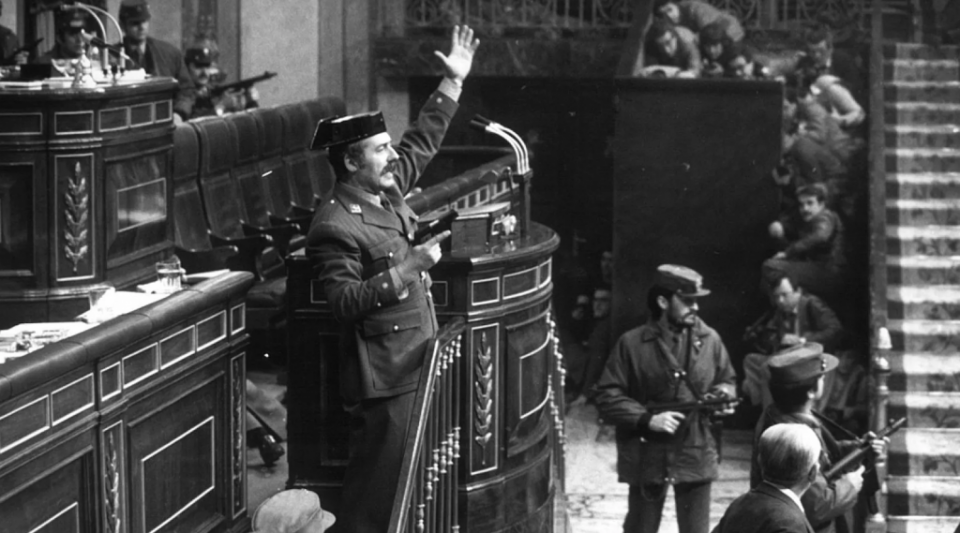
Spain’s fragile democracy was thrust into crisis on 23 February 1981 — six years after Franco’s death — when Tejero led around 200 armed civil guards into parliament, interrupting a vote to confirm Leopoldo Calvo-Sotelo as prime minister.
Wearing the Guadia Civil’s patent leather tricorn hat and waving a pistol, he bellowed ‘Silence, everyone!’ and ‘Everyone, freeze!’ as MPs and ministers were held at gunpoint for almost 24 hours.
Television cameras captured parts of the dramatic siege, etching the images into Spain’s collective memory: officers firing shots into the ceiling, MPs diving for cover beneath their desks, and bullet holes that remain visible to this day.
The coup attempt was widely seen as the most serious attempt to derail Spain’s transition to democracy following Franco’s death. It ultimately collapsed after former king Juan Carlos I appeared on television to denounce the uprising and order the armed forces to remain loyal to the constitution.
Although the coup failed, its aftermath became a defining moment in Spanish political history. Writer Javier Cercas, whose book Anatomy of an Instant chronicles the events, later described it as ‘the founding myth of Spanish democracy’.
Tejero had already been linked to an earlier failed conspiracy, known as Operation Galaxy, in November 1978, for which he was sentenced to seven months in prison. For his role in the 1981 coup, he was convicted of military rebellion, expelled from the Guardia Civil, stripped of his rank, and sentenced to 30 years in prison. He ultimately served about half that sentence before being released on parole in December 1996.
During his trial, Tejero defended his actions, arguing that, ‘At the start of 1981, the situation in Spain … was worse than in 1936’, when rebel troops overthrew the elected republican government. Press reports at the time said he maintained that, if given the chance, he would ‘do the same again’.
While incarcerated, Tejero even sought to enter politics, standing as a candidate for the Spanish Solidarity far-right party in the 1982 elections. The party failed to win a single seat — sparing him the irony of sitting beneath the bullet holes he had fired into parliament’s ceiling.
He also took up painting in prison, producing nearly 300 artworks, according to El País. After his release, he continued painting, at one point reportedly selling canvases to supporters for up to €2,400, before prices later fell to around €600, El Mundo reported in 2016.
Fiercely protective of his privacy, Tejero largely avoided the media and never published memoirs. Speaking from prison in an interview with journalist Pilar Urbano, who had been in parliament’s press gallery during the coup, he said: ‘I did what I thought I had to do to save Spain.’
‘I am no longer a colonel, nor a member of the Guardia Civil. I have lost my career but I will never lose my patriotism,’ Urbano quoted him as saying.
After his release, Tejero divided his time between his native Málaga and Madrid. His death closes the chapter on one of the most recognisable — and divisive — figures of Spain’s post-dictatorship history.
Subscribe to the Weekly Newsletter from Spain in English.

Please support us with a donation.
Click here to get your business activity or services listed on our DIRECTORY.