
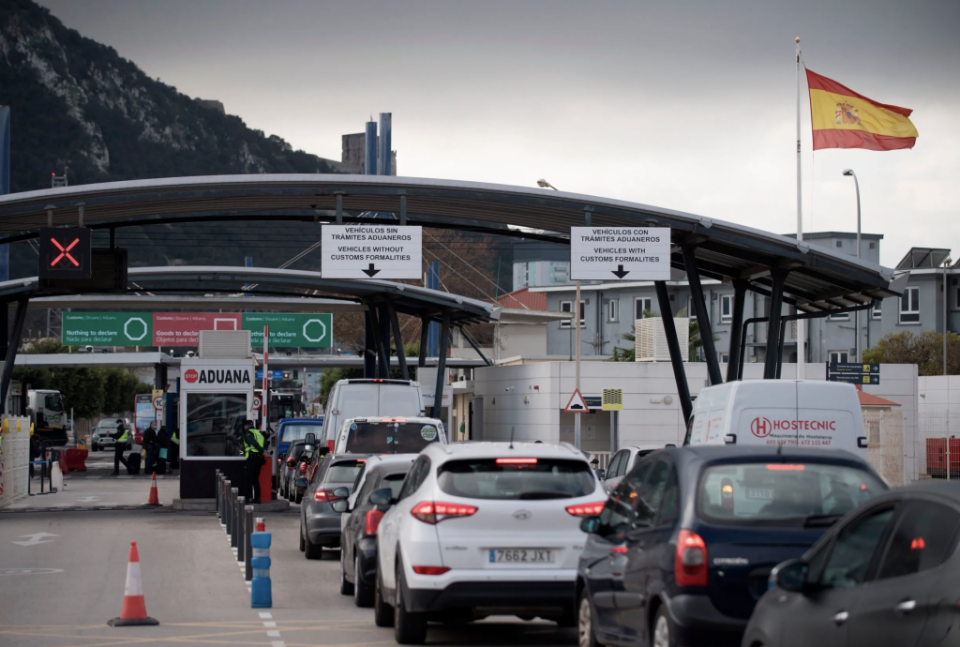
Spain will gain the authority to block British travellers from entering Gibraltar and to deny residency permits on security-related grounds under a post-Brexit treaty that seeks to redefine the territory’s relationship with the EU.
The agreement, which runs to 336 articles and 46 annexes and was published in English on Thursday, brings to an end nearly 10 years of uncertainty for the British overseas territory. Under its provisions, Spanish authorities will have the power to refuse entry to travellers from outside the EU who are judged to pose risks to security, public health or international relations.
Checks at Gibraltar’s airport and port will be carried out jointly by Spanish and British officials and police, effectively removing the need for controls at the land frontier. As part of the arrangement, the barbed-wire fence that has separated Gibraltar from Spain for more than a century will be dismantled.
Granting Spain responsibility for entry and residency checks has drawn criticism from British conservatives, who argue that it represents a dilution of UK sovereignty.
Although the treaty is based on a political agreement reached in June last year, it must still be ratified by the parliaments in Gibraltar and the UK. ALSO READ: Gibraltar-Spain border could vanish in early 2026 under post-Brexit deal.
Spain will not submit the text to its national parliament; instead, approval will be sought from the European parliament in Brussels. Should ratification not be completed before 10 April — the planned date for opening the land border — the treaty may be applied on a provisional basis.
Earlier rounds of negotiations had stalled over issues including the status of Gibraltar’s airport, which also functions as an RAF base.
Under the agreement, Gibraltar will also bring an end to its VAT-free regime, a long-standing demand of Madrid. Spain has repeatedly argued that Gibraltar’s lower taxes distorted the Spanish economy and encouraged smuggling, particularly of cigarettes.
In place of VAT, a new import levy described as a ‘transaction tax’ will be introduced. This will be set at a rate equivalent to EU VAT, starting at 15% and rising to 17% by 2029.
Gibraltar’s constitutional status — under British control since the 18th century — and the policing of its border with Spain have remained contentious ever since the UK voted to leave the EU in 2016.
The treaty would, in practice, integrate Gibraltar into the EU’s Schengen free-travel area, allowing for a fluid land border while introducing dual control checks for air arrivals at Gibraltar airport, overseen by both Gibraltar and Spanish officials.
While Spanish officials carrying out Schengen checks will not be able to refuse entry to Gibraltar residents, they will have that authority over non-resident third-country nationals, including British citizens who do not live in Gibraltar.
The agreement does not apply to British armed forces personnel or visitors to the RAF base. However, Mark Francois, the shadow armed forces minister, criticised the airport arrangements as ‘strategically barmy’.
‘Labour are rapidly running out of runways to give away,’ he said, following the government’s proposal to transfer sovereignty of the Chagos Islands — home to a joint US-UK air base — to Mauritius.
British and Gibraltar authorities will not have direct access to Schengen information systems or databases. Instead, they will provide advance passenger information for flights arriving in Spain from outside the EU, including from the UK.
The ferry service linking Gibraltar with Morocco will be discontinued, and cruise ships will be required to dock at a Schengen port before entering Gibraltar, ensuring passengers are checked in advance.
Anyone refused entry or residency by Spain will have the right to appeal to the Spanish authorities, who must issue a decision within 28 days, extendable to 42 days.
The deal will allow Gibraltarians and residents to travel freely within the Schengen area, subject to the standard limit of 90 days in any six-month period.
Spanish media reports have noted that the treaty permits Spain to exercise executive functions over Gibraltar’s infrastructure. However, according to El Confidencial, the text explicitly states that nothing agreed ‘shall constitute the basis for any assertion or denial of sovereignty’ by either the UK or Spain.
The reports added that Spain would be able to approve or reject entry into the Schengen area regardless of British decisions and ‘to carry out arrests and other coercive measures it deems necessary in the interests of its security’.
New customs clearance facilities will be established at three locations in Spain — Sagunto, Algeciras and La Linea — and one in Portugal. Goods entering Gibraltar will be required to meet EU standards, including labelling requirements.
Within Gibraltar itself, there remains uncertainty about the impact of removing the border, which many residents have viewed as both a source of tax advantages and a defining symbol of the territory’s separation from Spain.
At a meeting of business leaders last week, concerns were palpable. The Gibraltar Chronicle reported that the Gibraltar Federation of Small Businesses and the Chamber of Commerce summed up the mood in three words: ‘Frustration. Worry. Anger’.’
Stephen Doughty, a Foreign Office minister, said the treaty ‘ensures that Gibraltar’s economy, people and future are protected as an integral part of the British family’. He stressed that no final agreement would be reached without Gibraltar’s consent and added: ‘The UK’s commitment to Gibraltar will never falter.’
Wendy Morton, his shadow counterpart, argued that sovereignty was ‘not simply about words, it is about how arrangements operate in practice’, and questioned how Gibraltar and the UK would avoid ‘becoming subject to ongoing EU rule-taking without meaningful political control’.
Fabian Picardo, Gibraltar’s Chief Minister, said: ‘This is a safe and secure agreement we have negotiated alongside the UK and that unequivocally protects our position on sovereignty, safeguards our economy and delivers the certainty our people and businesses need.’
Keith Azopardi, the territory’s opposition leader, described the publication of the treaty text as a ‘seminal’ moment. However, he cautioned that its advantages would need to be balanced against the risks created by concessions already made before his party adopts a formal position.
While welcoming the expanded freedom of movement for residents, he warned that it came at the cost of the ‘cession of powers and information and a number of economic levers to the EU and Spain. That includes powers to Spanish law enforcement agencies in different guises’.
Subscribe to the Weekly Newsletter from Spain in English.
The text of the historic treaty on Gibraltar is now public https://t.co/OZK9q6OrP2
— Embassy of Spain UK (@EmbSpainUK) February 26, 2026
The treaty opens a new era of coexistence and future for Campo de Gibraltar, Andalusia, Spain and Europe. https://t.co/vFf4K2BcW8
The full text of the historic treaty concerning Gibraltar is now available.
— Spain MFA (@SpainMFA) February 26, 2026
A new chapter of coexistence and shared future for the Campo de Gibraltar, Andalusia, Spain and Europe.https://t.co/OoTldmA5XC
Key points 🧵 pic.twitter.com/RUVGv1kJJ5
Actually @nigelmp, this was a proposal agreed by Boris Johnson as Prime Minister, Dominic Raab, Liz Truss, James Cleverly and David Cameron as Foreign Secretaries. These parts had been negotiated and agreed BEFORE David Lammy and Keir Starmer had been elected. This is an… https://t.co/NYih8x64wv
— Fabian Picardo (@FabianPicardo) February 26, 2026

Please support us with a donation.
Click here to get your business activity or services listed on our DIRECTORY.