
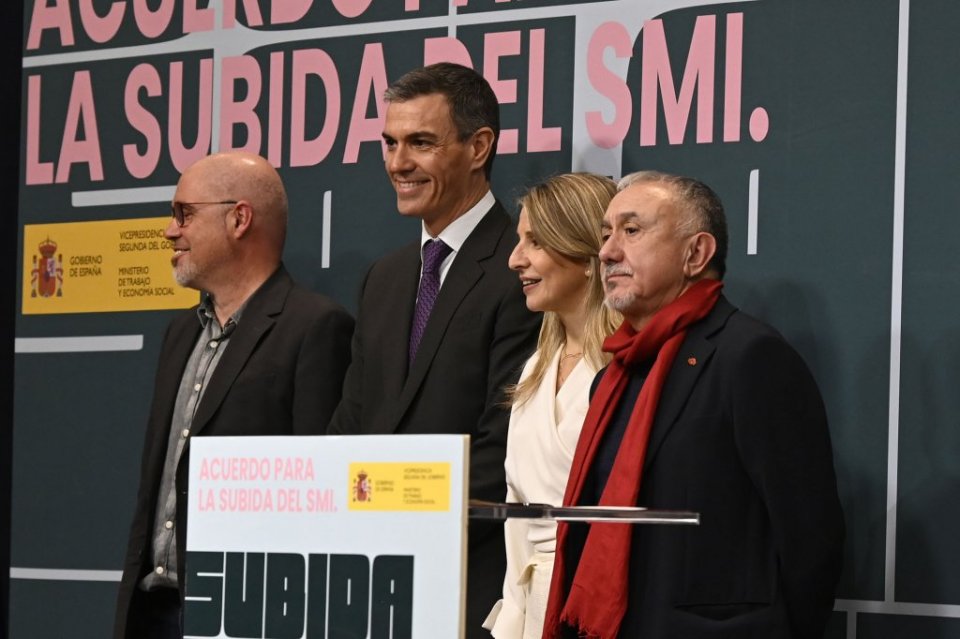
The Spanish Labour Ministry reached an agreement on Monday with the country’s main trade unions to raise the national minimum wage once again.
The 3.1% increase lifts it by €37 to €1,221 gross per month, paid over 14 instalments – 12 monthly payments and two extra ones, as is customary in Spain, typically issued in summer and at Christmas.
When calculated over 12 monthly payslips instead, the increase amounts to €43.16 per month, bringing the minimum wage to €1,424.50 gross per month across the year, or €17,094 gross annually.
The latest rise continues the steady upward trend of the minimum wage in Spain, boosting earnings for the lowest-paid workers and narrowing the gap with the average national salary.
The new SMI – Salario Mínimo Interprofesional, as it is known in Spain – will remain exempt from income tax (IRPF), an issue that had sparked debate following the previous increase.
The agreement was signed by Spain’s second Deputy Prime Minister and Labour Minister Yolanda Díaz, alongside Unai Sordo and Pepe Álvarez, the general secretaries of the major trade unions CCOO and UGT (pictured together with Spanish PM Pedro Sanchez in main image).
According to the Labour Ministry, the wage rise will apply retroactively from 1 January this year and is expected to benefit around 2.5 million workers.
Unlike other labour reforms, the minimum wage increase does not require approval from other political parties in parliament, meaning it should come into force without legislative hurdles.
‘This is the eighth increase in the minimum wage since we came to power,’ Spanish Prime Minister Pedro Sánchez said while celebrating the news.
‘No other country has raised the minimum wage so much. It’s a conscious political decision that can be summarised as follows: work must allow people to live with dignity.’
This marks the sixth consecutive year in which Yolanda Díaz has negotiated the minimum wage exclusively with trade unions, without the involvement of the CEOE and Cepyme employer organisations.
Following the latest 3.1%, Spain’s minimum wage for 2026 stands at €40.70 gross per day for general workers.
Temporary and seasonal workers will be entitled to a minimum of €57.82 per legal working day, while domestic workers must receive at least €9.55 per hour actually worked.
‘Today, we are taking up the mantle of history, once again improving the lives of the working class in this country. I am very proud,’ Díaz said.
‘This government is the government of working people, that is, of the social majority,’ she added. ‘We have put public policies at the service of those who live on their wages, those who fill commuter trains and the metro, those who don’t live off inheritances, and those who are self-made, because they are granddaughters, daughters and mothers of working people.’
The Deputy Prime Minister also urged employers to raise salaries, pointing out that Spain still faces ‘a negative differential of 25 points with the average wages in Europe’.
Subscribe to the Weekly Newsletter from Spain in English.
📈Yolanda Díaz firma con las organizaciones sindicales el Acuerdo de Diálogo social para la subida del SMI.
— Ministerio Trabajo y Economía Social (@empleogob) February 16, 2026
💶Se establecerá en 1.221€ al mes en 14 pagas.
‼️Se impulsará una reforma para que las subidas del SMI no puedan ser absorbidas por los denominados complementos y pluses pic.twitter.com/WhY4UdFVZj
En 2018 el SMI era de 735€. Hoy firmamos un nuevo aumento: hasta 1.221€.
— Pedro Sánchez (@sanchezcastejon) February 16, 2026
Reafirmamos nuestro compromiso de seguir dignificando el trabajo, ampliando derechos y gobernando para la mayoría social.
Porque España avanza cuando avanzan sus trabajadores y trabajadoras. pic.twitter.com/N7Seoa2UMw

Please support us with a donation.
Click here to get your business activity or services listed on our DIRECTORY.