
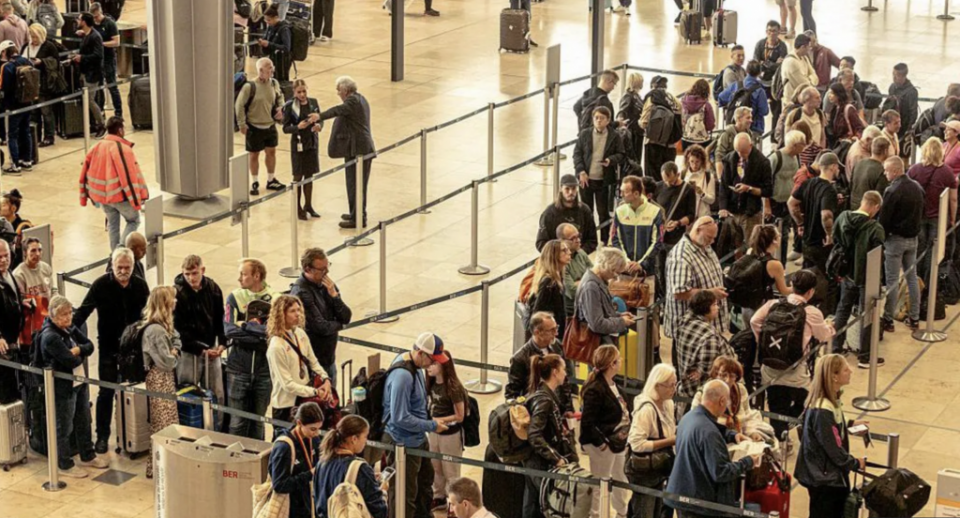
Airlines and airport authorities across Europe have urged EU leaders to urgently reconsider the rollout schedule of the Entry/Exit System (EES), warning that the new border regime could trigger severe disruption during the busy summer travel season.
In a letter addressed to the European Commission, the industry groups cautioned that without swift adjustments, lengthy queues at Schengen border checkpoints are likely.
‘Failing immediate action to provide sufficient flexibility, severe disruptions over the peak summer months are a real prospect, with queues [at Schengen border checks] potentially reaching 4 hours or more,’ they wrote.
The EES – a new EU-wide digital border control system – is being introduced across EU member states, with the exception of Cyprus and Ireland, as well as in the Schengen-associated countries of Iceland, Liechtenstein, Norway and Switzerland.
Under the scheme, third-country nationals entering the Schengen area must provide personal details and biometric data at their first point of entry. This information is stored in a centralised EU database that records every entry and exit, helping authorities enforce the 90/180-day short-stay limit. Over time, the system is intended to replace the traditional manual passport stamp.
On Wednesday, three major aviation organisations – Airports Council International (ACI) Europe, Airlines for Europe (A4E) and the International Air Transport Association (IATA) – formally raised concerns with the EU Commission. They said the EES ‘continues to cause significant delays for passengers’ and pointed to ‘persistent excessive waiting times of up to 2 hours at airport border control’.
According to the groups, the hold-ups stem from ‘chronic border control understaffing, unresolved technology issues, especially with regard to border automation, and the very limited uptake of the Frontex pre-registration app by Schengen states’.
The EU border agency Frontex has created the backend infrastructure for a voluntary self-registration app designed to allow travellers to submit information in advance.
While the app has been offered to Schengen countries, individual governments decide whether and how to deploy it, including developing their own front-end interface. So far, only Sweden has opted to use the tool.
The EES officially came into effect on 12 October 2025, with the aim of gradually increasing the proportion of travellers registered and achieving full operational capacity within six months, by April 2026. ALSO READ: The EU launches Entry/Exit System (EES) biometric border checks.
However, the aviation bodies argue that pressing ahead with mandatory registration for all border crossings during the height of the summer rush – particularly in July and August – could overwhelm border controls.
They warn that ‘unless immediate action is taken to resolve these critical issues, mandatory EES registrations of all border crossings during the peak summer season, in particular in July and August, would result in waiting times of up to 4 hours or more’.
A European Commission spokesperson recently stressed that Schengen member states retain the option of temporarily easing the system’s application during the summer.
‘After the completion of the roll-out, Member States will still be able to partially suspend EES operations where necessary during a period of an additional 90 days with a possible 60-day extension to cover the summer peak,’ Commission spokesperson Markus Lammert said.
Even so, airlines and airports are calling for broader flexibility or a revision of the current timetable.
In a joint statement, industry leaders said: ‘There is a complete disconnect between the perception of the EU institutions that EES is working well, and the reality, which is that non-EU travellers are experiencing massive delays and inconvenience.’
‘We need to be realistic about what will happen during the peak summer months, when traffic at Europe’s airports doubles. The rollout of EES must be flexible to react to operational realities. This is an absolute prerequisite for its success – and for safeguarding the reputation of the EU as an efficient, welcoming and desirable destination,’ they added.

Please support us with a donation.
Click here to get your business activity or services listed on our DIRECTORY.