
ALSO READ: RENFE president: human error ‘practically ruled out’ as cause of high-speed train collision in Andalusia.
At least 40 people have been killed and many others seriously injured after two trains collided in the Andalusian province of Córdoba on Sunday evening.
Over 150 people have been injured, according to Spanish media. 24 of them have ‘critical injuries’, including four children. Juanma Moreno, Andalusia’s regional president, said the death toll was likely to rise.
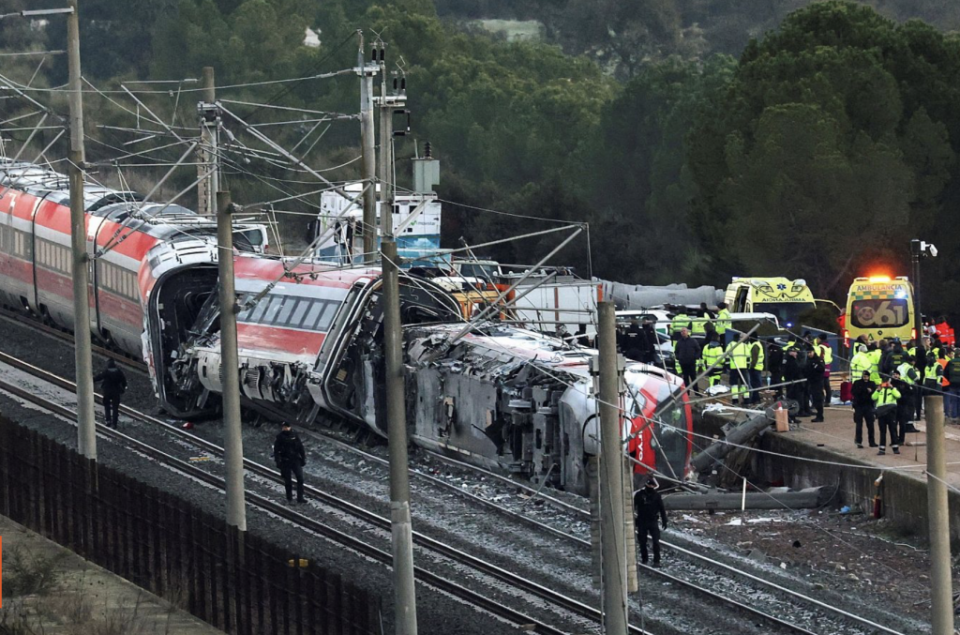
An Iryo train, carrying 317 passengers and travelling from Málaga to Madrid, derailed near Adamuz, crossing onto the other track where it hit an oncoming Alvia (Renfe) train, which also derailed.
The accident happened when carriages 6,7 and 8 of the Iryo 6189 train derailed at around 7.45pm when the train was near Adamuz station, invading the opposite track and colliding with an Alvia 2384 travelling between Madrid and Huelva with around 100 passengers on board. The first train had left Malaga at 6.40pm.
According to witnesses, the Iryo train appeared to be shaking and vibrating just prior to the collision.
Emergency services were at the scene with five mobile ICUs, a logistical support vehicle and four emergency critical care units (ECU). A field hospital was set up at the scene, in Adamuz station.
Trapped passengers sent footage that was broadcast on national television. The images showed a carriage on its side and sections of carriages reduced to twisted metal.
The mayor of Adamuz, Rafael Moreno, arrived at the scene with local police and saw at least one severed body several metres from the point of impact.
‘I saw a passenger torn to shreds,’ he told El País newspaper. ‘We were the first to arrive and there was a body cut in half. But there was no light, it was night-time. The scene is horrific.’
A journalist from RTVE state television, Salvador Jiménez, who was travelling on one of the trains, described how a strong impact that felt like an ‘earthquake’ shook the carriage. Passengers grabbed hammers to open doors and windows and began to leave the train.
Óscar Puente, Spain’s Transport Minister, posted on X: ‘The impact was terrible, causing the first two cars of the Renfe train to be thrown off the tracks.’
Puente also described the accident as ‘extremely strange’. He said it took place ‘on a straight stretch of track’, which had been renewed in May, while the train that first derailed was no more than four years old.
According to Puente, the Alvia train travelling from Madrid to Huelva suffered the worst damage, ‘specifically the two front carriages, where 37 people were travelling in the first and 16 in the second’. Spanish media reported that one of the confirmed fatalities was the driver of the Alvia train.
Spanish Prime Minister Pedro Sánchez said in a post on X: ‘Tonight is a night of profound sorrow for our country due to the tragic train accident in Adamuz. No words can alleviate such great suffering.’
He said he was ‘closely monitoring’ the emergency and confirmed that the central government is working with all the competent authorities and emergency services to help the passengers.
Sánchez had been due to meet on Monday with the leader of the opposition, Alberto Núñez Feijóo, but due to the gravity of events, they cancelled their meeting.
All trains between Madrid and the southern region of Andalusia were cancelled for Monday, affecting thousands of passengers.
Rescue services continued working at the scene on Monday morning. All the injured and the rest of the passengers were evacuated from the scene late on Sunday night.
Renfe has set up the phone number 900 10 10 20 to assist passengers’ families and gather any information.
Iryo has set up the number 900 001 402 for those affected.
Spain’s railway network, one of Europe’s most extensive and technologically advanced, has been hit by serious accidents in past years that have led to scrutiny of safety protocols.
On 24 July 2013, near Santiago de Compostela in Galicia, a train travelling from Madrid to Ferrol left the tracks on a curve at high speed. Official investigations concluded that the train was travelling significantly above the posted limit. Eighty people died and more than 140 were injured in what was one of the worst rail disasters in the country’s history.
🔴 Se elevan a 39 los fallecidos en el accidente de tren en Adamuz https://t.co/MrAxzd2kA6
— RTVE Noticias (@rtvenoticias) January 19, 2026
Subscribe to the Weekly Newsletter from Spain in English.
Click here to get your business activity or services listed on our DIRECTORY.