
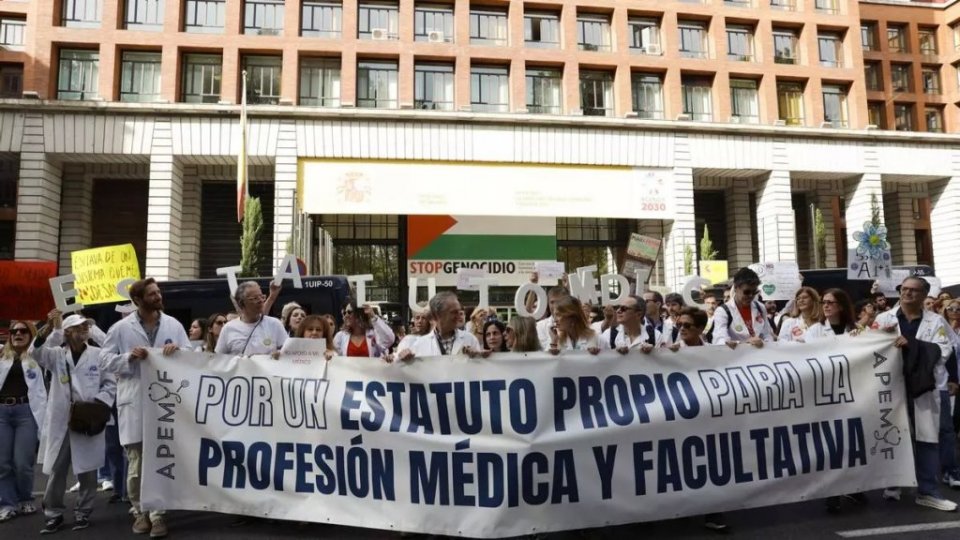
Doctors across Spain started a nationwide strike on Tuesday, with four consecutive days of planned action against the framework statute of the Ministry of Health.
This is the third time they have been on strike this year, following those on 3 October and 13 June.
The stoppage could last up to four days in a row, as doctors push for a statute of their own that recognises the specific nature of their profession.
The action comes on top of an open-ended strike called in January by the five unions representing the health sector.
‘What we want is the same rights as any other worker in this country, and for that we believe it is essential that we are able to defend ourselves against potential abuses and injustices by the administration,’ Samuel García Rubio, spokesperson for the Asociación Médicos Unidos por sus Derechos, said on Las Mañanas on Radio Nacional de España.
In his view, ‘certain abuses against the profession are tolerated’, such as endless extra shifts that ‘are neither paid as such’ nor ‘limited by law’. ‘It’s an injustice we’ve been suffering for more than 20 years,’ he said.
Medical professionals believe budgetary changes will jeopardise improvements in working conditions and healthcare services, and demand their own participation in creating a system which functions in practice.
There will be minimum medical services in place at hospitals across Spain, but non-urgent operations and consultations will, for the most part, not be carried out.
The Spanish Confederation of Medical Unions (CESM) and the Andalusian Medical Union (SMA) have called for four consecutive days of national strikes, beginning on Tuesday and ending on Friday 12 December.
The CESM has planned demonstrations across all regions of Spain, which will affect many residents.
In Madrid, the Amyts Union has called for a demonstration in front of the Spanish Congress on Tuesday, followed by a march to the headquarters of the Ministry of Health on the Paseo del Prado.
This third strike comes after almost three years of negotiations and more than 60 meetings between the Ministry of Health, unions and strike committees, who are trying to come to an agreement on the Statue, which has been in force since 2003.
Currently, healthcare staff work a standard 37.5-hour week, not including mandatory on-call shifts , which vary depending on the specific department, meaning there is no defined limit.
The Ministry of Health, led by Mónica García, has called for ‘collective responsibility’, warning that blocking the latest draft text would mean missing a ‘historic opportunity’ to reform a law that has been stalled for two decades.
‘Blocking the approval of the new Framework Statute due to demands outside the scope of its competence would mean losing a historic opportunity for reform that we have been waiting for, for two decades,’ said García.
According to CESM, the latest draft ‘does not classify on-call duty as extraordinary activity, nor does it guarantee remuneration above the ordinary hourly rate, nor that these hours count as time worked for retirement, nor a clear and well-defined schedule to establish their voluntary nature’.
If the unions still cannot reach an agreement after the latest stoppages, nationwide protests may affect healthcare facilities for a significant period of time moving forward.
Subscribe to the Weekly Newsletter from Spain in English
Los médicos, llamados a cuatro días de paro en su tercera huelga del año contra Sanidad.https://t.co/TIByBPwEYz pic.twitter.com/7ZPSZOLqGS
— EFE Noticias (@EFEnoticias) December 8, 2025

Click here to get your business activity or services listed on our DIRECTORY.