
Spain has approved a package of welfare reforms extending survivor’s pensions to unmarried parents, introducing specific sick-leave protection for incapacitating menopause conditions and increasing support for families caring for seriously ill children.
The measures also raise pensions linked to terrorism and gender-based violence, while strengthening the financial safety net for children whose maintenance payments go unpaid.
Approved by the Cabinet on Tuesday, the royal decree-law was published in the Official State Gazette on Wednesday. Although the legislation has entered into force, several measures have later implementation dates. It must also be ratified within 30 days by Congress’s standing committee, the Diputación Permanente, which operates while parliament is dissolved. ALSO READ: Sánchez revives housing measures with €10bn loan plan as Spain heads towards election.
Pension access for unmarried parents
One of the principal changes removes the requirement for couples with children together to have married or formally registered their partnership before the surviving partner can qualify for a widow’s or widower’s pension.
Instead, applicants must demonstrate at least two years of continuous cohabitation immediately before their partner’s death. The published legislation specifies that this must be documented through the municipal population register, or padrón.
The reform therefore broadens access to an existing pension rather than creating a separate benefit for unmarried couples.
A 12-month application window will also allow surviving partners whose previous claims failed because their relationship had not been formally registered to seek recognition under the new rules, provided they meet the applicable conditions. This offers a route for some people whose partners died before the reform took effect.
Sick-leave protection for menopause and abuse victims
The legislation introduces specific temporary incapacity protection for women unable to work because of qualifying menopause-related medical conditions. Access will not depend on having completed a minimum period of Social Security contributions. ALSO READ: Spanish Nutrition Agency to review menopause report after male-only research concerns.
The provision concerns medically recognised conditions that prevent a woman from working while she receives public healthcare; it does not establish an automatic entitlement to leave for everyone experiencing menopause. The legal wording refers specifically to a limiting condition associated with a coded secondary menopausal disorder.
Women unable to work because of injuries caused by gender-based violence will also receive specific temporary incapacity protection.
For this leave, the employer will cover the employee’s salary on the first day. Social Security will then fund the benefit, calculated at 60% of the regulatory assessment base through the 20th day of leave, rising to 75% thereafter. The assessment base is the figure used to calculate the benefit, rather than necessarily the employee’s full salary.
The new temporary incapacity provisions are scheduled to take effect on 1 December.
More flexibility for parents caring for seriously ill children
Families looking after children with cancer or other serious illnesses will have greater flexibility in accessing the associated care benefit.
Both parents will be able to receive support, either by taking turns or simultaneously, under the scheme’s conditions. The change is intended to make it easier to share care responsibilities.
Protection can also continue beyond the dependent person’s 26th birthday in particularly demanding circumstances, including recognised grade III dependency or a disability of at least 65%. These reforms take effect on 23 October.
Higher payments for victims and children
Extraordinary pensions arising from terrorist attacks will have a minimum monthly value equivalent to twice Spain’s statutory minimum wage: €2,442 at the current rate. That represents an increase of approximately 36% in the existing minimum level.
The package also strengthens financial protection for children orphaned by gender-based violence. Contributory orphanhood pensions will have a minimum linked to twice the minimum wage, while non-contributory benefits may reach the same level.
Separately, the maximum monthly advance available through the Child Maintenance Payment Guarantee Fund will rise from €100 to €300 per beneficiary. The fund provides support when court-ordered maintenance has not been paid.
The reform also extends the period for which these advances can be received, replacing the previous time limit with protection linked to the continuing maintenance obligation, subject to the fund’s eligibility rules.
Government defends action ahead of election
The package comes as Spain prepares for a snap general election on 29 November, with Prime Minister Pedro Sánchez’s PSOE trailing the right-wing People’s Party (PP) in most opinion polls.
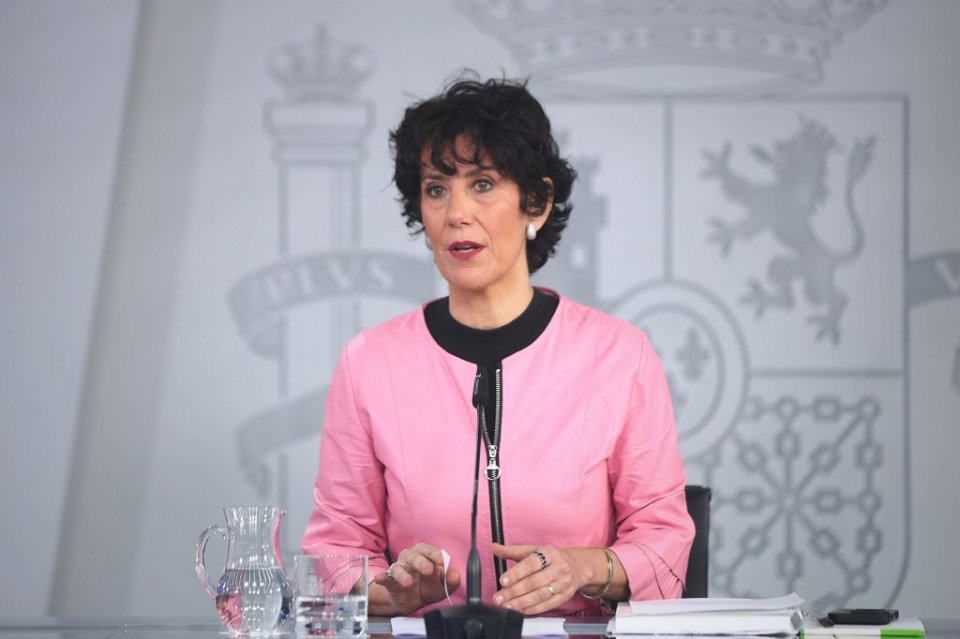
Government spokeswoman and Social Security Minister Elma Saiz (main image) defended the decision to approve the measures during the electoral period.
‘This government continues to govern. It must continue to respond to the challenges facing citizens,’ she said in the press conference following the Cabinet meeting.
Saiz also argued that broader social protection was compatible with fiscal discipline and Spain’s strong economic indicators.
The announcement follows the JEC electoral commission’s decision earlier this month to open proceedings against Sánchez over a news conference at his official Moncloa residence, held the day after he announced the election.
The commission said his remarks went beyond explaining Cabinet decisions and included praise for his administration’s record, criticism of the opposition and an appeal for a stronger parliamentary majority.
‘The prime minister can defend his political position and criticise those of other parties, but during the electoral period he cannot do so by taking advantage of the public resources available to him by virtue of his office,’ the JEC commission said.
However, it also made clear that the electoral period does not suspend the normal work of constitutional institutions, including the government’s ability to approve measures.
Enjoying the news from Spain in English? Add us as a preferred news source in Google.
Subscribe to the Weekly Newsletter from Spain in English.
💜 Damos respuesta a situaciones que necesitaban más protección. Se reconocen dos nuevas situaciones de baja laboral: por menopausia incapacitante y por lesiones derivadas de la violencia de género 🛡️ Más protección para las mujeres y para las familias. Seguimos avanzando. https://t.co/KqNH3GHSNC
— Elma Saiz (@SaizElma) October 20, 2026

Click here to get your business activity or services listed on our DIRECTORY.