
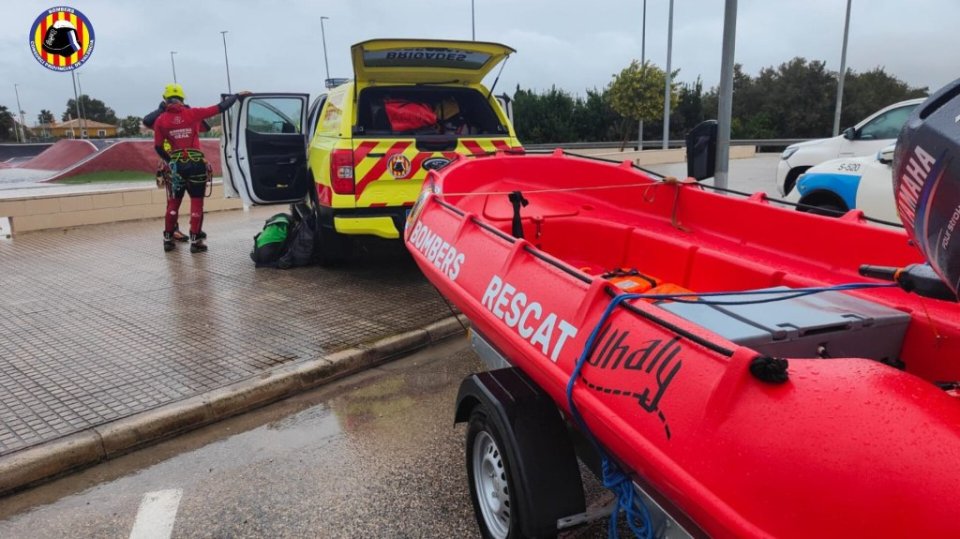
#UPDATE (13h) – The death toll from storm Adam in eastern Spain has risen to three people after a body was discovered by the Military Emergency Unit (UME) on Monday in Oliva (Valencia).
Original full report:
Emergency crews and military rescuers were evacuating residents from flooded homes in eastern Spain on Monday as storm Adam brought exceptional rainfall, forced schools to close and prompted confinement orders across 145 municipalities.
Two women died over the weekend in Catalonia and the Valencia region. By Monday morning, some of the worst flooding was concentrated in southern Valencia province and northern Alicante, where overflowing rivers and ravines had cut off roads and left people awaiting rescue on rooftops.
The Balearic Islands also faced widespread disruption, while forecasters warned that very heavy and persistent rain would threaten parts of Catalonia as the weather system moved north.
The Valencian government ordered residents in 145 municipalities along the southern Valencia and northern Alicante coastal areas to remain indoors and restricted movement as rescuers struggled to reach flooded neighbourhoods.
‘Road travel is impossible, you must stay at home,’ the region’s emergency chief, Juan Carlos Valderrama, said on Monday morning.
Residents told to move upstairs as rescues continue
The regional emergency coordination centre, CECOPI, activated its Situation 2 emergency level for Valencia, with warnings sent to mobile phones through the Es-Alert system.
Valderrama and the central government’s representative in the region, Pilar Bernabé, urged residents to shelter on upper floors and avoid all unnecessary movement. Guardia Civil officers closed road access to the hardest-hit areas to prevent further incidents and keep routes available for emergency vehicles.
In Gandia, mayor José Manuel Prieto appealed to residents to seek safety above ground level. Local authorities in Oliva and Pego described waist-deep water in built-up areas and outlying residential communities.
Spain’s Military Emergency Unit, the UME, deployed its Third Emergency Intervention Battalion to Oliva to help evacuate elderly and vulnerable residents trapped inside their homes.
In neighbouring Pego, mayor Enrique Moll said people were sheltering on rooftops in the Pego-Oliva marshland while awaiting aerial rescue. Floodwater had left heavy fire service vehicles stranded on access routes.
Emergency services had dealt with almost 800 incidents across the Valencia region. The Girona and Vernisa rivers and the Beniopa ravine overflowed, while rough seas hampered the discharge of floodwater into the Mediterranean.
Footage released by the regional meteorological agency showed powerful currents surging through streets and carrying away vehicles in towns across Valencia and Alicante provinces.
Prime Minister Pedro Sánchez described the situation in the Valencia region as ‘very difficult’.
‘Rescue operations are continuing in areas that are difficult to access. People are urged to avoid all travel,’ he wrote on X.
Rainfall draws comparisons with the 1987 disaster
The most extreme accumulations were recorded in La Safor and Marina Alta, where Spain’s national weather agency, Aemet, described conditions as exceptionally adverse.
Over periods of roughly 36 to 48 hours, rainfall totals in locations including Pego, Real de Gandia, Barx and Villalonga exceeded 500 or 600 litres per square metre. The Forna station recorded 651 litres per square metre, with totals reaching around 700 litres in the worst-affected locations.
At Oliva beach, 131.9 litres per square metre fell in just one hour.
Aemet identified the floods of 3 November 1987 as the comparable historical episode for the area. Oliva recorded 817 litres per square metre in 24 hours that day, Spain’s national record for a single day’s rainfall.
Two weekend deaths amid a wider sequence of floods
One woman died in Sagunto, in the Valencia province, with local authorities reporting the death overnight between Sunday and Monday.
The other victim was a 35-year-old woman swept away on Saturday night while attempting to cross a watercourse with her children in Cabrera de Mar, around 27 kilometres north of Barcelona. Rescuers found her body in the sea on Sunday, according to Catalonia’s Civil Protection service.
Cabrera de Mar mayor Óscar Fernández said she had attended a basketball match at a municipal sports facility, where those present had been asked to remain inside because of the torrential rain.
Catalan authorities closed roads, reduced train services and urged people to avoid unnecessary journeys.
The woman’s death brought the reported toll from heavy rain and flooding in Spain over the preceding 15 days to five as of Sunday. That figure covers a wider period than the two deaths reported in connection with the weekend’s storms.
Schools shut and emergency accommodation opens
More than 102,000 pupils were affected by school closures across the Valencia region on Monday. Teaching was suspended in 25 municipalities in the Alicante province and 42 in the Valencia province, as well as parts of Valencia city.
Schools were also closed on Mallorca, Ibiza and Formentera. In the Balearics, some day-centre services and non-urgent healthcare appointments were cancelled.
More than 20 roads remained closed in the affected areas. Gandia suspended its urban bus service, while Spain’s traffic authority, the DGT, cancelled driving tests at El Saler and Alzira.
The Red Cross prepared a temporary, 40-place emergency shelter at Gandia’s Raval sports centre following the preventive evacuation of homes threatened by rising water in the Beniopa ravine. The shelter was arranged at the regional government’s request in coordination with the town hall.
Red Cross teams also provided basic supplies to motorists whom the Guardia Civil had directed to the La Safor motorway service area.
In Xàbia, more than 100 people evacuated from the El Naranjal campsite remained in municipal accommodation.
Threat shifts towards Catalonia
Following the morning’s red warnings in eastern Spain, Aemet forecast that the focus of the instability would move towards Catalonia, with orange warnings for very heavy and persistent afternoon rainfall in Barcelona, Girona and Tarragona provinces.
Rain was expected to ease in the Valencia region and the Balearic Islands, where warnings were being lowered to orange and yellow. Authorities nevertheless urged residents to remain cautious because of flooding, damaged roads and continuing rescue operations.
Sánchez and Catalan president Salvador Illa appealed to the public to follow official instructions and observe restrictions.
Flood damage follows record heat
The latest emergency follows other destructive downpours in Spain, including flooding in Almería that inundated properties, swept away cars and forced roads to close.
In August, two elderly women died in flooding and a landslide near Pontevedra in north-western Spain during another spell of torrential rain. Those floods followed weeks of extreme heat and devastating wildfires.
Scientists say human-driven warming can intensify heavy rainfall because a warmer atmosphere holds more moisture. In the Mediterranean, heat accumulated by the sea during summer can also increase evaporation, supplying moisture for the powerful storms that frequently affect eastern Spain in autumn.
Aemet said on Friday that September had been mainland Spain’s hottest on record, following the country’s warmest June-to-August summer.
Enjoying the news from Spain in English? Add us as a preferred news source in Google.
Subscribe to the Weekly Newsletter from Spain in English.
La dana Adam ha afectado mucho las playas del litoral sur de Valencia y del norte de Alicante. Algunas instalaciones han quedado destrozadas y la mayoría de accesos, completamente cortados https://t.co/C89hzHyK3o https://t.co/zXIZvVIHae
— RTVE Noticias (@rtvenoticias) October 19, 2026
⚠️ Dana Adam | Actualización avisos 19 octubre 🟠🌧️ En las zonas con aviso naranja puede haber inundaciones y crecidas locales, con impactos graves. 🟠🌩️ En zonas de Región de Murcia y Baleares se suman naranjas por tormentas. ➡️ Sigue recomendaciones de Protección Civil. https://t.co/hNvrotMgCO
— AEMET (@AEMET_Esp) October 19, 2026
Misiones de salvamento y evacuación de personas afectadas por #DanaAdam Militares del @EjercitoTierra y del #BIEM3 están realizando rescates con el helicóptero HU-27 en la zona de Oliva, en coordinación con la @guardiacivil y el resto de los servicios de emergencias. @GVA112 https://t.co/jZMcvHnz2d
— UME (@UMEgob) October 19, 2026
Situación muy complicada en la Comunitat Valenciana, especialmente en el litoral sur de Valencia y norte de Alicante, ante las intensas lluvias de las últimas horas. La @UMEgob está ya desplegada para colaborar con los servicios de emergencia. Y se está trabajando en el rescate de personas en zonas de difícil acceso. Se pide a la población que evite cualquier desplazamiento y permanezca en plantas altas. Sigamos las informaciones de los canales oficiales en emergencia. Mucha precaución.
— Pedro Sánchez (@sanchezcastejon) October 19, 2026

Click here to get your business activity or services listed on our DIRECTORY.