
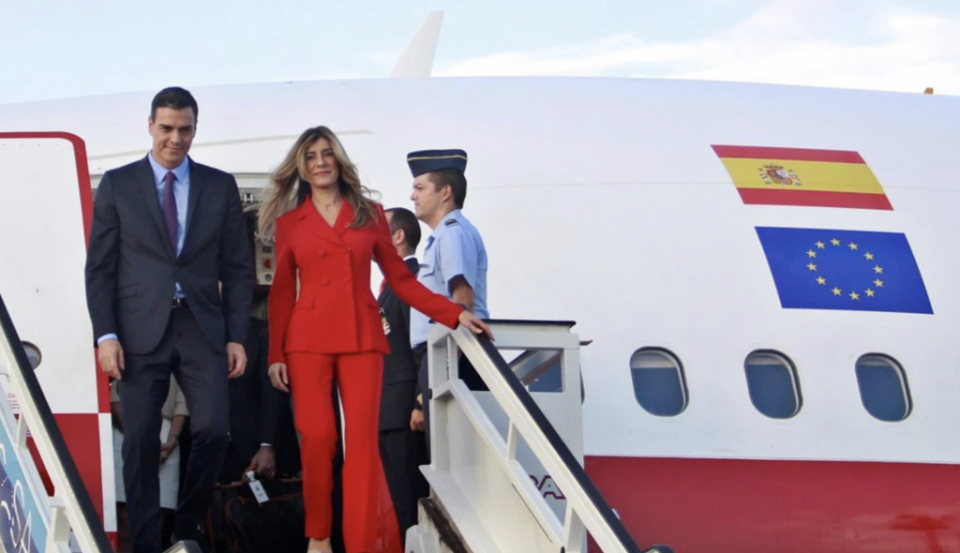
A Spanish court has authorised Prime Minister Pedro Sánchez’s wife, Begoña Gómez, to travel to London this week to attend her daughter’s graduation, while refusing permission for her to accompany the prime minister to the NATO summit in Ankara, intensifying political divisions over the corruption case against her.
The Madrid court ruled that Gómez could temporarily recover her passport to travel to the British capital between 8-10 July, despite a ban on leaving Spain imposed last month as part of an ongoing corruption investigation. However, it rejected her request to accompany Sánchez to the NATO summit in Turkey on Tuesday and Wednesday, following an invitation to do so from Turkley’s first lady.
Judge Juan Carlos Peinado confiscated Gómez’s passport after ordering her to stand trial on allegations of influence peddling, embezzlement, corruption in business dealings and misappropriation of funds following a two-year investigation. No trial date has yet been set, as a higher court reviews his decision. ALSO READ: Spanish PM’s wife ordered to stand trial on corruption charges and surrender passport.
The investigation centres on the creation and management of a chair at Madrid’s Complutense University, which Gómez co-directed, as well as the alleged use of public resources and personal connections to advance private interests.
Explaining the differing decisions, the Madrid court said Gómez could travel to London because the United Kingdom maintains close judicial and police cooperation with Spain despite no longer belonging to the European Union.
However, it refused permission for her to travel to Turkey, stating: ‘Turkey does not belong to the European Union’s freedom, security and justice space, in which police and judicial cooperation in criminal matters is facilitated.’
The court also noted that Gómez had been ‘invited for reasons of international institutional courtesy, without having an active role in the said summit’, and ordered her to surrender her passport again after returning from London.
The contradictory rulings mean Gómez will be able to attend her daughter’s graduation but not accompany her husband to the NATO gathering, after Judge Peinado previously argued that she posed a potential flight risk while her appeal remains unresolved. ALSO READ: Poll finds most Spaniards believe ‘lawfare’ exists amid deepening trust crisis in justice.
Justice Minister Félix Bolaños criticised the restrictions, describing the precautionary measures as ‘unnecessary’ and arguing that ‘an overwhelming majority’ of both the public and the legal community believed Gómez posed ‘zero risk of evading justice because she is accompanied by National Police officers at all times’. ALSO READ: Judge probing Spanish PM’s wife faces disciplinary action over comments on police.
Speaking after Tuesday’s Cabinet meeting, Bolaños acknowledged that neither the United Kingdom nor Turkey forms part of the European Area of Freedom, Security and Justice, but insisted Spain enjoys ‘extraordinary judicial and police cooperation’ with both countries.
Referring to Turkey, he noted that his counterpart had recently visited Spain and that he was due to make a return visit, adding: ‘Cooperation with both countries is extraordinary.’
Sánchez has consistently defended his wife’s innocence and denounced what he describes as a politically motivated smear campaign by the right aimed at destabilising his minority left-wing government. ALSO READ: Pedro Sánchez: ‘There are judges doing politics and politicians trying to do justice’.
The court’s decision prompted sharply differing reactions across Spain’s political spectrum.
The right-wing People’s Party (PP) declined to criticise the ruling directly but stressed the importance of equal treatment before the law. The party’s deputy secretary for Finance, Housing and Infrastructure, Juan Bravo, said he was not in a position to judge the court’s decision but warned that ‘we are all equal’ before the law and that ‘if that principle is broken, then a fundamental value is undermined, and that is something that should concern us’. He also accused Sánchez of having ‘pushed institutions to their limits’.
Speaking on Spanish public broadcaster RNE, Bravo added that while much attention was focused on the justice system, ‘morality, ethics and principles should also be taken into account’.
Another senior PP figure, Elías Bendodo, described the international attention surrounding Gómez’s legal troubles as ‘bad news’ for Spain, saying it ‘damages Spain’s image and diminishes the standing of its institutions’. He added that ‘everyone at the NATO summit will know’ she was unable to attend ‘because her passport has been withdrawn’.
Vox leader Santiago Abascal said he had no personal opinion on the court’s decision to allow Gómez to travel abroad in limited circumstances, although he claimed the Prime Minister’s wife was ‘capable of anything, just like Sánchez’.
The Madrid Appeal Court is expected to decide Gómez’s legal future as it reviews Judge Peinado’s order for her to stand trial. Until then, she remains subject to the travel restrictions imposed by the investigating judge, with temporary exceptions granted only under specific circumstances.
Enjoying the news from Spain in English? Add us as a preferred news source in Google.
Subscribe to the Weekly Newsletter from Spain in English.
El Gobierno critica el argumento del juez que prohíbe viajar a Begoña Gómez a la cumbre de la OTAN. Creen que no hay ningún riesgo de fuga y ven incomprensible que la deje ir a la graduación de su hija en Londres y no a Turquía.
— Telediarios de TVE (@telediario_tve) July 7, 2026
El PP y Vox piden respeto a la justicia. pic.twitter.com/1eu5AuKGgc
El juez sustituto de Peinado permite viajar a Begoña Gómez a Londres para la graduación de su hija pero no a la cumbre de la OTAN.
— La Hora de La 1 (@LaHoraTVE) July 7, 2026
Lo cuenta @GarciaFrigenti en #LaHora7J https://t.co/W2XU5eYbgg pic.twitter.com/0xTKBqKNcy

Click here to get your business activity or services listed on our DIRECTORY.