
Spain’s left-leaning coalition government said on Monday that it will declassify long-sealed documents linked to the failed 1981 coup attempt, a move Prime Minister Pedro Sánchez said was intended to settle a ‘historic debt’ with the public and shed new light on one of the most decisive moments in the country’s modern history.
‘Memory cannot be locked away. Tomorrow we will declassify the 23-F documents to repay a historic debt to the public. Democracies must understand their past to build a freer future,’ Sánchez wrote on X, referring to the 23 February 1981 coup attempt.
The cabinet was expected to formally approve the measure on Tuesday, with the declassification taking effect the following day. The documents will be made available to the public on the official website of La Moncloa, the seat of the Spanish government, after years of repeated requests for their release.
The 1981 coup attempt came six years after the death of dictator General Francisco Franco and was led by military figures nostalgic for the privileges they had enjoyed during more than four decades of authoritarian rule. It has come to symbolise a critical moment when Spain’s transition to democracy faltered but ultimately held firm.
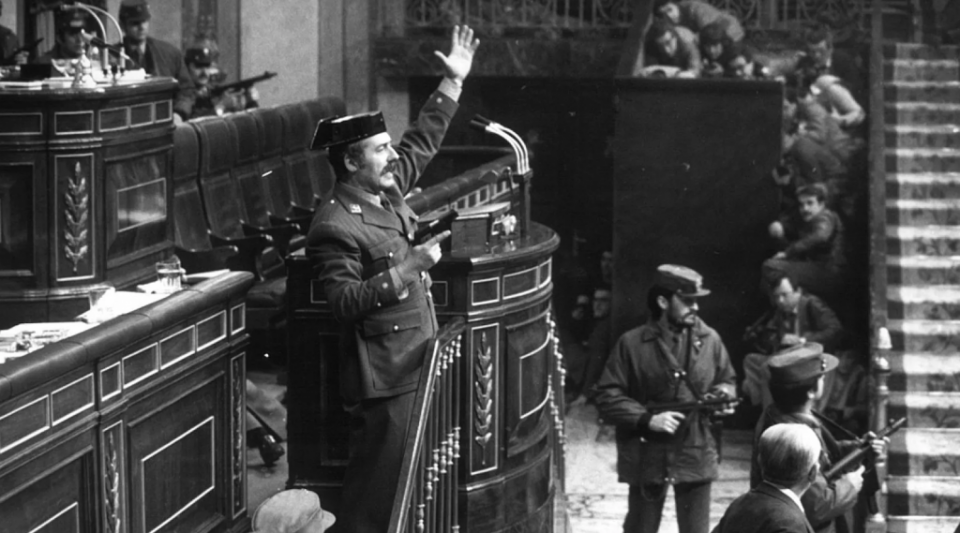
On 23 February 1981, Spain’s fledgling democracy was shaken when rebellious civil guards, led by Lieutenant Colonel Antonio Tejero Molina (main image), burst into parliament in Madrid, fired shots in the air and held MPs at gunpoint for between 17 and 24 hours, interrupting the swearing-in of a new government. The aim was to force a return to dictatorship, purportedly in the name of the king.
The siege ended only after it became clear that Juan Carlos I, Franco’s designated successor, would not back the uprising. In a live televised address, the king declared that the crown would not tolerate any attempt to interrupt the democratic process by force, publicly backing the elected government and the constitutional order.
Although the coup is one of the most studied episodes in contemporary Spanish history, historians say major questions remain unanswered, including how extensive the conspiracy network was and which elements of the military and state institutions were involved. The newly released files may also offer further insight into the role of the former king, as well as the possible involvement of intelligence services and other bodies.
At the same time, expectations are tempered by warnings that parts of the historical record may never be recovered. Former intelligence chief Alberto Saiz said in a 2022 interview with broadcaster La Sexta that many documents related to the plot had disappeared.
Among those later convicted was General Alfonso Armada, once considered close to the king, who was sentenced to 30 years in prison for his role in the conspiracy. Prosecutors accused him of trying to lead a military-backed government intended to ‘correct’ Spain’s democratic transition.
Writer Javier Cercas, author of a book on the coup, has described its failure as ‘the founding myth of Spanish democracy’, telling El País that it marked the end of two centuries of military intervention in Spanish politics.
Subscribe to the Weekly Newsletter from Spain in English.
La memoria no puede estar bajo llave.
— Pedro Sánchez (@sanchezcastejon) February 23, 2026
Mañana desclasificaremos los documentos del 23F para saldar una deuda histórica con la ciudadanía.
Las democracias deben conocer su pasado para construir un futuro más libre.
Gracias a quienes abristeis camino. pic.twitter.com/VNHEAadVxv

Please support us with a donation.
Click here to get your business activity or services listed on our DIRECTORY.