
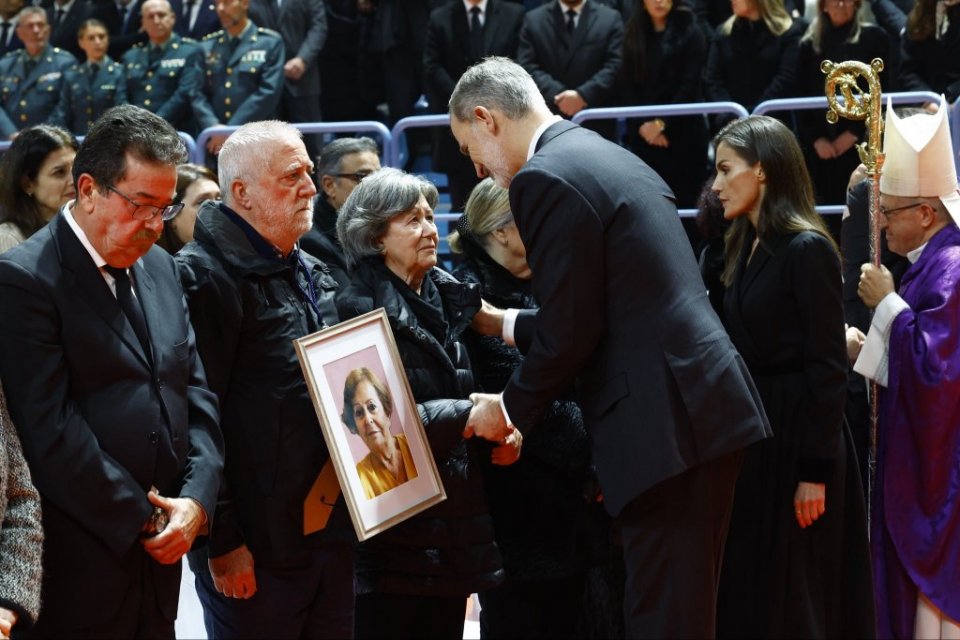
A funeral mass in memory of the 45 people killed in the Adamuz train crash was held on Thursday at the Carolina Marín sports centre in Huelva, the province of Andalusia that suffered the highest number of fatalities.
The religious service was attended by some 336 relatives of the victims, who had declined to participate in a secular state funeral that had originally been scheduled for 30 January. The families made clear that they would only attend a ceremony conducted ‘in God’s presence’. ALSO READ: Families of Adamuz train crash victims to receive €216,000 under €20m compensation plan.
Huelva Cathedral was ruled out as a venue because it could not accommodate the approximately 5,000 people who gathered for the service, among them several passengers who were still visibly injured, wearing bandages and slings.
Although held outside a church, the ceremony retained its religious nature at the express request of the victims’ families, who sought to strip the event of any political overtones. Some of the relatives vowed to find out why the two high-speed trains collided, making their promise before survivors at the funeral mass.
The mass was officiated by the bishop of Huelva, Santiago Gómez Sierra, while bishop emeritus José Vilaplana read aloud the names of the 45 victims.
During the service, Gómez Sierra conveyed a message from Pope Leo and reassured mourners that ‘God does not disapprove’ of their grief.
Spain is trying to come to terms with the 18 January disaster that caused one of the highest death tolls from a train crash in European history. ALSO READ: 45 dead, dozens injured, after high-speed trains collide in southern Spain.
The government has been scrutinised over whether it has sufficiently invested in maintenance of Spain’s vaunted railway system since the crash and other incidents that same week, including the death of a train driver in Catalonia. ALSO READ: One dead, 37 injured, as commuter train ploughs into rubble of collapsed wall near Barcelona.
A fracture in the rail appeared to have occurred before one of the trains in the Andalusian tragedy (the Iryo train travelling from Malaga to Madrid) derailed and was hit by a second, Huelva-bound train coming in the opposite direction 20 seconds later, authorities have said. ALSO READ: Initial report from train tragedy investigators points to fracture in track prior to accident.
Despite the focus on mourning, Thursday’s ceremony in Huelva unfolded against a backdrop of political strain, heightened by the absence of several senior political figures, including Prime Minister Pedro Sánchez.
One of the most powerful moments came from Liliana Sáenz, whose mother Nati de la Torre was among those killed. Standing beside her brother, Sáenz addressed the gathering on behalf of all the bereaved families.
She said the trains were not only carrying victims but ‘virtues and flaws, triumphs and defeats, longings and silence’, adding: ‘They were carriages full of hope.’
Sáenz recalled how, at 7.45pm on 18 January, time effectively stopped for 45 families. She described how relatives waited for updates at a civic centre and, ‘with the slow advance of the hours’, came to realise they would return home without their loved ones.
‘The 45 on the trains,’ Sáenz continued, ‘were part of a society so polarised that it began to crack a long time ago and we were not realising it’, in remarks widely interpreted as a rebuke of the political class.
‘Only the truth will help us heal this wound. We will know the truth, we will fight so that there will never be another train,’ she added, demanding accountability. In a symbolic moment, mourners and injured passengers joined her in asking why the Iryo train derailed.
Sáenz expressed gratitude to church officials for organising the only tribute the families had wanted. Relatives had firmly rejected the state funeral planned by Sánchez and the president of the Andalusian regional government, Juanma Moreno, prompting both the central and regional governments to postpone the secular ceremony.
King Felipe VI and Queen Letizia, whose presence at the ceremony in Huelva was warmly received, spoke privately with the families of the victims.
Three months earlier, Felipe VI and Letizia had also offered condolences following the deadly dana floods in Valencia. On that occasion, Sánchez and Valencian regional president Carlos Mazón were present, though Mazón resigned days later amid intense public backlash. ALSO READ: Carlos Mazón, leader of flood-hit Valencia, finally resigns.
Although unconfirmed, the absence of Sánchez on Thursday was reportedly due to the political sensitivity surrounding the disaster. Transport Minister Óscar Puente was also absent, as he was required to appear before the Senate to give an account of the events. ALSO READ: Sánchez vows ‘to get to the truth’ about cause of train tragedy, as Spain declares three days of mourning.
Earlier the same day, Madrid regional president Isabel Díaz Ayuso held a separate local memorial service in the capital, a move that further fuelled political tension – even within her own party, as the president of the People’s Party (PP), Alberto Núñez Feijóo, attended the Huelva mass. Critics viewed Ayuso’s ceremony as a bid for political visibility that clashed with the main commemoration in southern Spain.
Thursday’s funeral was also attended by the PP Andalusian president Moreno. The central government was represented by First Deputy Prime Minister María Jesús Montero, who limited her interaction with families to brief greetings. ALSO READ: Hope amid tragedy as dog missing after train tragedy in Andalusia is found safe.
Subscribe to the Weekly Newsletter from Spain in English.
Misa funeral en memoria de las víctimas del accidente ferroviario de Adamuz (Córdoba) del pasado 18 de enero, ofrecida por el Obispado de Huelva, a la que han asistido los Reyes.
➡️https://t.co/kd8NplrtHf pic.twitter.com/ET7X5PepKM
— Casa de S.M. el Rey (@CasaReal) January 29, 2026

Please support us with a donation.
Click here to get your business activity or services listed on our DIRECTORY.