
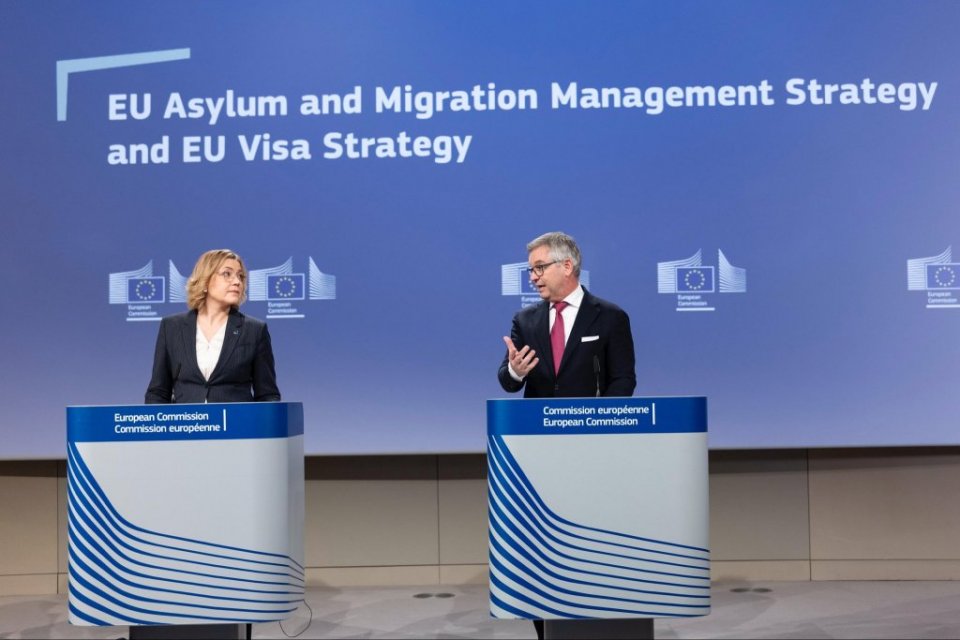
The European Union on Thursday presented plans to revamp its visa regime and intensify deportations as part of a new five-year migration framework, marking a continued shift toward a tougher stance on the politically sensitive issue.
The European Commission has proposed a new visa policy designed to use access to EU territory as leverage in advancing the bloc’s broader diplomatic and strategic objectives.
Under the plan, countries that refuse to readmit their own nationals could face restrictions on visa access, while procedures would be simplified for select categories of skilled workers the EU hopes to attract.
According to the EU’s border agency, irregular arrivals across the 27-member bloc fell by more than 25% in 2025. Despite the decline, migration remains a major political concern. ALSO READ: Irregular migration to Spain dropped by over 40% in 2025.
‘The priority is clear: bringing illegal arrival numbers down and keeping them down,’ said Magnus Brunner (right, main image), the EU’s commissioner for migration.
A central element of the strategy unveiled on Thursday is a renewed push to increase the deportation of rejected asylum applicants.
‘Abuse gives migration a bad name — it undermines public trust and ultimately takes away from our ability to provide protection and undercuts our drive to attract talent,’ Brunner said.
Separately, the European Parliament is reviewing proposed legislation from the European Commission that would allow for the establishment of so-called ‘return hubs’ outside EU territory.
The initiative, which has drawn criticism from human rights organisations, would also introduce tougher sanctions for migrants who refuse to leave the EU, including extended periods of detention.
European governments are facing mounting pressure to adopt stricter migration policies as public sentiment hardens, contributing to a broader political shift to the right across the bloc. In Spain, however, the left-leaning coalition government this week marked a clear departure from the tougher approaches adopted elsewhere in Europe, by preparing a decree that will grant legal status to around 500,000 undocumented migrants.
The EU’s strategy calls for strengthening what it describes as an ‘assertive migration diplomacy’, aimed at persuading third countries to curb migration flows toward Europe and readmit nationals without the right to remain.
The Spanish government has repeatedly argued that reducing irregular migration requires tackling the issue before migrants set off. PM Pedro Sánchez has attributed the decline in arrivals to the Canary Islands during 2025 – which fell by 62% to 17,788 in 2025 – to closer cooperation with Mauritania and other African nations. ALSO READ: Mauritania and Spain pledge cooperation on migration and to combat people smuggling.
In recent months, Brussels has signed or entered negotiations on agreements with several North African countries — including Tunisia, Mauritania, Egypt and Morocco — offering financial aid and investment in exchange for cooperation on migration control. ALSO READ: Spain, Morocco sign 20 agreements on migration, investment, energy & education.
Amnesty International condemned the EU’s approach, calling it ‘flawed’.
It ‘only heightens its dependence on third countries to manage migration, while making it complicit in any rights violations that may result’, said Olivia Sundberg Diez, a policy analyst with the organisation.
The European Commission is expected to present a detailed reform proposal before the end of the year.
Subscribe to the Weekly Newsletter from Spain in English.
The reforms that we are putting in place give us the momentum to prepare for a new chapter of European Migration and Asylum policy.
— Magnus Brunner (@magnusbrunner) January 29, 2026
With today’s strategy we shift the order of our priorities: stepping up migration diplomacy and working along the routes.https://t.co/n2nmujppuH pic.twitter.com/UXi9PTieJf

Please support us with a donation.
Click here to get your business activity or services listed on our DIRECTORY.