
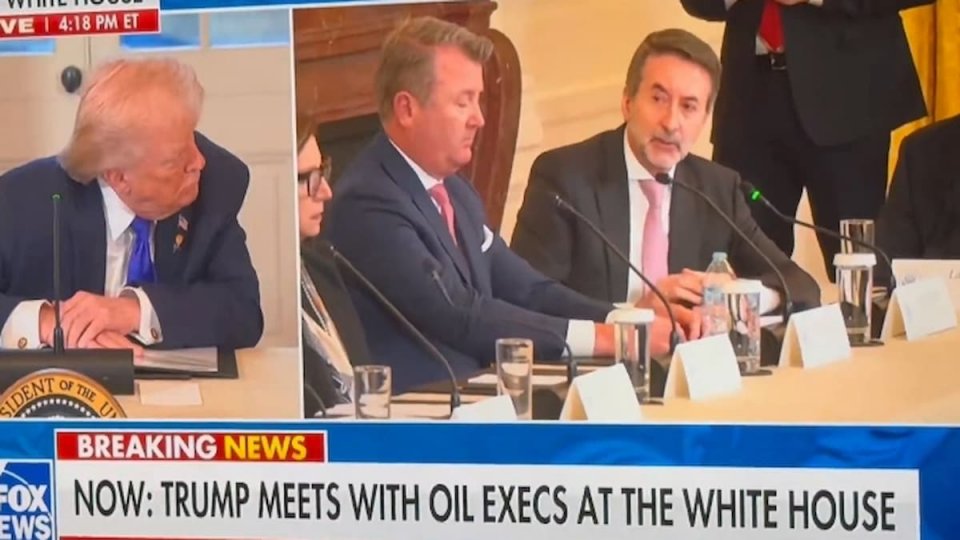
Josu Jon Imaz, the CEO of Repsol – Spain’s largest oil and gas company – has said that the company is ready to ‘invest heavily in Venezuela‘ and to triple its crude oil production in the country to around 135,000 barrels per day (159 litres in each).
According to the company, this target could be achieved within two to three years if the necessary conditions are met.
The Basque-born executive stated Repsol’s current daily production in Venezuela at 45,000 barrels. He was attending a meeting at the White House in Washington alongside other senior figures from the energy sector with US President Donald Trump. ALSO READ: As Venezuelans rejoice in Madrid, Sánchez warns against US intervention that violates international law.
Josu Jon Imaz had pursued a political career in the Basque Nationalist Party (EAJ-PNV) in the early 1990s until the mid-2000s, as an MEP. In January 2004 he was elected chairman of the executive committee of EAJ-PNV. In autumn 2007, he announced his decision not to stand for re-election and ended his career in politics.
Trump reiterated on Friday that US oil companies would invest around $100 billion to revitalise Venezuela’s oil industry. ‘They will invest their own money, not our government’s. They don’t need it — but they do need our protection,’ he said.
He added that Washington would provide ‘government security’ for the companies involved, and stressed that his administration would control which firms would be allowed to operate in Venezuela.
Despite the White House meeting, major US oil industry players have expressed scepticism about investing in the Venezuela, citing uncertainty over its political future, memories of past policies involving the nationalisation of foreign assets, and the low price of crude, according to US media reports.
Trump also invited China and Russia to buy as much Venezuelan oil as they ‘need’ under arrangements managed by Washington, arguing that his administration should take control of the country’s oil sales because otherwise Moscow and Beijing would have done so first.
Venezuela holds the world’s largest proven oil reserves — around 303 billion barrels, equivalent to 17% of global reserves. Most of these lie in the Orinoco Belt, in the form of extra-heavy crude that requires advanced technology and substantial investment to extract.
Washington imposed sanctions on Venezuela’s oil industry in 2019, during Trump’s first term, as part of its pressure campaign to remove President Nicolás Maduro from power. ALSO READ: Political reactions from Spain following United States’ air strikes on Venezuela.
Chevron is the only US oil major still operating in Venezuela and has been granted a licence by the US Treasury’s Office of Foreign Assets Control (OFAC). allowing it to import crude.
The oil giant agreed to remain in the country in 2007, after then-president Hugo Chávez nationalised the last privately operated oil fields. This move forced major foreign companies either to accept majority state control through Petróleos de Venezuela (PDVSA) or to leave the country.
Chevron’s joint ventures with PDVSA currently account for around 27% of Venezuela’s national oil output, roughly 242,000 barrels per day.
Subscribe to the Weekly Newsletter from Spain in English.
🔴Repsol asegura estar preparada para “invertir con fuerza en Venezuela” y para multiplicar por tres su producción
— Radio 5 (@radio5_rne) January 10, 2026
▪️Así lo ha asegurado el consejero delegado, Josu Jon Imaz, en el encuentro que ha mantenido Trump con las principales petroleras
🎙️@jgarri9 pic.twitter.com/d19EVsHTea
📢Josu Jon Imaz, consejero delegado de Repsol, asegura a Trump que quieren “invertir con fuerza” y triplicar su producción en Venezuela pic.twitter.com/QNFgZ29EzF
— expansioncom (@expansioncom) January 10, 2026

Click here to get your business activity or services listed on our DIRECTORY.