
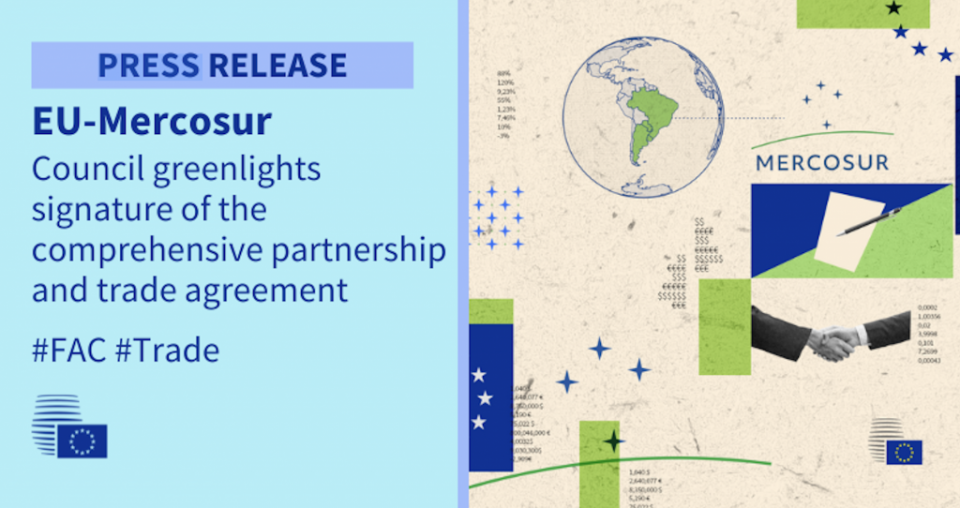
The European Union on Friday finally cleared a long-stalled trade agreement with the South American Mercosur bloc, backing a pact strongly supported by business groups but fiercely opposed by many European farmers — and pushing it through despite resistance led by France.
Spain, Germany and several other countries strongly supported the deal, seeing it as a much-needed lift for industries facing stiff competition from China and trade barriers in the United States.
The deal finally won the backing of a majority of the EU’s 27 member states at a meeting of ambassadors in Brussels, opening the door for it to be formally signed in Paraguay next week.
After more than a quarter of a century of negotiations, supporters argue the agreement is vital for boosting exports, shoring up Europe’s struggling economy and strengthening diplomatic ties at a moment of global uncertainty.
‘At last,’ Spanish PM Pedro Sánchez wrote on X. ‘After three decades of negotiations, the EU will culminate a new trade agreement with the Mercosur countries. Thanks to it, Spanish companies will be able to enter new markets, export more, and generate more jobs. And Europe will be able to maintain a strong bond with that sister and strategic region that is Latin America.’
‘In today’s world,’ he added, ‘not everything is tariffs, threats, and bad news. Some of us are building new bridges and alliances to forge shared prosperity.’
German Chancellor Friedrich Merz also welcomed the decision.
‘The approval of the EU-Mercosur Agreement is a milestone in European trade policy and an important signal of our strategic sovereignty and capacity to act,’ the German leader said.
However, the European Commission — which negotiated the agreement — was unable to secure unanimous backing from member states.
France, a heavyweight within the bloc, spearheaded a failed attempt to block the deal. Politicians from across the political spectrum there have condemned the accord, arguing it would severely damage the country’s powerful farming sector.
Ireland, Poland, Hungary and Austria also voted against the agreement.
Their opposition proved insufficient, however, after Italy, which had sought and secured a last-minute delay in December, ultimately shifted its position and backed the pact.
Once implemented, the agreement would create a combined market of more than 700 million people, making it one of the largest free trade zones in the world.
The deal is part of a broader EU strategy to diversify trade in response to US tariffs. It would deepen ties between the EU and Brazil, Paraguay, Argentina and Uruguay by eliminating import tariffs on over 90% of goods.
According to the EU, the agreement would save European companies around four billion euros annually in customs duties and boost exports of products such as vehicles, machinery, wines and spirits to Latin America.
It would also help reduce the bloc’s reliance on China for key raw materials, said Agathe Demarais of the European Council on Foreign Relations.
‘The conclusion of the EU-Mercosur trade deal is great news for Europe’s global geopolitical and economic clout,’ she said, calling it one of the ‘best responses to US tariffs, growing protectionism and trade tensions with China.’
France and other critics, however, have warned that domestic farmers would be undercut by an influx of cheaper agricultural products — including meat, sugar, rice, honey and soybeans — from Brazil and its regional partners.
Failure to approve the deal risked derailing it altogether, after Brazil warned last month it could walk away if the EU delayed the process again.
In recent months, the European Commission had been working to reassure farmers that the benefits outweigh the drawbacks.
It has highlighted forecasts that EU agri-food exports to South America could rise by 50%, helped by protections for more than 340 emblematic European products — ranging from Greek feta to French champagne — against imitation.
The commission has also outlined plans for a €6.3 billion crisis fund, along with safeguard mechanisms allowing preferential tariffs on agricultural goods to be suspended if imports surge sharply.
Those safeguards were further strengthened at the last moment, after member states agreed to lower the threshold for intervention — a concession aimed at securing Italy’s support.
‘It seems to me that the balance that has been created is a sustainable one, and I hope that the agreement will bring benefits in many areas, as I believe it will, and hopefully for everyone,’ Italian Prime Minister Giorgia Meloni told journalists on Friday.
Despite the approval, opposition remained visible on the ground. French farmers drove tractors into Paris, while Belgian farmers blocked major roads across the country in protest ahead of the vote.
The agreement must still be approved by the European Parliament before it can fully enter into force.
Subscribe to the Weekly Newsletter from Spain in English.
‼️ @EUCouncil has authorised the signature and provisional application of the EU-Mercosur Partnership Agreement and the interim Trade Agreement, strengthening political ties, cooperation and trade with #Mercosur partners.
— EU Council Press (@EUCouncilPress) January 9, 2026
Read more about the agreements 👇https://t.co/nGUZIDYsTh
Today’s Council decision to support the EU-Mercosur deal is historic.
Europe is sending a strong signal.
We are serious about creating growth, jobs and securing the interests of Europeans consumers and businesses.
With Mercosur, we are creating a shared market of 700 million… pic.twitter.com/WMGXWzFgua
— Ursula von der Leyen (@vonderleyen) January 9, 2026
AL FIN. Tras tres décadas de negociaciones, la UE culminará un nuevo acuerdo comercial con los países de Mercosur.
Gracias a él, las empresas españolas podrán entrar a nuevos mercados, exportar más, y generar más empleos. Y Europa podrá mantener un vínculo fuerte con esa región…
— Pedro Sánchez (@sanchezcastejon) January 9, 2026

Click here to get your business activity or services listed on our DIRECTORY.