
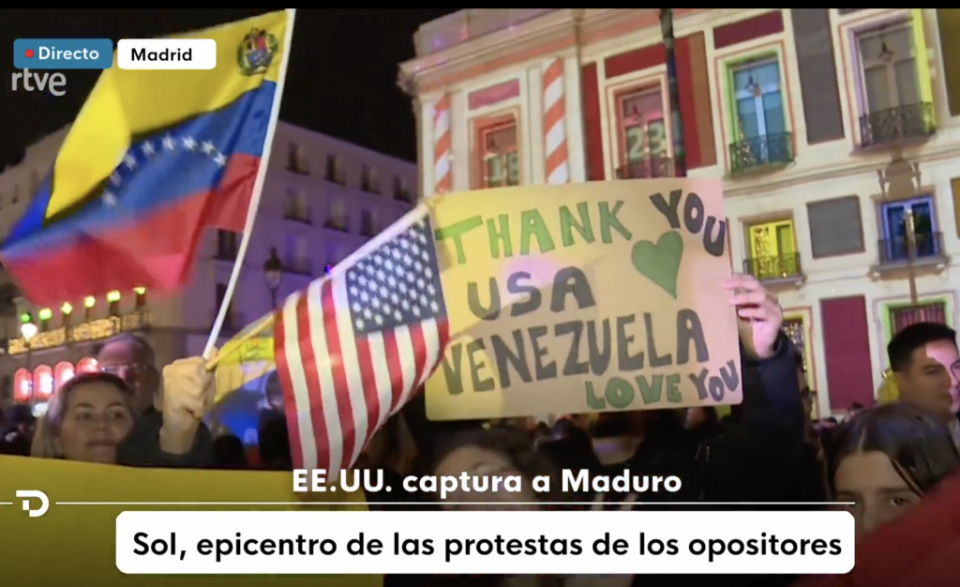
Venezuelans gathered in Madrid’s city centre on Saturday in scenes of spontaneous celebration after the United States announced it had captured Venezuelan leader Nicolás Maduro, prompting hopes that a long chapter in their country’s history may be coming to an end.
Shouts of ‘He’s gone, he’s gone’ and ‘He’s fallen, he’s fallen’ rang out across the Puerta del Sol, where crowds sang, danced and waved Venezuelan flags. Some wore caps in the national colours, while others applauded as an improvised effigy of a handcuffed Maduro was lifted above the throng.
Across the Spanish capital, Venezuelan opposition supporters and others closely following events at home spent the day glued to television screens and social media, trying to absorb the scale of the news. While many expressed relief and excitement, uncertainty quickly followed — particularly over what political order might replace Maduro’s rule.
That uncertainty deepened after US President Donald Trump said that Washington would ‘run Venezuela until such time as we can do a safe, proper and judicious transition’, raising concerns among Venezuelans abroad about instability or a power vacuum.
Maduro’s capture took place after a months-long US pressure campaign against his government, which included US seizures of oil tankers off the Venezuelan coast, as well as deadly attacks on alleged drug-smuggling boats in the Caribbean. The attacks were widely denounced as extrajudicial killings.
Washington had accused the Venezuelan leader, who has been in power since 2013, of having ties to drug cartels. Maduro had rejected the claim, saying the US was working to depose him and take control of Venezuela’s vast oil reserves.
During Saturday’s news conference, Trump did say that ‘very large United States oil companies’ would move into Venezuela to ‘fix the badly broken … oil infrastructure and start making money for the country’.
He added that his administration’s actions ‘will make the people of Venezuela rich, independent and safe’.
Maduro and his wife are currently being held in New York and a first court appearance is expected as early as Monday there.
The charges against them include ‘narco-terrorism conspiracy, cocaine importation conspiracy, possession of machine guns and destructive devices, and conspiracy to possess machine guns and destructive devices against the United States’, US Attorney General Pam Bondi said.
‘They will soon face the full wrath of American justice on American soil in American courts,’ she added in a post on X.
Spain is home to one of the world’s largest communities of Venezuelans outside the Americas, including senior opposition figures such as Edmundo González and Leopoldo Lopez.
Venezuelan opposition supporters speaking to Spanish media said their initial sense of relief was tempered by concern over how a political handover might unfold, stressing the need for a calm, orderly and non-violent transition.
They rejected suggestions that the current vice president, Delcy Rodriguez, could legitimately assume power, arguing instead that opposition leaders who had won elections before being blocked by Maduro remained the rightful claimants to the presidency.
Venezuela’s opposition, along with the United States and many Western governments, maintains that Maduro’s election victories in 2018 and 2024 were fraudulent, and that the July 2024 vote conferred constitutional legitimacy on the opposition ticket, effectively excluding any continuity of the existing leadership.
In Spain’s Canary Islands, where many Venezuelans have settled, Agustín Rodríguez, vice president of the Canarian-Venezuelan Union migrant support network, said Saturday’s developments left him conflicted.
Still, he said he hoped the events could allow millions of Venezuelans who left the country to return home. Around 7.7 million people have fled Venezuela in recent years — nearly a third of the population.
‘No one likes to see these kinds of fireworks,’ he said. ‘But they may be necessary to find a way out for the country — one where power can alternate, there can be a future, and people can return.’
As celebrations unfolded in Madrid, the Spanish government continued to adopt a more cautious stance. ALSO READ: Political reactions from Spain following United States’ air strikes on Venezuela.
Prime Minister Pedro Sánchez said Spain would not recognise a US intervention in Venezuela that violates international law, despite Madrid’s long-standing refusal to recognise Maduro’s government.
‘Spain did not recognise the Maduro regime. But neither will it recognise an intervention that violates international law and pushes the region toward a horizon of uncertainty and belligerence,’ Sánchez wrote on X.
He urged all parties to prioritise civilians, respect the United Nations Charter and work toward what he described as ‘a fair and dialogued transition’ — highlighting the gap between the jubilation felt by many Venezuelans on Spain’s streets and the diplomatic caution shaping Europe’s response. ALSO READ: Spain offers to mediate for ‘peaceful and negotiated solution’ in Venezuela.
Subscribe to the Weekly Newsletter from Spain in English.
A esas reacciones políticas se suma la reacción de la amplia comunidad venezolana que vive en España y que en los últimos años hemos visto crecer a medida que se agravaba la situación política y económica del país.
Informa Daniel Luis https://t.co/UL3QYKWJWi pic.twitter.com/OITjHZgI86
— Telediarios de TVE (@telediario_tve) January 3, 2026

Click here to get your business activity or services listed on our DIRECTORY.