
Spain’s economy is expected to slow in the coming months as a result of the war in the Middle East, although growth is still projected to remain relatively strong compared with many European peers.
In its latest outlook published on Friday, the Bank of Spain warned that the conflict is likely to weigh on activity, even as it slightly revised up its growth forecast for 2026 to 2.3%, from the 2.2% predicted in December. The upgrade reflects a solid start to the year, with economic expansion in the first quarter estimated at between 0.5% and 0.6%.
However, the central bank cautioned that momentum is expected to ease as global conditions deteriorate. ‘The central scenario anticipates a marked slowdown in the pace of activity, shaped by an international context dominated by the conflict in the Middle East,’ it said, also warning of potential ‘episodes of financial market instability’.
The warning comes after a strong performance in 2025, when Spain’s economy grew by 2.8%, making it one of the fastest-growing economies in the European Union. ALSO READ: Confirmed: Spanish economy grew 2.8% in 2025, roughly double eurozone average.
A key concern is inflation, which has accelerated sharply in recent weeks due to rising energy costs linked to the conflict. According to preliminary data released on Friday by the National Statistics Institute (INE), annual inflation rose to 3.3% in March, up from 2.3% in February.
The increase – as measured by the Consumer Price Index (CPI) – was driven primarily by higher fuel prices as the war pushed up global oil costs. On a monthly basis, consumer prices rose by 1% in March, six-tenths of a percentage point more than in February.
By contrast, electricity prices were lower than a year earlier, helping to partially offset the overall rise. Core inflation, which excludes more volatile components such as energy and unprocessed food, remained unchanged at 2.7%.
The Bank of Spain now expects inflation to average around 3% this year, significantly higher than its previous forecast of 2.1%, reflecting the recent surge in energy prices. It also highlighted the ‘great uncertainty’ surrounding the duration of the conflict and its broader economic impact.
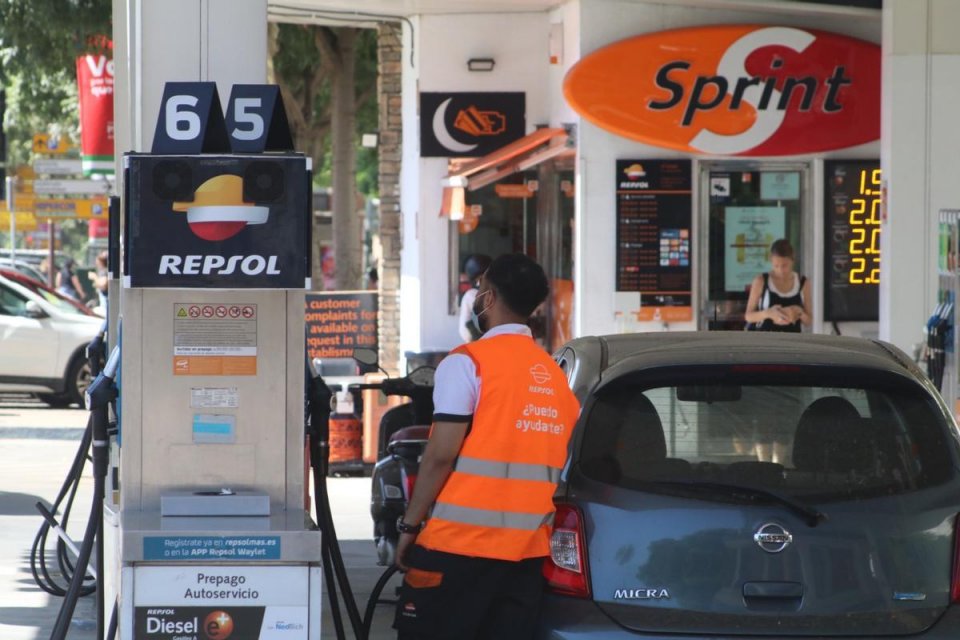
Fuel prices in Spain have fluctuated sharply since the escalation of hostilities. Petrol rose from €1.48 per litre on 28 February — when US-Israeli bombings against Iran began — to around €1.78 per litre over the weekend before easing back to €1.56 per litre as of Thursday, according to government figures.
In response, Prime Minister Pedro Sánchez’s government has introduced a package of 80 measures worth €5 billion, approved by parliament on Thursday, aimed at cushioning households and businesses from the shock. ALSO READ: Spain unveils €5bn emergency package to offset energy shock from Middle East conflict.
The measures include cuts to value-added tax on gas and fuel, expected to reduce prices at the pump by up to €0.30 per litre — roughly €20 per tank for an average car. Additional support includes a direct subsidy of €0.20 per litre of fuel for transport operators, farmers, ranchers and fishermen, as well as reductions in electricity taxes.
‘The plan is designed so that this external shock does not have a lasting effect on inflation or household income,’ the economy ministry said in a statement.
Despite the challenges, the government believes Spain is better positioned than many European neighbours to withstand the impact of the crisis, thanks to its diversified energy supply and significant investment in renewables. Around 55% of the country’s energy mix comes from renewable sources, while most of its crude oil imports are sourced from the Americas and Africa.
Spain’s economy has consistently outperformed many of its eurozone counterparts since 2021, supported by lower energy costs, resilient domestic consumption and a strong rebound in tourism following the pandemic.
Further details on regional inflation trends, including figures for Catalonia — where inflation stood at 2% in February — are expected when the INE publishes its final March data in mid-April.
Enjoying the news from Spain in English? Add us as a preferred news source in Google.
Subscribe to the Weekly Newsletter from Spain in English.
Indicador adelantado Índice de #precios de consumo #IPC. Marzo 2026 @es_INE
— INE España (@es_INE) March 27, 2026
El indicador adelantado del IPC sitúa su variación anual en el 3,3% en marzo, un punto por encima de la registrada en febrero.
Nota de prensa
👇https://t.co/ari8CKjpBp
Resultados➡️… pic.twitter.com/kWk8KvZeAz

Click here to get your business activity or services listed on our DIRECTORY.