
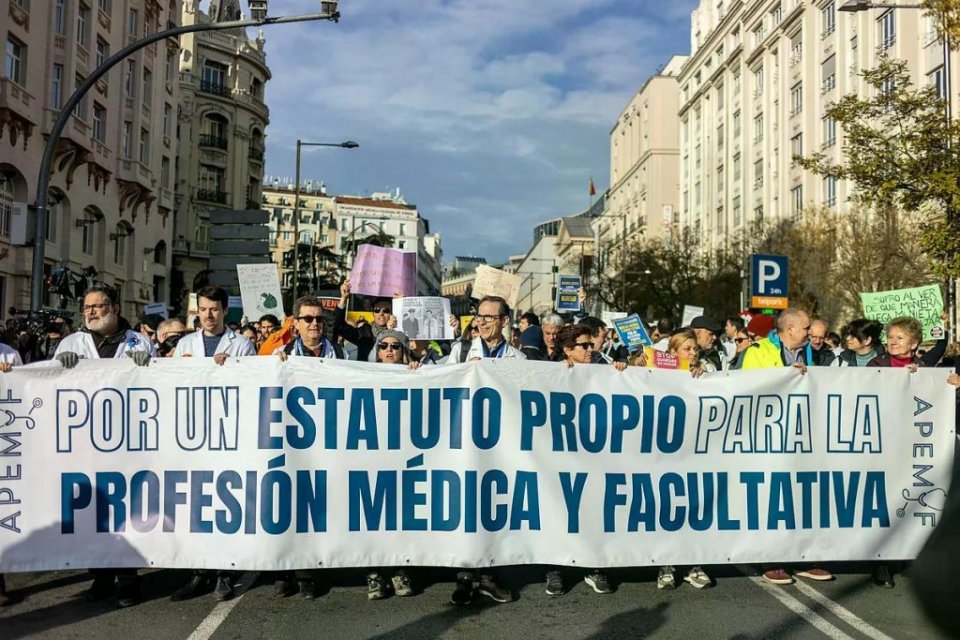
Doctors in Spain commenced a strike this week to express their opposition to the Estatuto Marco (‘framework statue’) being imposed by the Ministry of Health, which regulates working conditions within Spain’s National Health System.
The strike runs from 16-20 February. Further strikes are scheduled for 16-20 March, 27-30 April, 18-22 May and 15-19 June.
The organisations behind the strike reject the proposed reform of the Estatuto Marco agreed on 26 January between the Ministry of Health and the unions SATSE-FSES, CCOO, UGT and CSIF. They are calling for a framework specifically tailored to the medical profession, separate from the rest of the National Health System workforce, and reflecting the particular demands of medical practice.
More than 5,000 people attended a demonstration in Madrid last Saturday, marking the start of this new protest calendar. During the rally, doctors called for the resignation of Health Minister Mónica García.
The stoppages beginning this week represent the first coordinated action by these organisations, which have for some time voiced their dissatisfaction with the direction taken by the Estatuto Marco, a regulation that the Ministry of Health and unions have been negotiating for the past three years. ALSO READ: Doctors in Spain strike for the third time this year.
Among their key demands are a distinct professional classification – specifically the creation of a new A1 category – a maximum working week of 35 hours, and the recognition that any hours beyond this should count as overtime, to be voluntary and paid.
The unions are also calling for a system of voluntary early retirement, whether full or partial, and a ban on forced relocation, among other measures.
The Ministry of Health, however, is defending the new text, stressing that it introduces significant improvements in working conditions for all healthcare staff, including professional classification, early retirement options and work–life balance. It notes that the proposal limits the working week to 45 hours and reduces on-call shifts from 24 to 17 hours, among other changes.
In addition to this week’s strike, demonstrations have been called outside hospitals and health centres across the country, including in Aragón, Valencia, Andalusia, Catalonia, the Basque Country, Extremadura, Galicia and Madrid.
The strike committee has emphasised that the open-ended nationwide stoppages planned for the coming months are a last resort, following repeated attempts to reach agreements that, they say, have been ignored.
Medical unions have apologised for the inconvenience the strike action may cause patients, but insist that improving doctors’ working conditions will ultimately lead to better quality care.
Minimum services covering emergency services will still be available to patients at public hospitals across the country.
Subscribe to the Weekly Newsletter from Spain in English.
“A Mónica García la política le ha ganado hace mucho tiempo”, asegura Ángela Hernández, sindicato AMYTS. Sobre el Estatuto Marco de Sanidad, Hernández añade: “Se ha hecho una clasificación por años de formación en la que se están mezclando categorías y esto va a llevar a que unas… https://t.co/6bslqGbj9v
— RTVE Noticias (@rtvenoticias) February 16, 2026
Gran parte del malestar provocado por un Estatuto Marco caduco escrito hace más de 23 años queda subsanado en el nuevo texto: mejorando las condiciones laborales, eliminando las guardias de 24h y reduciendo el número de horas trabajadas. Todo ello respetando la ley y las…
— Mónica García (@Monica_Garcia_G) February 16, 2026
Los médicos vuelven a la huelga nacional esta semana para exigir un Estatuto Marco propio con paros previstos entre este lunes y el viernes https://t.co/h6HhvYrZwf
— Europa Press (@europapress) February 16, 2026

Please support us with a donation.
Click here to get your business activity or services listed on our DIRECTORY.