
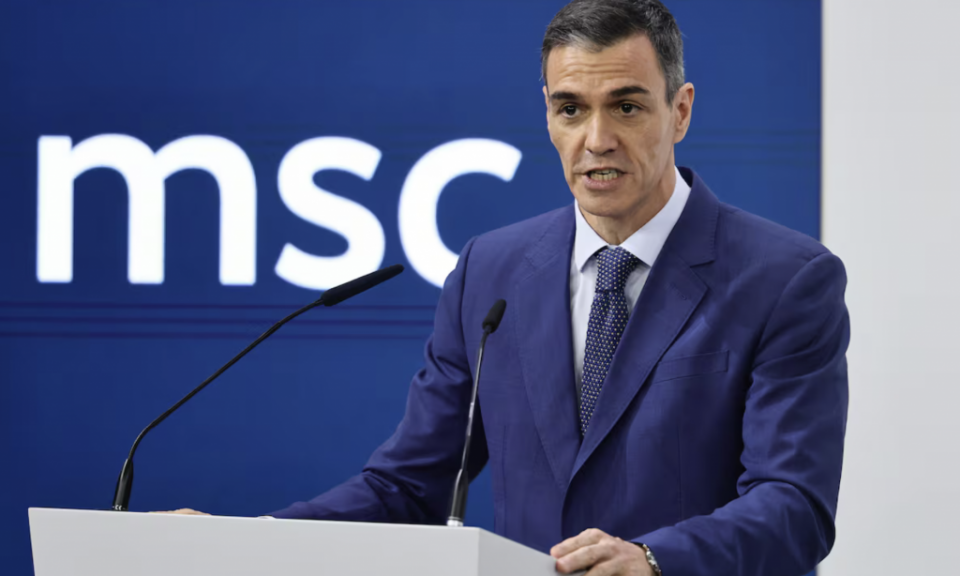
Spanish Prime Minister Pedro Sánchez used his first appearance at the Munich Security Conference (MSC) on Saturday to deliver a blunt warning against nuclear rearmament, arguing that expanding atomic arsenal would do nothing to protect Europe from Russia’s President Vladimir Putin.
Speaking amid the most strained transatlantic relations in decades, Sánchez said global powers now spend more than $11 million every hour on nuclear weapons, with the United States alone set to devote $946 billion to its nuclear forces over the next decade.
‘This is enough to eradicate extreme poverty in the world,’ he said, adding that the growing role of artificial intelligence in nuclear systems made the risks even greater.
Quoting former US president Ronald Reagan, Sánchez stressed that ‘a nuclear war cannot be won’, framing the issue not as a left-right ideological dispute but as a practical choice between strategies that genuinely improve security and those that do not.
Rejecting nuclear rearmament, he insisted, does not amount to neglecting defence. Spain has tripled its military spending and doubled the number of troops it has deployed, he said, while backing the creation of a genuine European army and pledging that his country ‘will collaborate with whatever is necessary’.
‘Europe must strengthen its defence capabilities to protect our freedom and our way of life, and to ensure the security of our partners,’ said Sánchez. ‘But let us be clear: nuclear rearmament is not the way.’
The Spanish leader also used his speech to criticise voices in the United States that view the European Union as a rival rather than a partner.
‘Some would like to see a more fragmented EU,’ he said, while expressing confidence that European countries were instead moving towards closer cooperation.
A long-time critic of Donald Trump since his return to the White House, Sánchez said Europe must strengthen the transatlantic bond without what he has described as ‘vassalage’, calling for EU enlargement to include Ukraine, internal reforms and greater economic competitiveness. ALSO READ: Marco Rubio says US and Europe ‘belong together’, but warns immigration is ‘destabilising societies’.
The annual conference, held since 1963 and attended this year by around 200 government representatives from 120 countries, took place against a backdrop of mounting concern in Europe over Russia’s nuclear arsenal and growing doubts about the durability of US security guarantees.
EU’s nuclear options
Those anxieties have pushed nuclear deterrence back into the mainstream of European politics. German Chancellor Friedrich Merz told delegates he had ‘held confidential talks with the French president about European nuclear deterrence’, while British Prime Minister Keir Starmer said the UK was ‘enhancing our nuclear cooperation with France’.
Britain’s nuclear deterrent already extends protection to NATO allies, and Starmer said ‘any adversary must know that in a crisis they could be confronted by our combined strength’ alongside France.
Even so, the combined British and French arsenals number in the hundreds of warheads, far fewer than the thousands held by the United States and Russia. A report prepared for the conference on ‘Europe’s nuclear options’ warned that these smaller forces might not be sufficient to deter Moscow without US backing.
‘Europeans can no longer outsource their thinking about nuclear deterrence to the United States,’ a group of 11 experts wrote in the report, urging policymakers to ‘urgently confront a new nuclear reality’ created by what they called ‘Russia’s nuclear-backed revisionism’.
Many European officials believe Moscow’s territorial ambitions may not stop at Ukraine and could eventually threaten other countries, including NATO members. ALSO READ: NATO leaders agree to increase spending and reiterate ‘ironclad commitment’ to collective defence.
The report outlined five possible paths for Europe: continuing to rely on US deterrence; strengthening the European role of British and French nuclear forces; jointly developing European nuclear weapons; increasing the number of European states with their own arsenals; or expanding conventional military power to provide a stronger non-nuclear deterrent. None, the authors cautioned, offered a cheap or risk-free solution.
Relying on America’s unmatched military power remains ‘the most credible and feasible option’ in the short term, the report said, noting that the gap between US and Russian capabilities and those of Britain and France is so wide that few believe Europe can assume full responsibility for nuclear deterrence any time soon.
Expanding British and French arsenals would involve heavy costs and unresolved questions over who would ultimately control their use, while Britain’s system in particular still depends heavily on US technology.
French President Emmanuel Macron, who has previously floated the idea of extending France’s nuclear umbrella across Europe, is due to deliver a major speech on French nuclear doctrine at the end of February. In Munich, Macron said he was considering a framework that could include ‘special cooperation, joint exercises, and shared security interests with certain key countries’.
Against that backdrop, Sánchez’s rejection of nuclear rearmament stood out sharply at Munich, highlighting a widening debate within Europe over how far the continent should go in confronting what many see as a far more dangerous and uncertain security environment.
Subscribe to the Weekly Newsletter from Spain in English.
#Canal24Horas | Pedro Sánchez advierte en la Conferencia de Múnich que “el rearme nuclear no es el camino a seguir”
Sánchez ha lamentado que hay personas en Estados Unidos que “ven el proyecto de la Unión Europea como una amenaza”https://t.co/1YKsdA9ocs pic.twitter.com/19dA9RtSLE
— RTVE Noticias (@rtvenoticias) February 14, 2026
Europa debe reforzar sus capacidades de defensa para proteger nuestra libertad y nuestro modo de vida, y garantizar la seguridad de nuestros socios.
Pero seamos claros: el rearme nuclear no es el camino. pic.twitter.com/TUOdgJgMjl
— Pedro Sánchez (@sanchezcastejon) February 14, 2026

Please support us with a donation.
Click here to get your business activity or services listed on our DIRECTORY.