
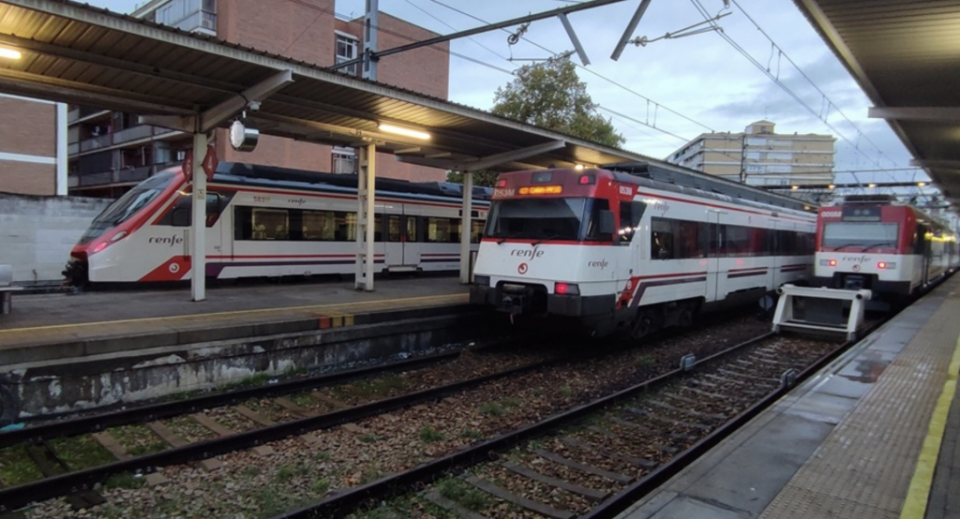
Unions representing Spanish train drivers have suspended the rail strike that began on Monday and had been due to continue until Wednesday.
The unions had originally planned industrial action from 9-11 February, accusing authorities of disregarding safety warnings and underinvesting in rail infrastructure.
It comes after a series of serious incidents that have shaken Spain’s transport system and sparked renewed concerns over rail safety in a country that operates the world’s second-largest high-speed rail network, behind only China.
However, the government has since committed to boosting spending on maintenance, prompting the unions to call off the stoppage.
The decision follows an agreement with the Ministry of Transport that includes a substantial rise in funding for rail upkeep, an increase in staffing at RENFE and infrastructure operator Adif, and additional personnel at the State Railway Safety Agency.
‘We have finalised an agreement that improves investment in infrastructure, security measures, and, above all, the incorporation of all the necessary protocols to carry out all the measures and all the investment we have agreed upon,’ said Diego Martín, general secretary of the train drivers’ union Semaf, after talks on Monday with the Transport Ministry.
Monday’s negotiations marked the fourth ‘institutional’ meeting between the two sides, following discussions held on Wednesday, Thursday and Friday last week.
Unions have not yet confirmed whether the strike will formally end later today or on Tuesday 10 February.
Despite the breakthrough, disruption was widespread across Spain on Monday, particularly at Madrid’s Atocha station — the country’s busiest — where thousands of commuters packed platforms during the morning rush hour as services were cancelled or delayed.
At Barcelona’s main Sants station, passenger numbers were noticeably lower than usual. The strike followed weeks of disruption on Catalonia’s ageing commuter rail network in the northeast, which serves hundreds of thousands of daily users. ALSO READ: Rodalies commuter trains in Catalonia gradually restart after chaotic Monday morning incidents.
Concerns over safety intensified after a high-speed train collision in southern Andalusia on 18 January that killed 46 people, making it one of Europe’s deadliest rail disasters of the century. ALSO READ: Spain’s train crash victims mourned as families call for truth and justice.
Just two days later, a commuter train in the Barcelona area struck debris from a collapsed wall, killing the driver and leaving dozens injured. ALSO READ: One dead, 37 injured, as commuter train ploughs into rubble of collapsed wall near Barcelona.
Subscribe to the Weekly Newsletter from Spain in English.
📢 Información para viajeros
— InfoRenfe (@Inforenfe) February 9, 2026
Desconvocada la huelga en Renfe prevista para los días 9, 10 y 11, por los sindicatos mayoritarios convocantes y comité de huelga.
ℹ️ Como resultado, se está recuperando el servicio progresivamente a lo largo del día de hoy.
Desde Renfe trabajamos…

Please support us with a donation.
Click here to get your business activity or services listed on our DIRECTORY.