
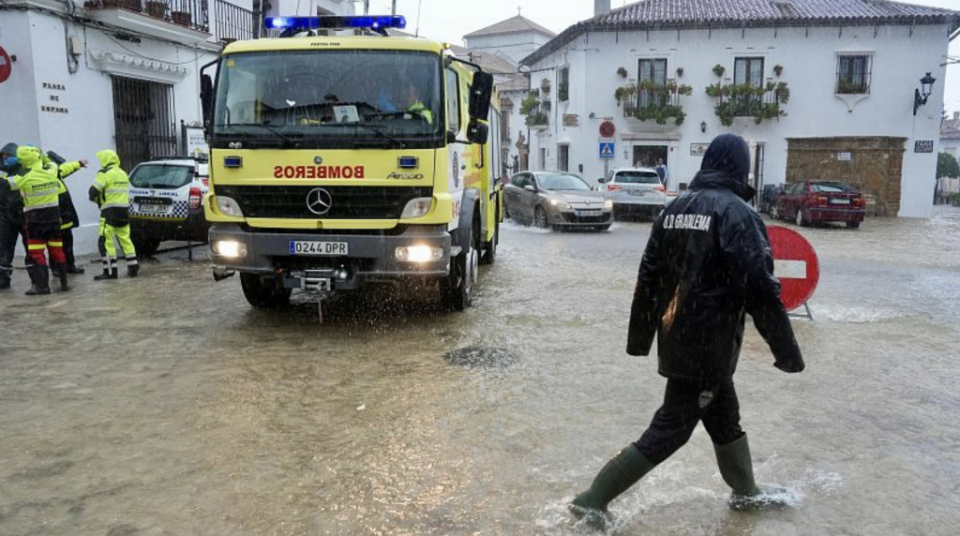
Storm Leonardo reached Spain’s southern Andalusia region on Wednesday, with forecasts warning of up to 400 litres of rain per square metre in some areas, prompting mass evacuations, school closures and widespread transport disruption.
Spain’s national weather agency, AEMET, issued its highest red alert for parts of the region, cautioning that the intense rainfall could lead to flooding and landslides.
An ‘extraordinary amount of rain’ was expected in a region where ‘the ground is very saturated and riverbeds are already carrying a lot of water’ following earlier rainfall, AEMET spokesperson Rubén del Campo said.
Local media reported that the provinces of Cádiz and Málaga could see as much as 400 litres of rainfall per square metre within a matter of hours.
Andalusian emergency services said more than 3,000 residents were evacuated from high-risk flood zones on Tuesday as a precaution. By Wednesday, authorities had logged over 150 incidents, none of which caused major damage.
The regional government in Andalusia urged residents to avoid non-essential travel, warning that public safety alerts could quickly escalate to the highest red-alert level as the storm evolves, regional leader Juanma Moreno said.
High-risk areas included Grazalema, Campo de Gibraltar, Ronda and parts of Jaen. Day centres for the elderly and disabled were closed on Wednesday, and local governments in affected areas were advised to cancel outdoor sports activities,
Authorities are concerned about the heightened risk of flooding as the ground remains saturated from the preceding storm and heavy rains last month.
Hundreds of soldiers from Spain’s Emergency Military Unit (UME) were deployed to support emergency operations, while schools across most of Andalusia were closed, with the exception of the eastern province of Almería.
State rail operator RENFE said it had suspended nearly all suburban, regional and long-distance rail services in the region. Bus replacements were not possible because of road conditions, with several routes closed.
By 3pm on Wednesday, no airport in southern Spain had cancelled flights as a result of the storm.
Power outages were reported at around 3,800 homes across Andalusia, while numerous roads in the Cádiz area were closed as a precautionary measure.
The severe weather comes months after Spain endured its deadliest flooding in decades, when more than 230 people were killed in October 2024, mainly in the eastern Valencia region.
Spain recorded 119.3 mm of rainfall in January, 85% above the 1992-2020 average, making it the second-wettest January of the 21st century, the Environment Ministry said.
In neighbouring Portugal, where storms killed five people last week, parts of the coastline were placed under an orange alert as Leonardo moved in from the Atlantic.
Portugal’s Civil Protection service said it had dealt with nearly 200 incidents, including local flooding, landslides and falling trees, none of which caused injuries or significant damage.
The Lisbon metropolitan area and the southern Algarve region were hardest hit, with rain and strong winds expected to peak overnight into Thursday.
Scientists say climate change driven by human activity is increasing the duration, frequency and intensity of extreme weather events.
Subscribe to the Weekly Newsletter from Spain in English.
#Últimahora de la #BorrascaLeonardo en Andalucía | Varias localidades anegadas, clases y trenes suspendidos, desalojos y carreteras cortadas https://t.co/mP0W23lpza
— RTVE Noticias (@rtvenoticias) February 4, 2026
🔴 La Junta despliega las medidas de prevención e intervención para paliar los efectos de la #BorrascaLeonardo
🏡 Actualmente permanecen desalojadas 3.044 personas en las provincias de #Cádiz, #Jaén, #Málaga, #Huelva y #Granada
Toda la información ⬇️
— EMA 112 (@E112Andalucia) February 4, 2026
⚠️ AVISO ROJO | Lluvias muy abundantes en Grazalema y Estrecho (Cádiz) y Ronda (Málaga) el día 4.
➡️ Se esperan cantidades de precipitación serán extraordinarias.
➡️ Posibles deslizamientos de tierra, inundaciones y crecidas.
¡Sigue recomendaciones de Protección Civil! pic.twitter.com/sZJvTO7mte
— AEMET (@AEMET_Esp) February 4, 2026

Please support us with a donation.
Click here to get your business activity or services listed on our DIRECTORY.