
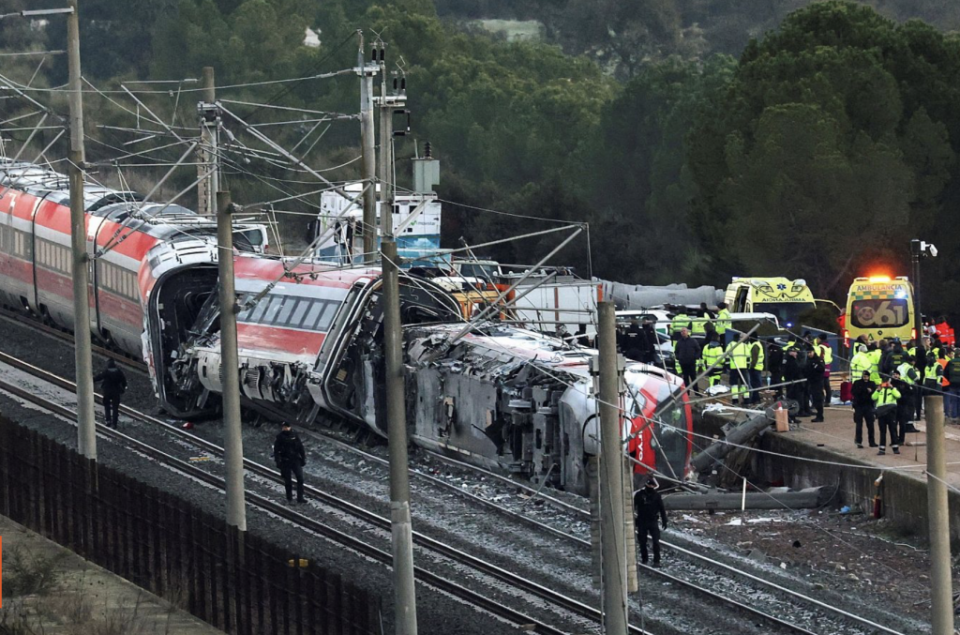
The Spanish government said on Tuesday that it will distribute €20 million in compensation to those affected by last month’s high-speed train disaster in southern Spain, which left 45 people dead and at least 150 injured.
The crash occurred on 18 January near Adamuz, close to the city of Córdoba (Andalusia), when a train derailed and struck another service. It was Spain’s deadliest rail accident since 2013 and ranks among the most serious train crashes in Europe in recent years.
According to Transport Minister Oscar Puente, the families of those killed will each receive €216,000 within a three-month period.
This sum comprises €72,000 in tax-free state assistance, a €72,000 advance from insurance coverage, and an additional €72,000 provided through passengers’ compulsory travel insurance.
Injured passengers will be compensated with payments ranging from €2,400 to €84,000, depending on the seriousness of their injuries, Puente said. ALSO READ: Hope amid tragedy as dog missing after train tragedy in Andalusia is found safe.
‘We know that ordinary procedures and legal timelines do not always respond to the vital urgency of a tragedy like this,’ the minister told reporters on Tuesday.
‘Economic uncertainty cannot be compounded on top of the emotional pain.’
Puente has faced mounting criticism in the aftermath of the Adamuz crash, particularly after several other railway incidents occurred during the same week. One of those incidents, in Catalonia, resulted in the death of a train driver, while two further accidents caused no fatalities. ALSO READ: One dead, 37 injured, as commuter train ploughs into rubble of collapsed wall near Barcelona.
Spain’s main opposition party, the right-wing People’s Party (PP), has called for Puente to step down. Addressing the issue on Tuesday, Puente said he had a ‘clear conscience’ and insisted he was doing ‘my job as best I can’.
‘I am acting according to my conscience, my sense of duty, and I will take the decisions I have to take,’ he said, adding that he would show ‘with deeds, not words’ the government’s commitment to supporting victims.
Authorities have so far released limited information about the cause of the accident, though an official inquiry is ongoing and some initial findings have emerged. ALSO READ: Sánchez vows ‘to get to the truth’ about cause of train tragedy, as Spain declares three days of mourning.
Spain’s rail accident investigation agency, CIAF, said investigators believe a fracture in the rail was present before the derailment occurred. The origin of that fracture remains unclear, and officials have said no scenario has been ruled out. ALSO READ: Initial report from train tragedy investigators points to fracture in track prior to accident.
Álvaro Fernández, president of the national rail operator RENFE, has stated that ‘human error could be ruled out’. ALSO READ: RENFE president: human error ‘practically ruled out’ as cause of high-speed train collision in Andalusia.
Spain has invested heavily in high-speed rail over recent decades and now operates Europe’s largest such network, with more than 3,900 kilometres of track, according to the International Union of Railways. Accidents resulting in deaths or serious injuries are considered rare.
Subscribe to the Weekly Newsletter from Spain in English.
Lo más importante son las víctimas. Aprobamos 20 M€ para los afectados en Adamuz y Gélida.
— Óscar Puente (@oscar_puente_) January 27, 2026
Ayudas directas no reembolsables y anticipos sobre las cantidades a abonar por el seguro de responsabilidad civil. No queremos que a la desgracia del accidente se le añada penuria… pic.twitter.com/HfvVqX1iUl

Please support us with a donation.
Click here to get your business activity or services listed on our DIRECTORY.