
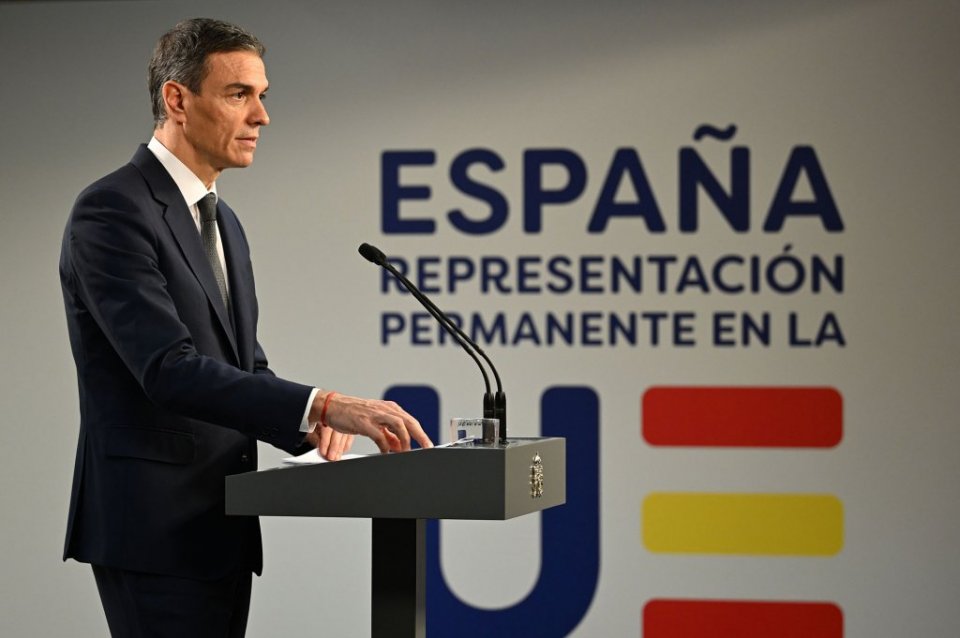
Spain has ruled out joining the ‘Board of Peace’ initiative unveiled by US President Donald Trump, saying its refusal reflects Madrid’s continued commitment to multilateralism and the United Nations system.
‘We appreciate the invitation, but we decline,’ Prime Minister Pedro Sánchez told reporters late on Thursday following an EU summit in Brussels.
The United States says the proposed body would play a role in negotiating and supervising ceasefires, coordinating security frameworks and overseeing reconstruction efforts in post-conflict regions. The initiative is rooted in Trump’s Gaza peace plan.
Noticeably absent from the board’s launch ceremony at the World Economic Forum in Davos on Thursday were many of Washington’s longstanding allies. Canada, the United Kingdom and all European Union member states — with the exception of Hungary and Bulgaria — did not attend.
Sánchez said Spain’s decision was guided by consistency with international law, the United Nations and a multilateral approach to global governance. He also pointed out that the Palestinian Authority is not included in the initiative.
Israel has signed on to the board, which has also received backing from several major Middle Eastern states, including Saudi Arabia, Turkey, Egypt and Qatar. In contrast, most European countries and Canada have either declined to participate or remain undecided.
Trump formally presented the ‘Board of Peace’ at Davos on Thursday, appearing alongside a number of world leaders who have agreed to join. The initiative is expected to focus initially on rebuilding Gaza.
The announcement coincided with the launch of the second phase of a ceasefire between Israel and Hamas, which ended Israel’s war on Gaza. That conflict has killed more than 71,000 people since October 2023. The board forms part of a 20-point proposal put forward by Trump and later adopted by the UN Security Council in November 2025.
Several countries have confirmed receiving invitations but have yet to make final decisions. Russian President Vladimir Putin said on Thursday that Moscow is ‘ready’ to allocate $1 billion to Trump’s Board of Peace, adding that he would discuss the use of frozen Russian assets during talks with US envoys in Moscow later the same day.
China acknowledged receipt of an invitation but did not clarify its position. Germany said it is reviewing the proposal, while India and Brazil stated that any decision would follow internal consultations. The Vatican confirmed that Pope Leo XIV had received an invitation.
Canada has taken a guarded stance, with Prime Minister Mark Carney yet to announce a decision. Later on Thursday, Trump said he was withdrawing Canada’s invitation to join the board.
Ireland said it would give the proposal ‘careful consideration’. Invitations have also been sent to Romania, Finland, Greece, Cyprus, Japan, Austria, Australia, the Netherlands, Thailand, South Korea, Singapore and New Zealand, none of which have announced final positions.
Several European governments have already declined participation, citing legal and institutional concerns. The United Kingdom said it would not sign up at this stage due to worries about potential Russian involvement. France said it does not intend to join ‘at this stage’, warning that the board could be granted powers that undermine existing UN mechanisms.
Norway and Sweden issued similar rejections, arguing the initiative is incompatible with international law and established multilateral structures. Italian Prime Minister Giorgia Meloni said Italy needs more time to assess the proposal, pointing to possible constitutional implications.
Subscribe to the Weekly Newsletter from Spain in English.
El futuro de Gaza deben dirimirlo los palestinos y los israelíes en un proceso dialogado que implemente la solución de los dos Estados. pic.twitter.com/mfPeDiYADu
— Pedro Sánchez (@sanchezcastejon) January 23, 2026

Click here to get your business activity or services listed on our DIRECTORY.