
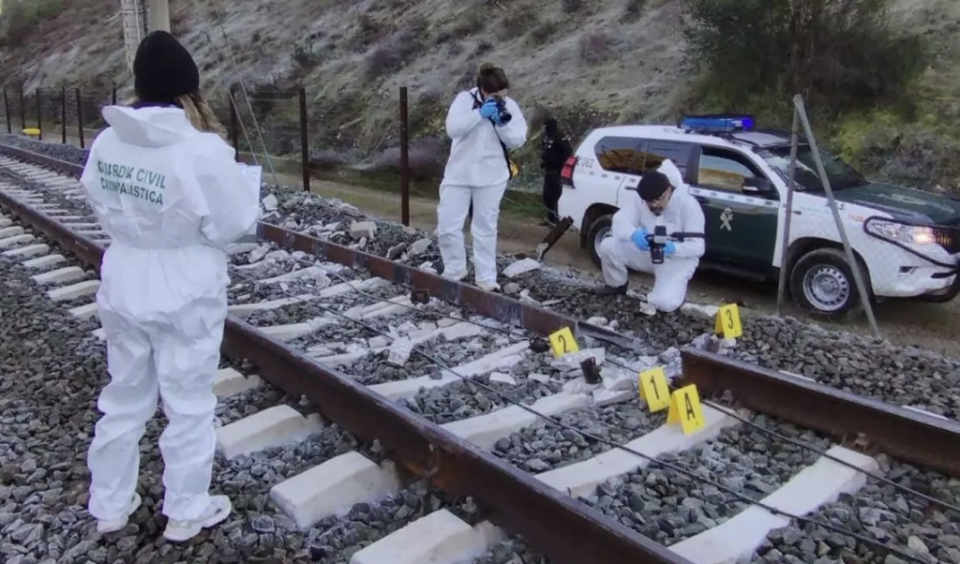
Investigators examining Sunday’s derailment of a high-speed train in Spain, which has now claimed at least 40 lives, have identified a damaged joint in the railway track, according to a Reuters news agency report citing a source familiar with the early findings.
The back three carriages of an Iryo train left the tracks and struck an oncoming Alvia (RENFE) train, forcing it off the rails and down an embankment in what ranks among the most serious rail disasters in Europe in recent decades.
The crash occurred close to Adamuz, in the Andalusian province of Córdoba, roughly 360 kilometres south of Madrid. ALSO READ: Sánchez vows ‘to get to the truth’ about cause of train tragedy, as Spain declares three days of mourning.
According to the Reuters report, engineers inspecting the site discovered wear in a joint connecting two rail sections — known as a fishplate — which appeared to have been deteriorating for some time, the source said. The defect had created a gap between the rails that gradually widened as trains continued to pass over it.
According to the source, who Reuters said spoke on condition of anonymity because of the sensitivity of the investigation, technicians believe the damaged joint is central to determining the exact cause of the accident. ALSO READ: At least 40 dead, dozens injured, after high-speed trains collide in southern Spain.
A separate report from Spain’s EFE news agency, however, has Transport Minister Óscar Puente stating that the investigation must still determine whether any break in a section of track detected at the site of the accident is ‘the cause or the consequence’ or the Iryo derailment that led to the collision with the Alvia train.
‘Determining at this time that there is a welding problem is completely unfeasible,’ Puente added, in one of the five TV interviews he took part in during Monday. ALSO READ: RENFE president: human error ‘practically ruled out’ as cause of high-speed train collision in Andalusia.
Spanish media said that the country’s rail accident investigation body, the Commission of Investigation of Rail Accidents (CIAF), which is leading the inquiry, did not immediately respond to requests for comment. Neither did the rail infrastructure manager Adif nor the Spanish transport ministry, which oversees the CIAF.
The train that initially derailed was operated by private company Iryo. While the first carriages passed over the gap in the track, the eighth and final carriage left the rails, pulling the seventh and sixth carriages with it, the Reuters report said.
Iryo is majority-owned by Italian state railway group Ferrovie dello Stato.
The source referred to a photograph showing the vertical gap in the rail, which also appears in images distributed to the media by Spain’s Guardia Civil. The area has been cordoned off and marked with police evidence numbers as forensic teams continue their work.
Spanish PM Pedro Sánchez and Transport Minister Puente were among senior officials who visited the site on Monday morning.
Puente said the Iryo train was less than four years old and noted that the track had undergone a full renovation last May.
The train’s manufacturer, Hitachi Rail, carried out a routine inspection on 15 January and detected no irregularities, the source also told Reuters.
The train involved is a Frecciarossa 1000 — the same high-speed model used across Italy’s rail network.
Subscribe to the Weekly Newsletter from Spain in English.
Nuestras labores de investigación, apoyo y seguridad tras el accidente ferroviario de #Adamuz no cesan, el trabajo conjunto con compañeros de emergencias está siendo fundamental. pic.twitter.com/kDRwdiR8sK
— Guardia Civil (@guardiacivil) January 19, 2026
Puente: Hay que ver si la rotura de la vía es «causa o consecuencia» del descarrilamiento. https://t.co/kjX7s2cJjt
— EFE Noticias (@EFEnoticias) January 19, 2026

Click here to get your business activity or services listed on our DIRECTORY.