
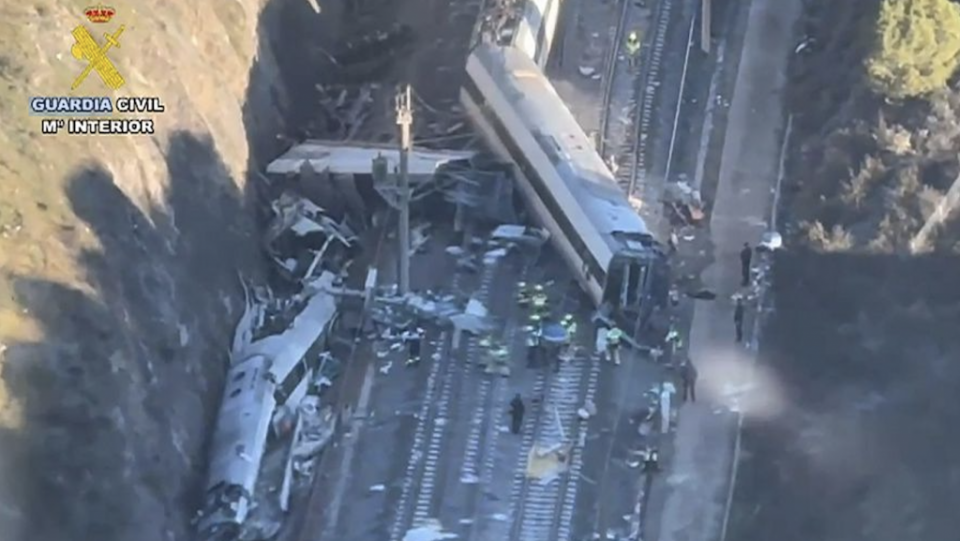
Álvaro Fernández Heredia, the president of RENFE – Spain’s national state-owned railway company – has ruled out human error as the cause of Sunday’s railway accident in Ademuz, in an interview with Spain’s National Radio (RNE).
‘Human error is practically ruled out. If a train driver makes an incorrect decision, the system itself corrects it. Let’s not speculate; let’s wait for the investigation,’ he said on the programme Las Mañanas.
‘It is an accident under unusual circumstances,’ the RENFE president acknowledged, adding that it would be ‘very difficult to reach any conclusions in a short space of time’. ALSO READ: At least 40 dead, dozens injured, after high-speed trains collide in southern Spain.
Fernández Heredia also stated that it ‘cannot be concluded’ that the Alvia train, which was also affected, collided with the Iryo carriages.
One of the key points currently known is that the Iryo train that derailed had undergone inspection on 15 January —just four days earlier — and was manufactured in 2022, according to company information.
Iryo’s chief executive, Fabrizio Favara, travelled to the scene of the accident last night to accompany the teams working on site, while the company’s president, Carlos Bertomeu, is on his way to the area.
In a statement, the Italian-owned Iryo said it remains in constant communication with all the institutions involved – the Ministry of Transport, Adif, the Government Delegation, the Andalusian regional government, and the city councils of Adamuz and Córdoba – and expressed its gratitude for the solidarity shown, the swift response, and the human and technical resources deployed from the outset.
The accident occurred on a straight section of track on the Madrid–Seville line, where renovation work was completed last May. The train itself is newly built, as Transport Minister Óscar Puente highlighted on Sunday night, describing the incident as ‘unusual and difficult to explain’.
The president of the General Council of Industrial Engineers, César Franco, explained on the programme Hora de La 1 that the initial analysis of the accident should focus on the wheels of the derailed Iryo train.
‘The focus will be on the wheels of the last two carriages,’ he said.
‘Train wheels are not cylindrical, which allows the train to centre itself automatically on the track. With a defect in a wheel at 200 km/h, the margin for manoeuvre is minimal,’ he explained. He added that if there is even slight misalignment, ‘any oscillation ends up affecting the rear of the train more than the front’.
He also said it will be necessary to investigate whether there was any object on the track and to rule out the possibility that part of the line was in poor condition. In any case, he stressed that ‘it will be several months before we have conclusions’.
Subscribe to the Weekly Newsletter from Spain in English.
🔴ENTREVISTA | Álvaro Fernández Heredia (@Transxte ), presidente de @Renfe
▪️”El fallo humano está prácticamente descartado. Si el maquinista toma una decisión errónea, el propio sistema la corrige. No especulemos, esperemos a la investigación”
▶️ https://t.co/lKXgCETRxP pic.twitter.com/RD8O5cvFs8
— Las Mañanas de RNE (@LasMananas_rne) January 19, 2026
🔸Imágenes aéreas del accidente ferroviario en Adamuz
Las autoridades advierten de que las donaciones de sangre serán especialmente necesarias en los próximos días.
📸Guardia Civil
▶️https://t.co/LGn7unFu4w pic.twitter.com/zAsRdSi3ZG
— RTVE Noticias (@rtvenoticias) January 19, 2026

Click here to get your business activity or services listed on our DIRECTORY.